☕ TL;DR
- The Miss: Q4 GDP grew only 1.5% YoY (0.2% QoQ), missing the 1.8% forecast.
- The Drag: Construction investment plunged 2.8%, and exports retreated 1.8%.
- The Risk: Looming US tariffs create massive uncertainty for an export-dependent economy.
The Signal: Growth Stall 📉
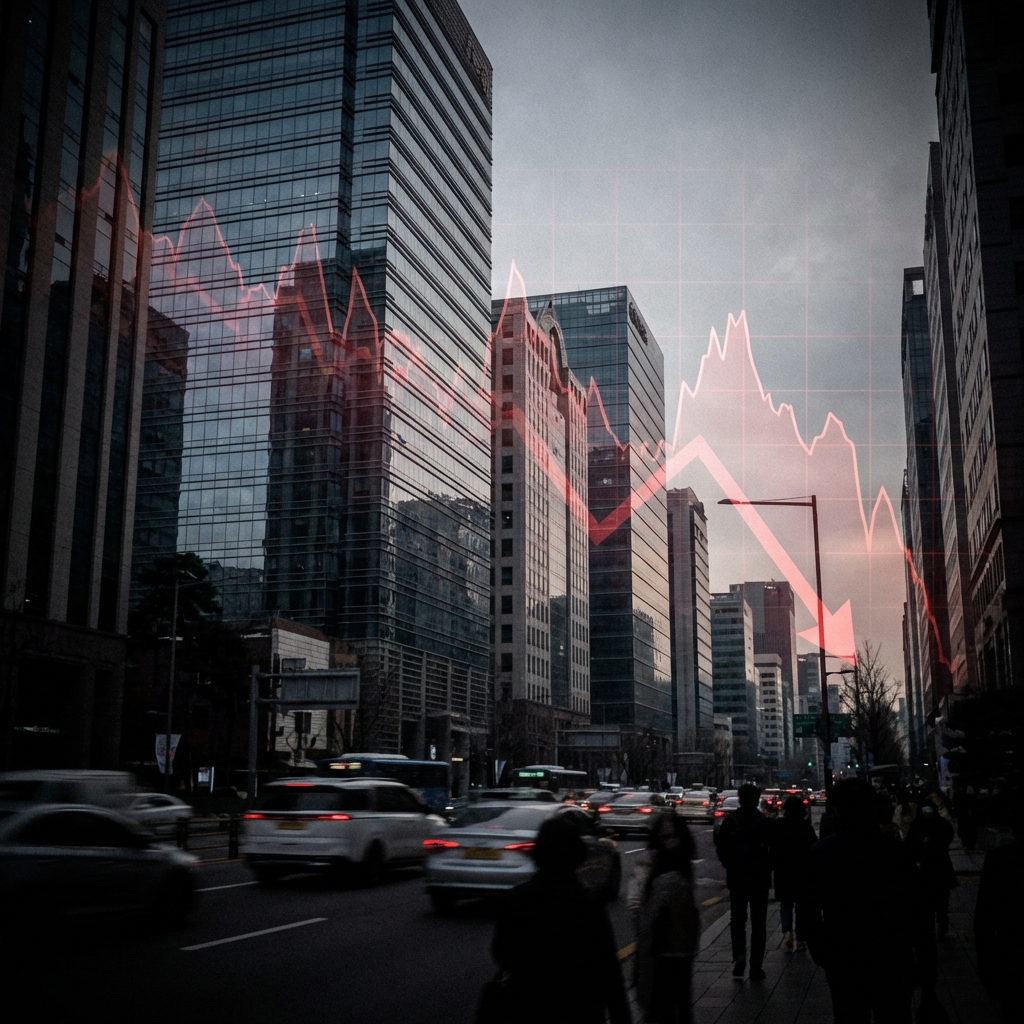
South Korea’s economic engine is sputtering. Data released today shows Q4 GDP expanded by just 1.5% year-on-year, significantly underperforming the consensus estimate of 1.8%. On a quarterly basis, growth was anemic at 0.2%, marking the second consecutive quarter of near-stagnation.
For the full year of 2025, the economy grew 2.0%, a sharp deceleration from the 2.6% recorded in 2024. This isn’t just a statistical miss; it’s a structural warning sign.
The Divergence: Domestic vs. External 🌏
The breakdown reveals a bifurcated economy struggling on multiple fronts:
- Construction Collapse (-2.8%): The hangover from the project financing (PF) crisis continues. Construction investment was the biggest drag, shaving significant points off the headline number.
- Export Fatigue (-1.8%): The semiconductor supercycle is showing cracks. Exports contracted quarter-on-quarter, signaling wobbly global demand.
- Consumption glimmers (+0.7%): Private consumption was the sole bright spot, but it wasn’t enough to offset the investment and trade slump.
The Threat: The Tariff Cloud ☁️
The timing couldn’t be worse. As South Korea grapples with internal weakness, an external storm is brewing. US President-elect’s threat of 10-20% universal tariffs poses an existential risk to Korea’s export-led model.
The math is brutal: A 10% universal tariff could slash Korean exports to the US significantly, putting further pressure on the Won (KRW) and corporate earnings. Safe to say, the “Korea Discount” isn’t going away anytime soon.
The Verdict: BOK in a Bind 🏦
Governor Rhee Chang-yong is stuck between a rock and a hard place.
- Bull Case for Cuts: With growth slowing to 2.0% and construction imploding, the economy screams for monetary easing.
- Bear Case for Cuts: Cutting rates now could ignite capital outflows and weaken the Won further ahead of potential trade wars.
My Take: The Bank of Korea (BOK) will hold rates steady. Stability trumps growth in this environment of “high uncertainty.” They need to keep their powder dry until the US trade policy becomes clearer.
Actionable Advice: Identify sectors with high domestic exposure or those immune to US tariffs. Avoid heavy capex-dependent industrials until the tariff dust settles. Cash is king in Q1 2026.
Disclaimer: This is not financial advice. Do your own research.