TL;DR
- The Study: A 6,941-person cohort published in Nature Communications (February 2026) found that lower gut microbial diversity is associated with poorer sleep quality, later chronotype, and greater social jet lag.
- The Mechanism: The gut-brain axis runs both ways — sleep shapes your microbiome, and your microbiome shapes your sleep.
- The Surprise: Specific Clostridia bacteria mediate how coffee intake influences your sleep-wake timing.
Less Than Half Your Body Is Human — And It Controls When You Sleep
Here is a number worth sitting with: roughly 37 trillion bacterial cells live in your gut right now, outnumbering your human cells by a factor that scientists are still debating. For decades, we thought of these microbes as passengers — helpful for digestion, perhaps, but largely irrelevant to what happens when you close your eyes at night.
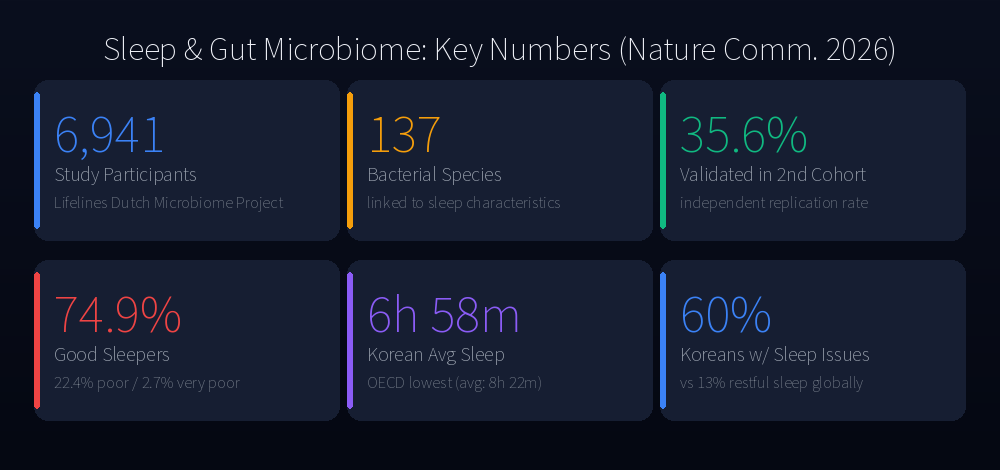
A study published in Nature Communications in February 2026 challenges that assumption at scale. Researchers from the University of Groningen analyzed gut microbiome data from 6,941 participants in the Lifelines Dutch Microbiome Project — one of the largest population-based microbiome cohorts in the world — and cross-referenced it with four dimensions of sleep: quality, chronotype, daytime sleepiness, and social jet lag (the mismatch between your body clock and your social schedule).
The conclusion was unambiguous: people with lower gut microbial alpha diversity reported worse sleep quality, later chronotypes, and greater social jet lag. Beta diversity — the variation in microbial communities between individuals — was also significantly associated with both sleep quality and social jet lag.
What 137 Bacterial Species Are Doing While You Sleep
The research team identified 137 bacterial species statistically associated with at least one sleep characteristic. Of these, 35.6% were independently validated in a separate cohort — a replication rate that meaningfully strengthens the findings beyond statistical artifact.
What makes this study stand out from earlier, smaller investigations is the longitudinal component. Using time-series data from participants who completed multiple assessments, the team showed that changes in sleep patterns precipitated rapid alterations in gut microbiome composition. This temporal sequencing provides directional evidence — not merely correlation — that sleep behavior causally shapes the gut ecosystem.
Among the most striking mechanistic findings: two specific Clostridia species (UC5_1_1E11 and SGB14844) were identified as mediators of the relationship between coffee intake and social jet lag. Scientists had known that caffeine disrupts circadian timing, but the role of gut bacteria as intermediaries in that process was entirely new.
The sleep distribution in the cohort itself tells a story: 74.9% of participants were classified as good sleepers, while 22.4% were poor sleepers and 2.7% were very poor sleepers. Female participants consistently reported lower sleep quality than male participants — a sex difference that aligns with prior epidemiological data and may partly reflect differential gut microbiome profiles between sexes.
The Gut-Brain Highway: Where Serotonin Actually Comes From
Understanding why the gut influences sleep requires a short detour into neurochemistry.
Approximately 90% of the body’s serotonin is produced in the gut — not the brain. This gastrointestinal serotonin, synthesized by enterochromaffin cells lining the intestinal wall in response to microbial metabolites, forms the upstream supply chain for melatonin production. Gut bacteria also directly synthesize gamma-aminobutyric acid (GABA), the primary inhibitory neurotransmitter that quiets neural activity during sleep onset. Species within Lactobacillus and Bifidobacterium genera are among the established GABA producers.
Short-chain fatty acids (SCFAs) — butyrate, propionate, and acetate — produced when gut bacteria ferment dietary fiber, add another layer. SCFAs cross the blood-brain barrier, modulate the hypothalamic-pituitary-adrenal (HPA) axis, and appear to influence slow-wave sleep architecture. Animal studies have shown that germ-free mice (with no gut bacteria) show severely disrupted sleep cycling, and recolonization with specific bacterial strains partially restores normal patterns.
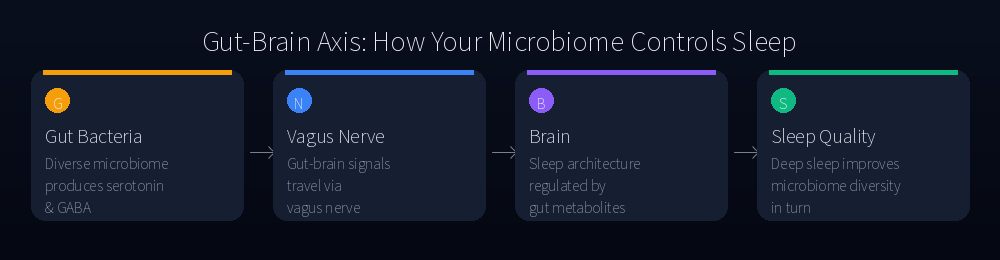
The bidirectionality is what this 2026 study confirms at population scale. Sleep deprivation elevates cortisol and disrupts the intestinal epithelial barrier, allowing lipopolysaccharides from gram-negative bacteria to enter systemic circulation — a process known as “leaky gut.” This triggers low-grade inflammation that, in turn, elevates pro-inflammatory cytokines including interleukin-6 and tumor necrosis factor, both of which are known to fragment sleep architecture. The feedback loop is self-reinforcing.
What the Science Changed: Caveats Worth Knowing
Good health journalism requires confronting what a study does not prove, not just what it suggests.
This is an observational cohort study. Even with longitudinal data providing directional clues, the research cannot establish causality with the certainty of a randomized controlled trial. Confounders that are difficult to fully control — diet quality, physical activity, socioeconomic stress, antibiotic use history — may account for some of the observed associations.
The Lifelines cohort is Dutch, meaning the findings were generated in a population with specific dietary patterns (high dairy, relatively low fermented vegetable consumption compared to East Asian populations), genetic backgrounds, and light exposure profiles. Direct extrapolation to other populations requires caution.
The specific bacterial species identified as significant — while validated in a second cohort — remain mechanistic hypotheses, not targets for clinical intervention. The question of whether deliberately supplementing those species via probiotics would improve sleep in a double-blind RCT is still open. A 2024 placebo-controlled probiotic trial reported a 69% improvement in self-reported sleep quality in the probiotic group relative to placebo, but the sample size was small enough that replication is warranted before drawing clinical conclusions.
What This Means For You
The findings do not justify abandoning your sleep hygiene routine and replacing it with kimchi. But they do provide evidence-backed reasons to pay attention to your gut as part of a comprehensive approach to better sleep.
1. Treat sleep consistency as non-negotiable.
The longitudinal data in this study show that disrupted sleep patterns alter gut microbiome composition rapidly. Weekend “catch-up sleep” — a habit roughly 40% of working adults rely on — increases social jet lag and appears to dysregulate microbial communities that took weeks to establish. The evidence most strongly supports maintaining consistent sleep and wake times across all seven days. According to Stanford Sleep Medicine Center, wake time consistency is the single most powerful lever for improving sleep quality.
2. Prioritize fermented foods with live cultures.
Lactobacillus and Leuconostoc species found in traditionally fermented foods — kimchi, kefir, yogurt with live active cultures, miso — have documented associations with increased microbial alpha diversity. The key qualifier is “live cultures”: heat-treated or pasteurized versions do not deliver viable bacteria. A 2024 clinical trial (ScienceDirect) showed measurable improvements in gut microbiome diversity and body composition in participants consuming fresh, traditionally fermented kimchi compared to placebo.
3. Time your caffeine to your microbiome.
The discovery that Clostridia species mediate the coffee-social jet lag relationship adds nuance to familiar advice. Caffeine has a half-life of 5–7 hours in most adults. Consuming coffee after 2–3 PM means meaningful caffeine blood concentrations persist past midnight. The American Academy of Sleep Medicine recommends avoiding caffeine at least 6 hours before intended sleep time — a guideline this research gives additional biological texture.
4. Cut late-night high-fat, high-sugar foods.
A 2026 systematic review in the Journal of Sleep Research found that sleep deprivation increases the Firmicutes-to-Bacteroidetes ratio — a microbial imbalance associated with metabolic disruption. High-fat, high-sugar diets accelerate the same shift even without sleep deprivation. Finishing meals at least 2–3 hours before sleep reduces the metabolic load on gut bacteria during the overnight period when microbial repair and diversity maintenance are thought to peak.
5. If you are a poor sleeper, consider discussing gut health with your physician.
The bidirectional relationship confirmed by this study means that addressing sleep and gut health in isolation may be less effective than treating them together. If you have a chronic sleep disorder and also experience digestive symptoms (bloating, irregular bowel habits, abdominal discomfort), the two may be linked. A gastroenterologist or functional medicine physician familiar with the gut-brain axis literature can provide individualized guidance.
The Bottom Line
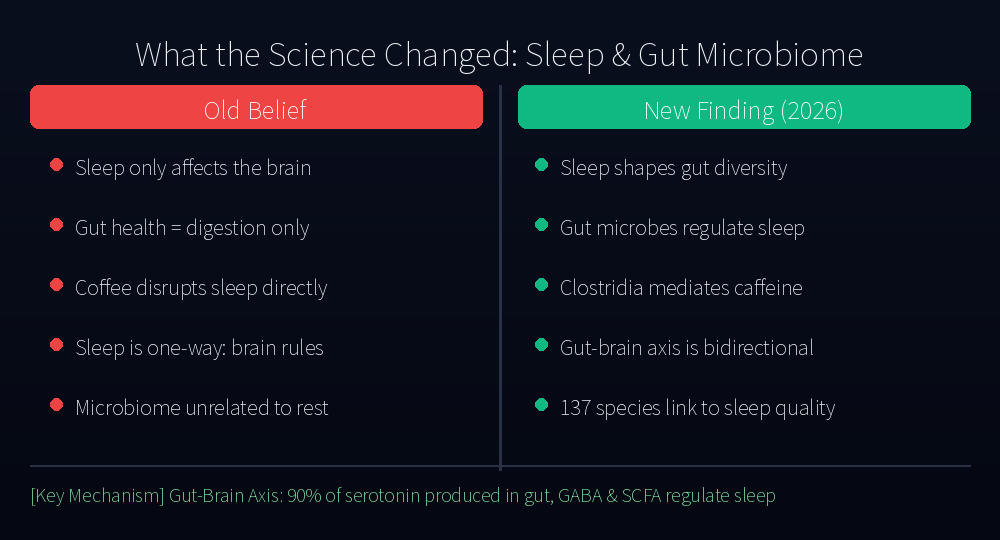
For most of human history, we treated sleep as a brain problem and gut health as a digestion problem. The 2026 Nature Communications study — with 6,941 participants and longitudinal validation — makes a compelling case that the two are not separable. Your gut microbiome is an active participant in regulating your circadian biology, not a passive bystander.
The science is not yet mature enough to prescribe a specific probiotic protocol for sleep improvement. But it is mature enough to say this: the habits most likely to improve gut microbial diversity — eating fermented foods, maintaining consistent sleep timing, managing caffeine, avoiding late-night dietary disruption — are the same habits most likely to improve sleep. That alignment is not a coincidence.
The next research frontier involves testing whether targeted probiotic interventions can improve objective sleep metrics in large randomized trials. Until those results arrive, the foundational work of consistent sleep hygiene and a diverse, fiber-rich diet with live fermented foods represents the most evidence-supported path forward.
This content is for informational purposes only and is not a substitute for professional medical advice, diagnosis, or treatment. Always seek the advice of your physician or other qualified health provider with any questions you may have regarding a medical condition or health objectives.
References
- Nature Communications (2026). “The interplay of sleep characteristics with health factors and gut microbiome.” DOI: 10.1038/s41467-026-68791-9
- Journal of Sleep Research (2026). “Sleep Deprivation Alters Gut Microbiome Diversity and Taxonomy: A Systematic Review and Meta-Analysis of Human and Rodent Studies.” DOI: 10.1111/jsr.70125
- ScienceDirect (2024). “Effects of kimchi consumption on body fat and intestinal microbiota in overweight participants: A randomized, double-blind, placebo-controlled trial.”
- American Academy of Sleep Medicine. Clinical Practice Guidelines on Caffeine and Sleep.
- Stanford Sleep Medicine Center. Sleep Consistency Research Findings.