TL;DR
- The Beat: Q3 revenue $15.8B (+12% YoY), non-GAAP EPS $1.06 — both above consensus.
- The Real Driver: FY AI order guidance raised from $5B to $9B. Q3 hyperscaler orders tripled year-over-year to $1.9B.
- My Verdict: The order book confirms the AI capex cycle is intact through 2026. CSCO is now an AI infrastructure play, not a networking hardware laggard.
The Numbers That Actually Moved the Stock
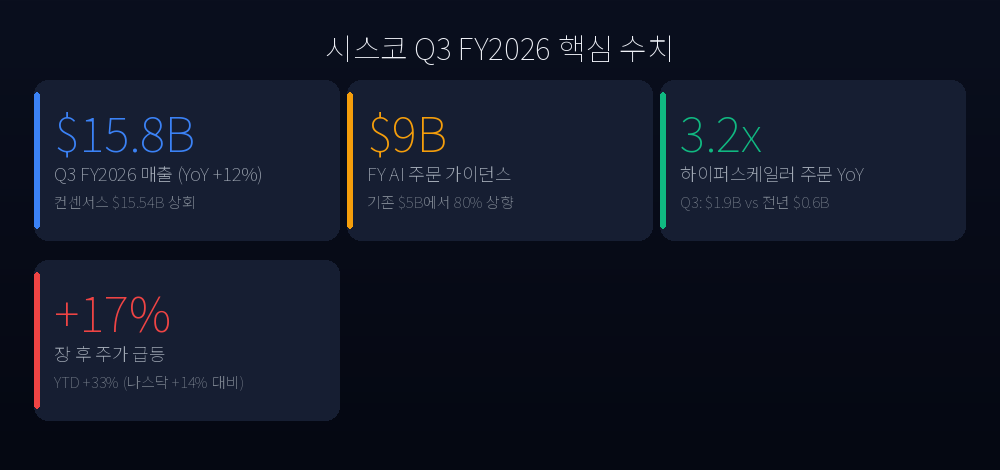
Cisco reported Q3 FY2026 results after the close on May 13, 2026. The headline beat was solid but unsurprising: revenue of $15.8B against a $15.54B consensus estimate, product revenue up 17%, non-GAAP EPS of $1.06 versus $1.04 expected.
What sent shares up 17% in after-hours wasn’t the EPS line. It was the AI order cadence.
Full-year AI infrastructure and hyperscaler order guidance was raised to $9 billion, up from a prior guidance of $5 billion — an 80% upward revision in a single quarter. Year-to-date AI orders stand at $5.3 billion. In Q3 alone, hyperscaler AI orders hit $1.9 billion, compared to $600 million in the same quarter last year. That is 3.2x year-over-year growth, and it’s not slowing.
For context: Cisco’s full-year AI revenue guidance also rose to $4 billion from $3 billion. This is no longer a rounding error on the income statement. AI is becoming Cisco’s primary growth engine.
Why the Layoffs Are the Second Bullish Signal
Alongside the earnings beat, Cisco announced it is cutting approximately 4,000 employees — roughly 5% of its workforce.
The market’s initial read was correct: this is a feature, not a bug. The restructuring playbook Cisco is executing is identical to what Meta ran in 2023 (Year of Efficiency) and what Google ran in early 2024. Cut the organizational fat, redirect the capital savings into high-return AI investments. Meta’s stock tripled within 18 months of those layoffs; the formula is now well-understood by institutional investors.
In Cisco’s case, the cost savings also fund the ongoing integration of Splunk, the security data platform acquired in 2024. Services revenue was -1% this quarter — a minor drag — but the Splunk synergies are expected to accelerate through FY2027 as enterprises consolidate their AI and security stacks onto a unified platform. That convergence is structurally favorable for Cisco’s software subscription mix, which carries far better margins than hardware.
From Networking Vendor to AI Infrastructure Company
The identity transformation at Cisco is worth examining carefully, because it’s not merely a marketing repositioning.
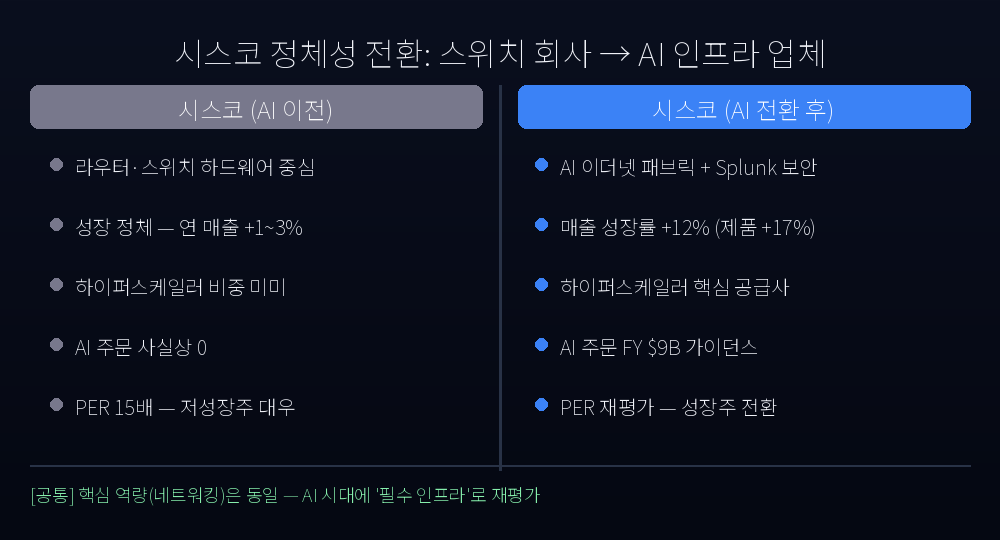
In the 2010s, Cisco was correctly characterized as a declining hardware vendor. Cloud migration shifted spending away from on-premise networking gear toward software-defined infrastructure. Cisco’s growth stagnated; multiple years of flat-to-low-single-digit revenue growth followed. The stock traded at 15x earnings — a value trap in slow motion.
The AI wave has inverted this dynamic. Hyperscalers are now building massive GPU clusters, and those clusters require ultra-low latency, high-bandwidth networking fabric to function. Cisco’s AI Ethernet Fabric — based on its switching and routing core competencies — has become a non-negotiable component of every large-scale AI training and inference deployment. You cannot run a 10,000-GPU cluster on commodity networking.
The competitive threat from Arista Networks is real and should not be dismissed. Arista has been gaining hyperscaler share in AI networking. However, Cisco’s scale, existing enterprise relationships, and the Splunk integration create switching costs that Arista cannot easily replicate at the enterprise layer. The moat is narrower than Cisco’s legacy position, but it exists.
What the Order Book Signals for the Broader Market
Cisco’s order data is a real-time leading indicator for AI capex — more granular than the guidance lines from hyperscalers themselves, because it reflects actual purchase orders rather than projected spend.
Three implications follow from this quarter’s data:
AI capex is not decelerating. The bears who predicted that hyperscaler spending would plateau in early 2026 are now looking at Q3 hyperscaler orders up 3.2x year-over-year. The infrastructure buildout is running ahead of schedule, not behind.
Networking is being repriced as core AI infrastructure. For years, investors assumed that Nvidia captured all the AI value. This quarter confirms that the networking layer — historically priced at commodity margins — is being repriced alongside GPU compute. Cisco, Arista, and others in the AI fabric space are beneficiaries.
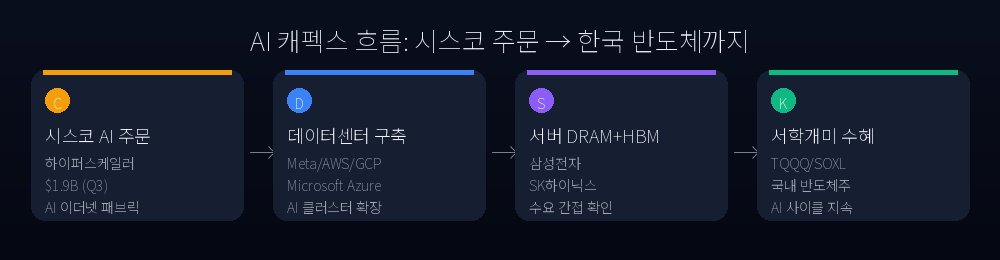
The server DRAM and HBM demand signal is intact. Every AI server that gets networked via Cisco’s fabric requires memory — specifically HBM for GPU compute and server DRAM for inference workloads. Cisco’s 3.2x YoY order growth in hyperscaler AI networking is a corroborating signal for sustained Samsung Electronics and SK Hynix HBM demand through the second half of 2026.
My Verdict and Positioning
Stance: Constructive on CSCO. Maintain broad AI infrastructure overweight.
The valuation is no longer cheap — CSCO is up 33% YTD versus Nasdaq’s 14%. The stock has already re-rated from a networking laggard to an AI infrastructure name. At current prices, new entry points require either a broader market pullback or a Q4 guidance miss from a hyperscaler.
That said, the order book data changes the risk calculus. If AI capex were slowing, Cisco’s Q3 hyperscaler orders would have shown it. They did not. The $9B FY guidance with $5.3B already locked in means the second half of FY2026 is largely de-risked on the revenue line.
Action framework:
- Existing holders: Hold through FY2026 Q4 earnings (August 2026). The thesis is confirmed.
- New entrants: Wait for a 5-8% pullback before initiating. The stock has moved significantly in one session.
- Indirect exposure: AI infrastructure ETFs (e.g., IGPT, BOTZ) offer diversified access to the networking-AI theme at lower single-stock risk.
- Sector read-through: AMD, Arista, and Nvidia all benefit from confirmation that hyperscaler AI capex continues at current rates. Maintain semiconductor overweight.
The key risk remains: enterprise IT spending outside of hyperscalers is soft. If the broader corporate upgrade cycle stalls, Cisco’s non-AI segments face headwinds. The services revenue dip (-1%) this quarter is an early signal worth monitoring.
This post is for informational purposes only and does not constitute investment advice. All investments carry risk, including potential loss of principal. Past performance does not guarantee future results.