TL;DR
- The Shock: CME FedWatch rate hike odds hit 45% — from under 1% just one month ago
- The Data: 10-year yield at 4.56%, 30-year past 5.1%, Empire State Manufacturing printed 19.6 vs 6.2 expected
- The Event: May 20 brings FOMC minutes AND Nvidia earnings on the same day — binary volatility risk
Rate Hike Odds at 45%: The Market Already Repriced
One month ago, a 2026 rate hike was a sub-1% tail scenario on CME FedWatch. Today it sits at 45%, with the highest odds pointing to a single hike to the 3.75%–4.0% range. That is not a small move. That is the market telling you the probability distribution has fundamentally shifted since Kevin Warsh took office.
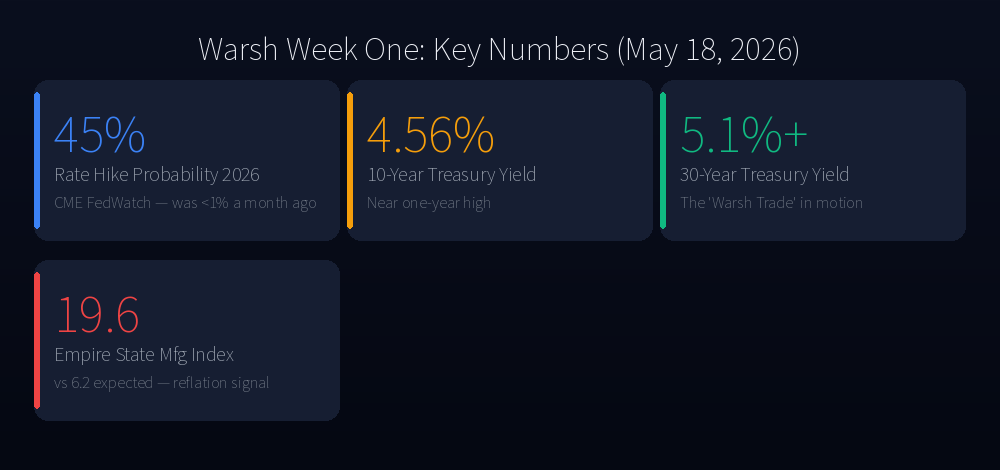
The 10-year Treasury note yielded 4.56% on Monday — its highest in nearly a year — and the 30-year crossed 5.1%. Both moves are significant. The 30-year yield above 5% is not just a headline; it is the rate at which duration risk becomes genuinely painful for long-equity portfolios. Every 100bps of additional yield on the long end mathematically compresses the present value of future earnings by 8–12% on a 20-year discounted cash flow basis. Nasdaq-heavy portfolios should not be indifferent to this.
Why the First Week Felt Different
Warsh was confirmed 54-45 by the Senate on May 13 and officially assumed the chair role on May 15. Jerome Powell stepped down from the chair but retained his Federal Reserve Board seat — an unusual arrangement that preserves his vote on interest rate decisions and creates a structural counterweight to Warsh within the committee.
Three things drove the repricing in Warsh’s first week:
Inflation at a 3-year high. April CPI data confirmed inflation running well above the Fed’s 2% target — the hottest reading in three years. Warsh has been unambiguous: inflation is the first priority.
Empire State Manufacturing at 19.6 vs 6.2 expected. Released this morning, the NY Fed’s manufacturing survey beat consensus by a factor of three. New orders and prices both climbed. This is a stagflationary signal — the economy is not breaking, but prices are not breaking either. That kills the “cut because growth is slowing” narrative.
The Warsh Trade is live. Bank stocks rallied. Long-duration bonds sold off. The dollar strengthened. The pattern is textbook tightening-regime rotation.
The Warsh Trade in Full
Warsh’s intellectual heritage is straightforward: he opposed QE2 in 2011 and resigned over it. His view is that prolonged balance sheet expansion distorts capital allocation. He has also stated that AI is a “significant disinflationary force” — language that gives him cover to hold rates even if headline inflation stays elevated. Markets are not yet buying the AI-disinflation thesis. They are buying the “rates stay higher for longer” thesis.
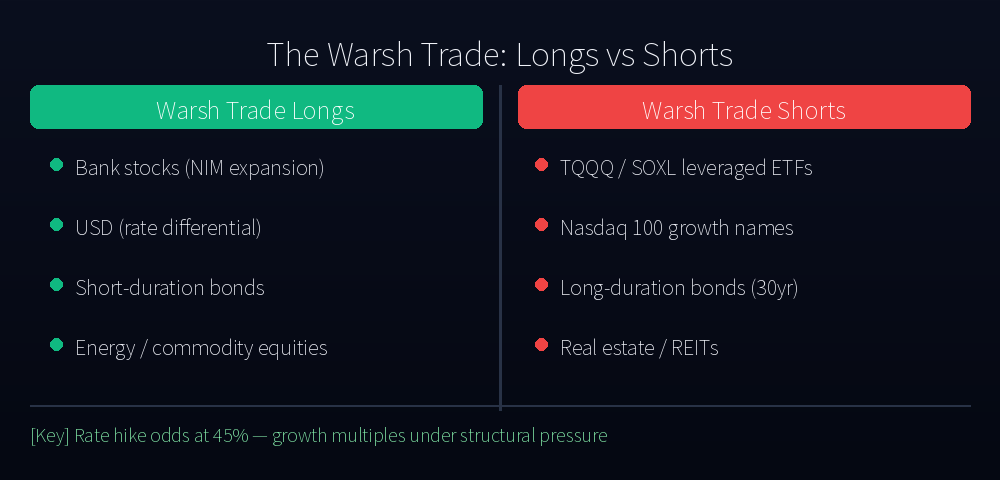
The playbook is clean. Long banks — higher net interest margins benefit from a steeper front-end yield curve. Short long-duration bonds — Warsh is not rushing to cut. Short geared growth ETFs — 30-year at 5.1% is a structural headwind for multiple expansion. The Warsh Trade is not a trade; it is a regime.
May 20 Double Event: Binary Risk on Both Sides
Both events land on the same day.
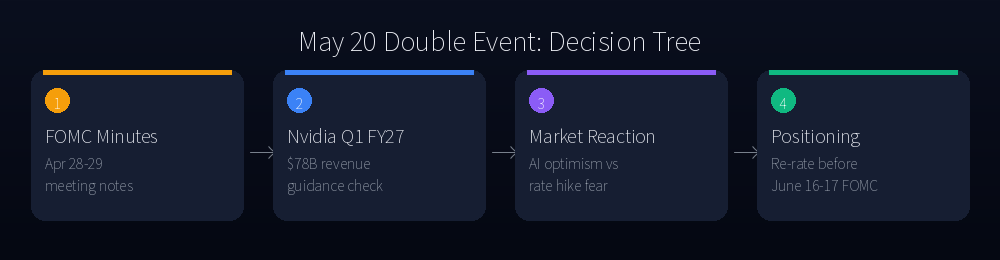
FOMC minutes from the April 28-29 meeting — Powell’s last as chair — drop on May 20. The key read: did committee members discuss rate hike scenarios? If yes, it confirms what the market is already pricing. If no explicit hike discussion appears, yields could pull back modestly as shorts cover.
Nvidia Q1 FY2027 earnings report after the close on May 20. Guidance was $78B revenue (+/-2%). Nvidia beating big would re-ignite the AI trade and potentially offset yield pressure in tech. A miss or soft forward guidance amplifies the downside: higher rates plus slowing AI demand is a difficult environment for Nasdaq multiples.
The overlapping risk on May 20 is genuine. Position accordingly before that date.
My Verdict: Cut Gearing, Watch June 16-17
My read of the data: the Warsh era has started with a clear signal. The 45% rate hike probability is not noise — it reflects a genuine regime shift in how markets interpret Fed leadership. The Empire State print this morning confirms the economy is not soft enough to force the Fed’s hand toward cuts.
Warsh’s first FOMC as chair is June 16-17. Between now and then, the risk/reward for levered long growth positions is unfavorable. The setup:
- Rates biased higher (Empire State data, Warsh hawkishness)
- Yield curve pressure on Nasdaq multiples (30-year at 5.1%)
- Dual event volatility on May 20 before direction clarifies
Positioning: Trim geared growth exposure ahead of May 20. Rotate into shorter-duration fixed income (2-year Treasury at current levels offers real yield). Bank sector exposure makes sense as a Warsh Trade expression. Re-evaluate the growth overweight after June FOMC.
The countercase — Warsh pivots dovish after seeing one more soft data print — is possible but not the base case. June 16-17 will clarify. Until then, the carry cost of being wrong on the high-gearing side is too high to ignore.
Investment Disclaimer: This article is for informational purposes only and does not constitute investment advice or a solicitation to buy or sell any security. All investment decisions should be made based on your own research and risk tolerance. Past performance does not guarantee future results.