TL;DR
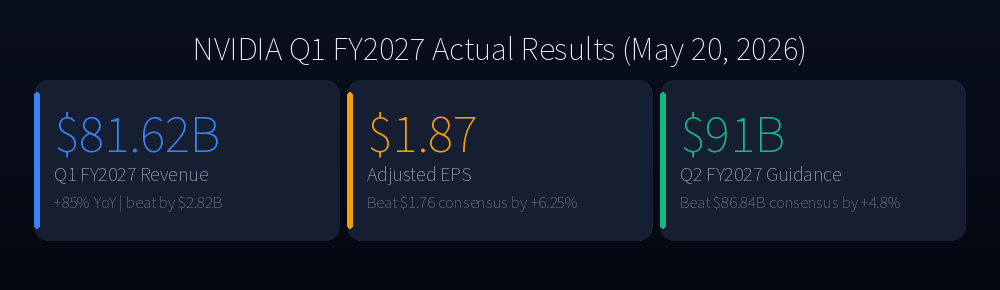
- 15 and counting: Nvidia beat Q1 FY2027 revenue consensus for the 15th straight quarter — $81.62B vs. $78.8B expected, +85% YoY.
- The guide is the story: Q2 guidance of $91B crushed the $86.84B consensus by 4.8%, not just cleared it.
- The margin inversion: SK Hynix, Nvidia’s HBM supplier, posted 72% operating margins. Nvidia posted 65%. The supplier is now more profitable per dollar than the customer.
$81.62 Billion Is Not the Headline
The revenue number is extraordinary. An 85% year-over-year growth rate at this scale — from $44.06B a year ago to $81.62B — would be the top result for any company on Earth in any sector. But for Nvidia, the revenue is almost the wrong place to look.
The real signal is sequential acceleration. Q4 FY2026 was $68.1B. Q1 FY2027 is $81.62B. That’s $13.5 billion added in a single quarter, up 19.9% sequentially. Companies generating $80B in quarterly revenue do not accelerate at 20% QoQ. Except this one is.
Jensen Huang’s explanation on the earnings call was direct: “Demand has gone parabolic. The reason is simple: Agentic AI has arrived.” This is not boilerplate CEO enthusiasm. The compute architecture behind agentic AI — systems that plan, reason, and execute multi-step tasks autonomously — consumes 1 to 2x more compute per output than traditional inference. The demand curve Nvidia is riding is not a pop. It is a structural shift.
What the Guide Tells You the Revenue Cannot
Revenue beats are common for Nvidia at this point. Fourteen consecutive EPS beats have become expected. The market has largely priced in the ability to beat.
What the market has not fully priced in is the magnitude of forward guidance relative to consensus. Q2 guidance of $91B against a $86.84B consensus average (LSEG) is not a comfortable beat — it is a $4.16B gap in a single quarter. Management did not guide conservatively and beat modestly. They guided aggressively and implied the quarter is tracking ahead.
The shareholder returns package reinforces this reading. The buyback authorization was expanded by $80 billion — cumulative authorization now exceeds $108 billion. More telling: the quarterly dividend was raised from $0.01 to $0.25 per share, a 25x increase. You do not raise a dividend by 25x unless you have overwhelming confidence in the cash generation trajectory. This is management putting its credibility on the line.
Nvidia has now generated $1 trillion from Blackwell and Vera Rubin combined across the 2026-2027 window by Jensen Huang’s own GTC projection. With Q1 at $81B and Q2 guided at $91B, that projection is beginning to look conservative.
The Margin Inversion Nobody Saw Coming
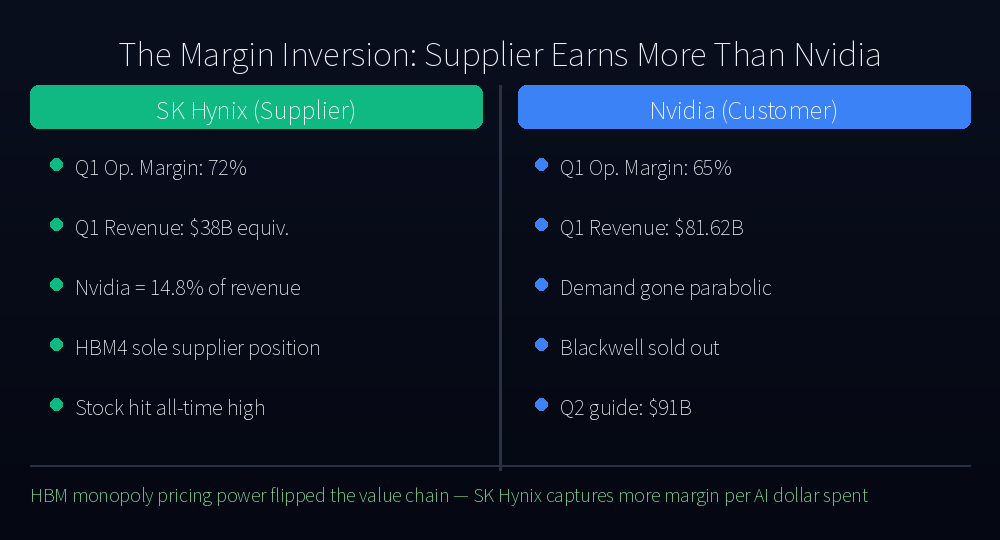
The most structurally interesting data point from this earnings cycle is not on Nvidia’s income statement. It’s on SK Hynix’s.
SK Hynix reported Q1 FY2026 operating margins of 72%. Nvidia’s Q1 FY2027 operating margin is 65%. A memory chip supplier — historically one of the most commoditized, cyclical businesses in semiconductors — is now generating higher operating margins than the world’s dominant AI chip designer.
The mechanism is straightforward. Nvidia consumes the vast majority of available HBM3E supply. SK Hynix has a near-monopoly on qualifying and shipping that supply. Samsung’s HBM4 qualification delays have extended SK Hynix’s window. When you control the supply of a critical input in a demand environment where the customer cannot substitute or defer, you capture the economics.
SK Hynix’s Q1 revenue was 52.58 trillion Korean won. Nvidia accounted for 14.8% of that total — a year-over-year increase of 62.6%. Nvidia is SK Hynix’s largest single revenue driver. If Nvidia’s Q2 $91B guide materializes, SK Hynix’s HBM4 shipment volumes will expand proportionally.
This is a supply chain dynamic worth watching. SK Hynix’s stock hit a new all-time high above 1.6 million won this week — the market is already pricing the sustained margin premium. The risk to the SK Hynix thesis is Samsung qualifying HBM4 faster than expected, which would compress the pricing power. The base case is that HBM4 production ramp is capacity-constrained through at least H1 2027.
Why Nobody Can Catch Nvidia Right Now
AMD’s MI350X is ramping. Google’s TPU v5e is in production. Custom silicon from Amazon, Microsoft, and Meta is displacing some Nvidia share in specific workloads.
None of this materially changes the picture at the margin level. Nvidia’s CUDA software ecosystem — 4 million developers, decades of optimization — represents switching costs that are structural, not temporary. AMD needs chips AND matching software performance. The gap on software is wider than the gap on silicon.
The more legitimate risk is if agentic AI deployment stalls — if enterprises slow AI capex due to ROI concerns. The hyperscalers (Microsoft, Google, Meta, Amazon) have collectively guided $600B+ in AI infrastructure spending for 2026. These commitments are already locked in. Nvidia’s order backlog reflects contracts, not aspirations.
My Verdict: Cycle Midpoint, Not Cycle Peak
Peak-cycle bears will point to valuation — Nvidia trades at 30-35x forward earnings, and sustaining that multiple requires continued execution above consensus. This is a legitimate constraint.
The counter-argument is structural demand evolution. Agentic AI is not an upgrade cycle. It is a new compute paradigm. When every enterprise application begins deploying autonomous agents — each requiring 1-2x more GPU cycles per task than current inference — the addressable compute market is not growing incrementally. It is multiplying.
My positioning: Overweight Nvidia in AI infrastructure allocation. The $91B Q2 guide creates a new earnings floor — any commentary on Q3 trajectory at the August call will reset the ceiling again. Near-term Sell-the-News volatility is possible given the stock’s pre-earnings appreciation; I would treat any 5-8% pullback as an accumulation opportunity rather than a thesis change.
For the SK Hynix trade: the margin inversion is the most underappreciated story in semiconductors right now. If you want AI infrastructure exposure with lower valuation risk than Nvidia itself, SK Hynix at current levels offers a compelling risk/reward against the HBM4 cycle.
Disclaimer: This article is for informational purposes only and does not constitute investment advice. All investment decisions are made at your own risk. Past performance does not guarantee future results.