TL;DR
- The Number: Walmart Q1 FY27 revenue $175.7B (+6.1% YoY), in-line. Q2 guidance slightly missed.
- The Signal: Management explicitly flagged tariff cost pass-through to consumers on imported goods.
- The Macro: PCE at 4.5%, 10yr yield at 4.6%. Warsh sworn in. Rate cuts? Off the table.
Walmart Printed Fine Numbers. That’s Not the Story.
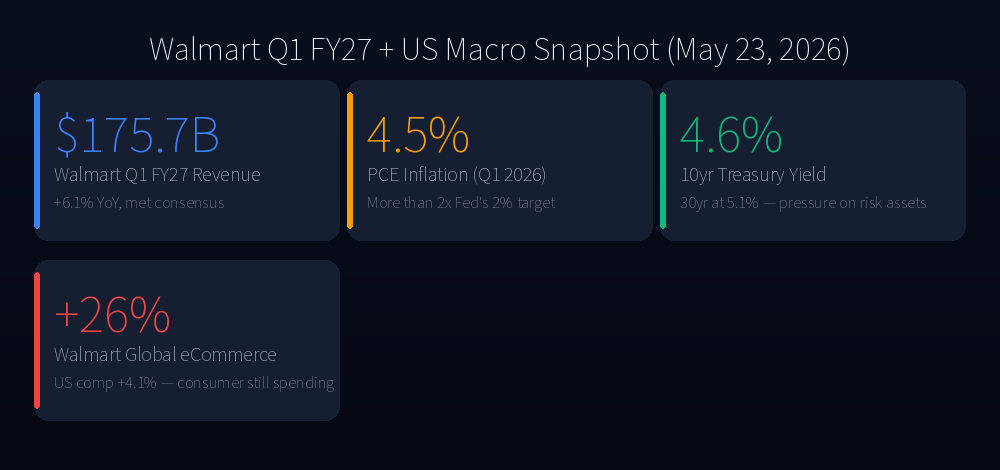
Walmart’s Q1 FY2027 results, announced May 21, were unremarkable by the company’s own high standards. Revenue of $175.7 billion beat whisper numbers, eCommerce grew 26% globally, and US comp-store sales rose 4.1%. Management left full-year guidance unchanged.
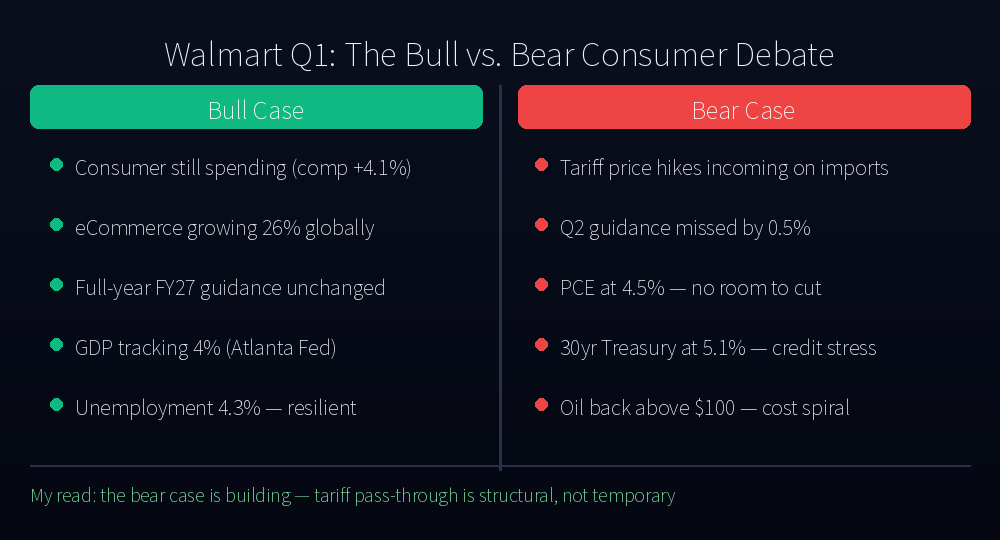
The stock still fell 7% intraday before recovering to +0.73%. The reason wasn’t the past — it was the future. On the earnings call, management made clear that some imported general merchandise prices would need to go higher to offset tariff-related cost increases. That single comment is worth more than the entire earnings beat.
Walmart commands approximately 25% of US grocery retail. When Walmart tells you prices are going up, they usually are.
The Numbers That Actually Matter Right Now
Strip away the eCommerce growth story and here’s what’s sitting in front of us:
US PCE inflation ended Q1 2026 at 4.5% — core PCE at 4.3%. The Federal Reserve’s stated target is 2%. At the current rate, we are not in “last mile” inflation territory; we are in “it stopped coming down” territory. The 10-year Treasury yielded 4.6% as of this week; the 30-year is at 5.1%. These are not bond yields pricing in rate cuts. These are bond yields pricing in prolonged restrictive policy.
The Atlanta Fed GDPNow model tracks Q2 2026 GDP growth at 4.0% annualized, with unemployment at 4.3%. The economy is not slowing. Inflation is not cooling. And now the largest retailer in the world is about to raise prices.
Why This Time Is Different From 2022
Inflation hawks will recall that the 2021-2022 inflation surge peaked at 9.1% (CPI) before collapsing once supply chains normalized. The argument at the time was structural: COVID disruptions are temporary; prices will revert. They did.
Tariff-driven inflation is different. Tariffs are a policy decision, not a supply shock. They do not self-correct when logistics normalize. Until trade negotiations produce meaningful tariff reductions — and the current US-China and US-global trade posture suggests that is not imminent — this cost is baked in. Walmart’s management is not projecting these price increases as temporary. They are signaling a sustained shift in their cost structure.
The distinction matters because 2022’s inflation could be “waited out” with higher rates. Tariff inflation under high rates simply compounds the squeeze on consumers: prices up, borrowing costs up, real wage purchasing power down.
Warsh Just Walked Into the Building
Kevin Warsh was sworn in as the 17th Federal Reserve Chair on May 22, 2026. His first day on the job features a PCE at 4.5%, a 30-year Treasury at 5.1%, and a major retailer announcing price hikes linked to trade policy.
History is instructive here. In every Fed cycle since 1970 where PCE has exceeded 4%, rate cuts that followed within 12 months have preceded an inflationary re-acceleration. The Fed that cut in 2021 when PCE was rising contributed directly to the 2022 inflation surge. Warsh, a market veteran with a hawkish intellectual reputation, is unlikely to repeat that mistake.
The market is pricing approximately 1.5 rate cuts for 2026. I think that pricing is optimistic. Flat is more likely; a hike is possible, not probable, but no longer inconceivable.
My Verdict: Cautiously Positioned, Not Panicking
The US consumer is not collapsing. Walmart’s comp growth of 4.1% and eCommerce expansion confirm demand remains. This is not a recession call.
But the rate-cut rotation trade — load up on leveraged tech, short-duration bonds, growth multiples — needs to be stress-tested. The macro environment is shifting from “cuts are coming” to “cuts are delayed, possibly indefinitely.”
My positioning adjustments:
Reduce leveraged long exposure. 3x ETFs like TQQQ and SOXL carry daily rebalancing drag that compounds negatively in range-bound or rising-rate environments. At PCE 4.5%, this is not the environment to run heavy leverage.
Watch the 10-year yield at 5%. If the 10-year crosses 5%, that’s a structural regime change for equity valuations. A 5% risk-free rate makes the equity risk premium on the Nasdaq’s 28x forward P/E look thin.
Sector tilt: Defensive names, not growth. XLP (Consumer Staples ETF) contains Walmart, Procter & Gamble, and Coca-Cola — companies that can pass through inflation to consumers. In a sticky-inflation, delayed-cuts environment, these names outperform the growth basket on a risk-adjusted basis.
Oil at $100+ matters. WTI crude back above $100 is a secondary inflation driver that compounds Walmart’s distribution cost problem. Energy exposure deserves a second look.
The data says inflation is re-entrenching, not retreating. Position accordingly.
Disclaimer: This article is for informational purposes only and does not constitute investment advice or a recommendation to buy or sell any security or ETF. All investment decisions should be made based on your own research and risk tolerance. Past performance does not guarantee future results.