TL;DR
- Lenovo posted a record quarter: $21.6B in Q4 FY2026 revenue (+27% YoY), with AI revenue up 84% and comprising 38% of total sales.
- Halo effect was immediate: Dell +16% (record high), HP +14%. The market read Lenovo as a forward indicator for the full sector.
- Korea supply chain wins: Samsung and SK Hynix supply the HBM memory going into these AI servers. This is a direct read-through.
What Actually Happened May 22
Lenovo, the world’s largest PC maker by volume, reported Q4 FY2026 results that stopped the conversation on AI demand skepticism. Revenue hit $21.6B — a quarterly record — and AI-related revenue grew 84% year-over-year to represent 38% of the total.
The same session, Dell Technologies hit an all-time record high, up 16%. HP Inc. added 14%. Neither had reported earnings. The market was pricing forward.
The mechanism is straightforward: Lenovo’s Infrastructure Solutions Group sells AI-optimized servers and GPU-accelerated compute racks to enterprises. Dell’s ISG division does the same. When Lenovo’s ISG order pipeline shows $21 billion in backlog and 5,800+ active AI deployments, the extrapolation to Dell is not a stretch — it’s arithmetic.
The Numbers That Matter
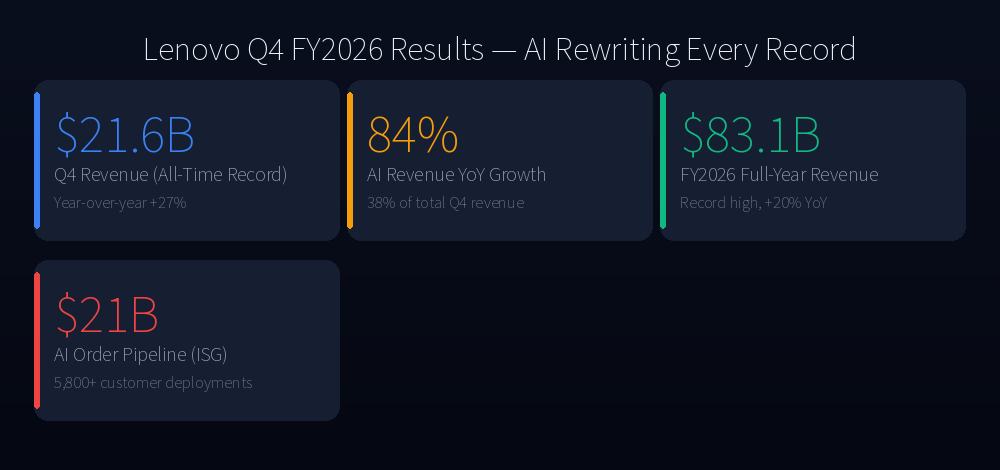
Breaking down what moved the market:
Q4 FY2026 results:
- Revenue: $21.6B (+27% YoY) — all-time record
- Full-year FY2026 revenue: $83.1B (+20% YoY) — all-time record
- AI revenue YoY growth: +84%
- AI as % of Q4 revenue: 38% (vs. ~20% two years ago)
- Adjusted Q4 net income: $559M (doubled YoY)
- ISG order pipeline: $21B
- Enterprise AI deployments: 5,800+
The number that stands out most isn’t the headline revenue — it’s the 38% AI mix combined with 84% growth. At this pace, AI becomes a majority of Lenovo’s revenue within 4-6 quarters. That structurally rerates the company and every peer in the supply chain.
This Is Not PC Refresh. It’s Structurally Different.
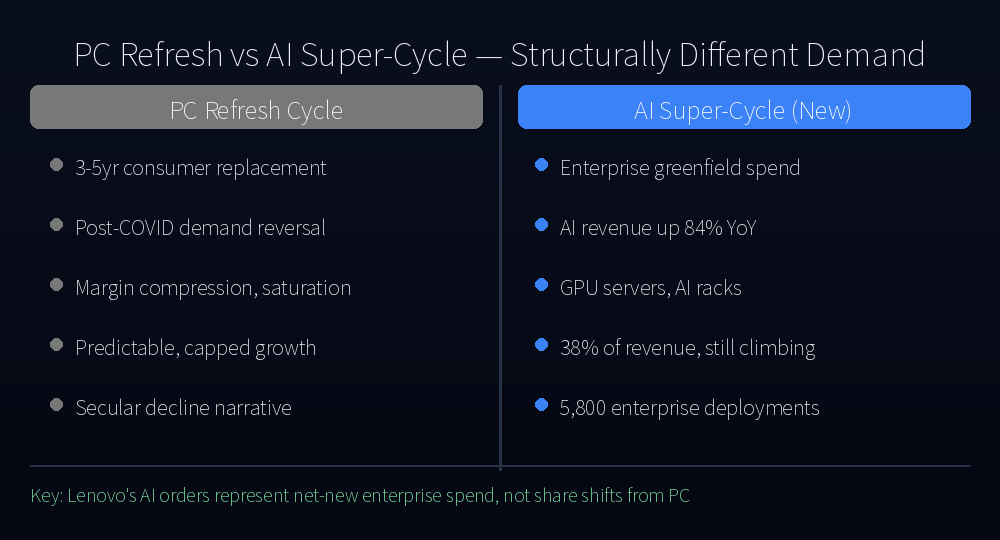
The bear case on PC hardware makers has always been that demand is cyclical: COVID pulled forward 3 years of refresh, then we paid for it with 3 years of contraction. The bull on AI hardware is that this isn’t a refresh cycle.
Enterprise AI infrastructure is greenfield spend. Banks, manufacturers, and healthcare systems are not replacing existing servers — they’re building entirely new AI compute layers that didn’t exist before. Once you deploy 100 AI servers, the maintenance, expansion, and upgrade cycle creates recurring revenue. This is closer to enterprise software economics than hardware cyclicality.
Lenovo’s 5,800+ enterprise deployment figure is the tell. This is not Microsoft or Google building hyperscale. These are mid-market and large-enterprise customers doing their first AI build-outs. The diffusion is real and ongoing.
Lenovo has become the best real-time indicator of enterprise AI diffusion speed. When their AI order pipeline grows 37% in one quarter and backlog hits $21B, the signal is clear: this demand is not slowing.
The Supply Chain Read-Through for Korean Semis
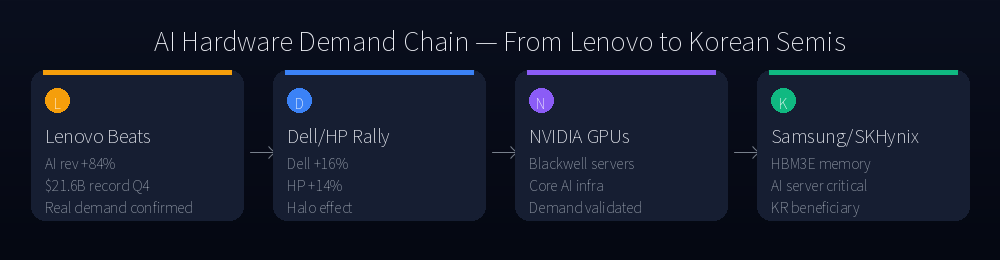
Every AI server Lenovo, Dell, or HP ships contains HBM (High Bandwidth Memory). HBM sits adjacent to the GPU and enables the ultra-high-bandwidth data throughput that AI inference and training require.
SK Hynix is the dominant HBM3E supplier today. Samsung Electronics is the second-largest and is scaling production. When AI server demand accelerates — as Lenovo’s results confirm — HBM demand grows in lockstep. There is no AI server without HBM. The yield curve on this relationship is approximately 1:1.
This is not an indirect read-through. It’s a direct demand signal. Korean semiconductor exports are already up significantly in 2026; this confirms the underlying driver is structural, not a pull-forward.
My Verdict: Positioning for Dell May 28
Dell reports Q1 FY2027 earnings on May 28. The market has already pre-priced a strong result — the 16% move happened before the print. The key question is whether Dell’s AI server revenue (ISG) can match or exceed the growth rate Lenovo showed.
Bull case for Dell post-earnings: Lenovo’s ISG pipeline data suggests the demand environment is strong enough that Dell’s numbers could show similar acceleration. If Dell’s ISG revenue shows 30%+ growth and management raises guidance, there is still upside from here — the AI hardware cycle is not priced for a multi-year run.
Bear case: Dell’s stock is now at record highs with a significant premium embedded. If ISG disappoints, or if management guidance is cautious (referencing macro uncertainty, tariffs, or China exposure), the 16% move reverses fast. “Buy the rumor, sell the fact” is a real risk.
My stance: Overweight Korean semiconductor exposure (SK Hynix, Samsung HBM division) over direct Dell/HP at current levels. The supply chain has less earnings-event binary risk and catches the same underlying demand. For Dell specifically — wait for the May 28 earnings reaction before adding. The conviction is high on the direction; the timing around the print is the risk.
Watch the ISG operating margin figure specifically. If Lenovo’s ISG margins expanded alongside revenue, Dell’s should too. That would be the structural re-rating signal — not just revenue growth, but evidence that AI infrastructure is a premium-margin business.
Actionable Takeaway
Three positions to consider based on this data:
- Korean HBM names (SK Hynix, Samsung Electronics HBM segment): Structural demand confirmation. Less binary than direct hardware plays.
- Dell (DELL) post-earnings: Enter on confirmation, not into the earnings event at current premiums.
- AI server ETFs (e.g., BOTZ, AIQ, ROBO): For broader exposure without single-stock earnings risk.
The signal from Lenovo is clear: enterprise AI demand is real, growing, and diffusing beyond hyperscalers. That’s the investable thesis.
Investment Disclaimer: This analysis is for informational purposes only and does not constitute investment advice or a recommendation to buy or sell any security. All investments involve risk, including the potential loss of principal. Past performance is not indicative of future results. Conduct your own due diligence before making any investment decisions.