TL;DR
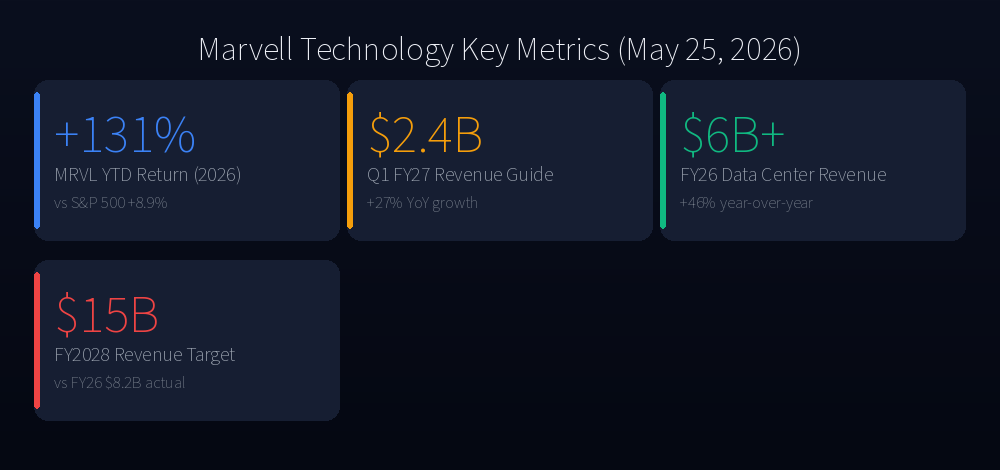
- The Setup: Marvell (MRVL) reports Q1 FY2027 earnings Wednesday, May 27, after close. Revenue guidance: $2.4B (+27% YoY).
- The Angle No One Is Pricing Fully: NVIDIA invested $2B in Marvell — a GPU incumbent funding a custom silicon rival. That’s not a partnership; it’s a structural bet on co-existence.
- My Verdict: Bullish on the structural thesis, cautious on the entry. The stock is up 131% YTD — this earnings call needs to deliver guidance uplift, not just a beat.
Key Numbers Going Into Wednesday
Marvell finished fiscal year 2026 with $8.2B in revenue — 42% growth year-over-year, driven almost entirely by data center. That segment alone crossed $6B, up 46%. For Q1 FY2027, management has guided $2.4B ± 5%, implying ~27% YoY at the midpoint.
Consensus EPS sits at $0.75–$0.79 non-GAAP. The custom AI chip business — which went from zero to a $1.5B annual run rate in FY2026 — is expected to grow over 20% in FY2027. Management has a stated target of $15B in revenue by FY2028.
The math works, but only if hyperscaler demand stays aggressive and Marvell keeps winning new design slots.
Why NVIDIA Invested $2B in a “Competitor”
The March 2026 announcement of NVIDIA’s $2B strategic investment in Marvell deserves more attention than it got. On the surface it looks strange: NVIDIA is the dominant AI chip company; Marvell designs custom XPUs that hyperscalers use partly to reduce NVIDIA dependency. Why would NVIDIA fund that?
The answer is NVLink Fusion. NVIDIA isn’t threatened by custom silicon — it’s building an interconnect ecosystem where its GPUs and Marvell’s XPUs can coexist inside the same AI factory. A hyperscaler that runs NVIDIA GPUs for training and Marvell XPUs for inference is a better customer for both companies than one that picks only one.
This move also signals that NVIDIA has accepted a two-chip-architecture future for AI data centers. That validation from the GPU leader is worth more than any analyst note.
Google’s TPU Move — The Broadcom Monopoly Is Cracking
Broadcom (AVGO) has been Google’s sole custom chip partner for its TPU line. That relationship drove significant revenue and gave Broadcom a moat few analysts questioned.
Reports now indicate Google is actively negotiating with Marvell on co-developing AI inference chips — potentially as a second supplier alongside Broadcom. If confirmed, this is the most significant competitive shift in the custom silicon space since Marvell re-entered the data center market.
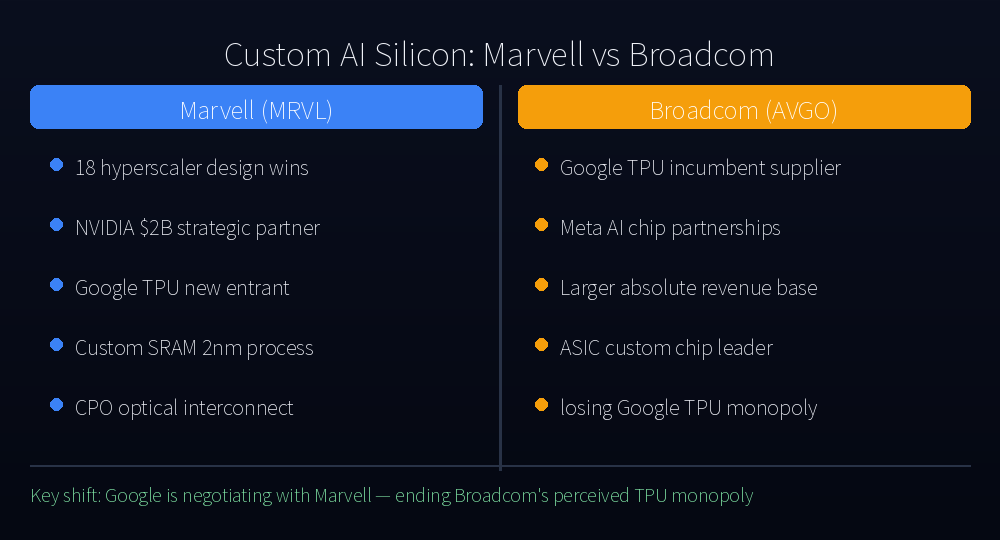
Amazon and Microsoft are already in Marvell’s customer base. Adding Google would make Marvell the only company with confirmed or advanced design relationships across all three major US hyperscalers. That’s a very different revenue profile than the Street is currently modeling for FY2027–FY2028.
Broadcom’s FY2027 AI chip revenue guide ($4B+) assumes its Google relationship is intact. Any formal Marvell-Google announcement Wednesday night would be a negative catalyst for AVGO and a positive re-rating trigger for MRVL.
What the Market Is Missing: The HBM Connection
Every Marvell XPU needs High Bandwidth Memory. At scale, a single XPU can consume dozens of HBM dies. Marvell’s custom chip growth directly translates into HBM demand — and the primary HBM3E supplier today is SK Hynix, followed by Samsung.
This creates an under-appreciated trade: investors bullish on Marvell’s custom chip trajectory should also be looking at SK Hynix as a high-beta play on the same thesis, with a lower valuation multiple. If Marvell raises its custom chip guidance Wednesday, the read-through to SK Hynix’s HBM order book is direct.
The Co-Packaged Optics (CPO) angle adds another layer. Marvell’s 448G electrical-optical SerDes is designed to scale AI clusters from tens to hundreds of XPUs using optical interconnects. CPO commercialization — which Marvell is targeting for late FY2027 — would unlock a networking revenue stream that is currently not in most models.
What I Need to See Wednesday
This is not a complicated earnings setup — the thesis is clear, the risks are known. Here’s the three-item checklist that determines my post-earnings positioning:
1. Custom chip FY2027 annual guidance above $2B Current run rate is $1.5B. If management raises their annual custom chip target above $2B, that’s a 33%+ guide-raise that the stock can grow into.
2. Data center revenue mix above 75% It was 73% in FY2026. Any acceleration in mix shift validates the transformation from networking chip company to AI infrastructure company.
3. Google partnership — any official language If management even drops a vague reference to “a new hyperscaler relationship in AI inference,” the market will correctly interpret it as Google. That’s a re-rating event.
My Verdict — Positioning
Structural view: Overweight MRVL vs. semiconductor index. The combination of NVIDIA partnership, 18 hyperscaler design wins, and a credible path to $15B revenue by FY2028 is not reflected in its peers’ multiples.
Tactical view: I would not add aggressively ahead of the print. The stock is up 131% YTD. A strong beat with soft guidance could still produce a 5–10% pullback, as we have seen in other high-multiple AI names. Wait for the guidance number Wednesday night, then decide.
Pair trade idea: Long MRVL / Short AVGO on the Google TPU narrative shift. If the Marvell-Google story gets confirmed, Broadcom’s AI chip moat narrative weakens materially.
This content is for informational purposes only and does not constitute investment advice. Past performance is not indicative of future results. All investment decisions should be made at your own discretion and risk.