
TL;DR
- Record Quarter: Q2 FY2026 revenue of $111.2B (+17% YoY) smashed the $108.9B consensus. EPS $2.01 vs. $1.95 expected.
- Leadership Transition: Tim Cook steps down as CEO on September 1, 2026. John Ternus — the engineer who built Apple Silicon — takes the chair.
- Capital Return: $100B buyback authorized + 4% dividend increase. Q3 guidance of 14–17% growth demolished the 9.5% consensus.
The Numbers That Actually Matter
Apple’s Q2 FY2026 results were not a modest beat. They were a statement.
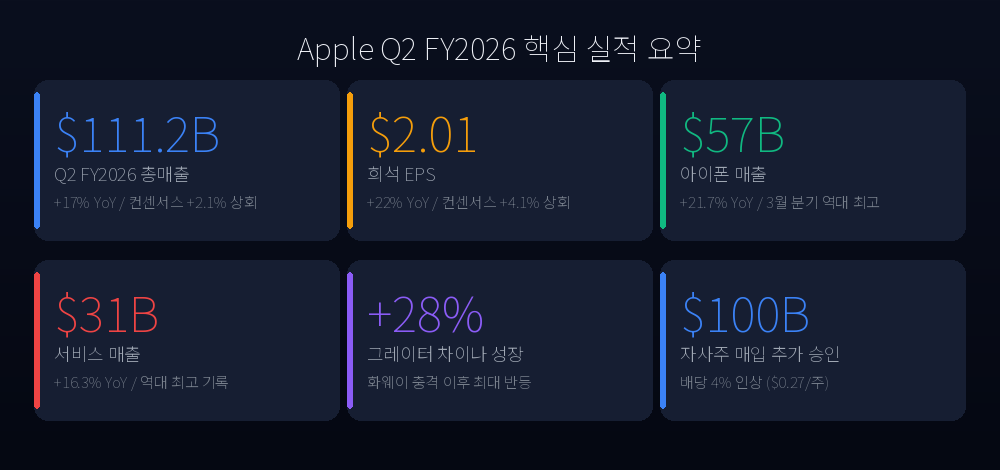
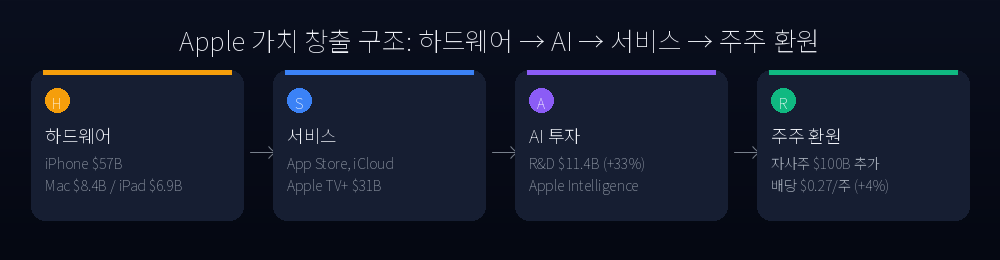
iPhone at $56.99B (+21.7% YoY) — a record for any March quarter. The iPhone 17 cycle is delivering, and China came back hard. Greater China revenue surged 28% year-over-year, the largest rebound since Huawei’s Mate series cut into Apple’s share in 2023–2024. Apple Intelligence features appear to have reignited premium demand in a market most analysts had written off as structurally challenged.
Services at $30.98B (+16.3% YoY) — another all-time high. Services now represent 27.8% of total revenue, up from roughly 5% when Cook took over in 2011. This segment carries gross margins north of 70%, meaning every incremental dollar of Services revenue converts to earnings at a rate hardware can’t match.
R&D at $11.4B (+33% YoY) is the most underappreciated data point. Management is investing in AI at twice the pace of revenue growth. This is the balance sheet prelude to what WWDC 2026 will showcase: an agentic Siri rebuilt on Google Gemini’s infrastructure.
Q3 Guidance: +14–17% revenue growth versus the 9.5% Street consensus. Management does not typically offer guidance this far above consensus without high conviction. The implication: the iPhone 17 upgrade cycle has more runway than the market priced in.
What Actually Changed: The Cook-to-Ternus Pivot
Tim Cook’s fifteen-year tenure is the greatest operational management story in corporate history. He inherited a $300B market cap company from Steve Jobs and returned a $4 trillion one to shareholders. His instrument: supply chain mastery and a relentless push into high-margin recurring revenue (Services).
John Ternus is a different kind of executive. He joined Apple in 2001 in product design, spent two decades in hardware engineering, and became SVP of Hardware Engineering in 2021. He is the architect behind every Apple Silicon chip from M1 through M4 — the engineering decision that decoupled Apple from Intel dependency and restructured the PC industry’s competitive map.
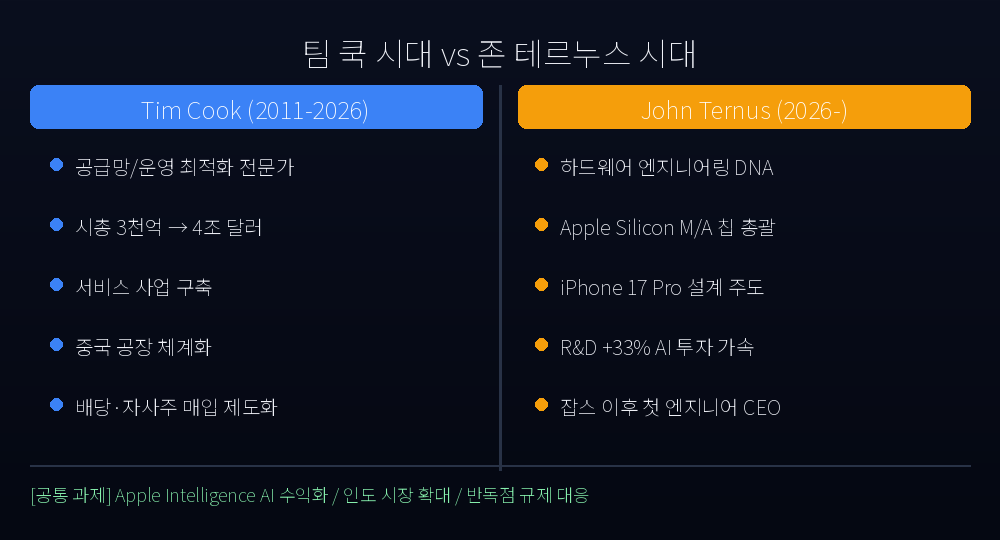
The transition signals a deliberate strategic pivot: from operations-led growth to hardware-AI-led innovation. Cook optimized the machine. Ternus will rebuild the engine.
There’s a relevant historical parallel. When Cook replaced Jobs, many investors worried the supply chain operator couldn’t preserve the product visionary’s legacy. They were wrong — Cook’s operational genius was exactly what Apple needed for that phase of growth. Today, with AI becoming the central battleground in consumer hardware, appointing an engineer who built the silicon that powers Apple’s AI ambitions sends a clear signal about where management sees the next decade of value creation.
The key risk in this transition: execution uncertainty. Ternus has not yet run a public company. His first major product cycle post-September 2026 will be scrutinized intensely.
Competitive Context
Three data points the headline coverage missed:
1. China +28% changes the competitive calculus. Samsung’s MX (Mobile) division has been under pressure from Huawei’s recovery in the premium China segment. Apple’s +28% reversal suggests Apple Intelligence has more traction in China than consensus modeled. If this holds through the September quarter, it puts material pressure on Samsung’s premium volume estimates for H2 2026.
2. R&D +33% signals an AI arms race Apple intends to win. The Street tends to focus on near-term EPS impact of higher R&D. The better frame: Apple is paying to compress the AI feature gap. WWDC 2026 (June 8–12) is the first public read on whether that spending is producing results. The rumored agentic Siri with Gemini integration would be the most significant software upgrade to iOS since the App Store launch. If it ships on schedule, the “Apple is behind on AI” narrative inverts.
3. The $100B buyback is accretive at current prices. At $280/share, Apple is trading at roughly 28–30x trailing earnings — below its 5-year average PE. The buyback at these levels will reduce share count by an estimated 2–3% annually, providing an automatic EPS tailwind independent of revenue growth.
My Verdict: Overweight, With a June Checkpoint
The data supports a constructive position. The quarter was clean: revenue beat, EPS beat, guidance beat, and capital return was increased. The CEO transition is the principal overhang, but the market’s reaction on April 20 (announcement day: +1%) and post-earnings after-hours (+5%) suggests investors are treating this as an orderly, confidence-preserving succession — not a disruption.
My positioning framework:
- Short-term (now → WWDC June 8–12): Hold. Buyback provides price floor. Earnings momentum is intact. The AI narrative catalyst (WWDC) is a near-term event with asymmetric upside.
- Post-WWDC: If agentic Siri delivers on its promise, add on any dip. If the AI demo disappoints, trim to neutral — the AI gap thesis will reassert.
- Post-September 1 (Ternus takes over): Reassess based on his first strategic communication. The first 90-day product and AI roadmap announcement will be the true signal.
Key numbers to watch: Services gross margin trajectory; China revenue trend in Q3; WWDC AI feature completion and developer response.
Wedbush has a $350 price target. The consensus sits at $297.88. My own estimate: $310–$330 by year-end, contingent on WWDC AI delivery. The bear case at $215 requires a simultaneous China policy reversal and AI execution failure — low probability, but not zero.
Disclaimer: This article is for informational purposes only and does not constitute investment advice or a recommendation to buy or sell any security. All investments involve risk, including the possible loss of principal. Past performance is not indicative of future results. Conduct your own due diligence before making investment decisions.