
TL;DR
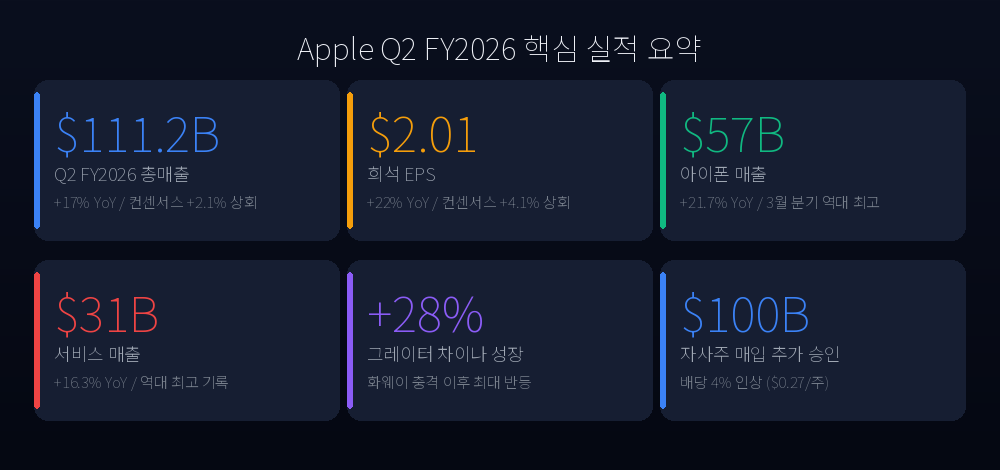
- Numbers Beat: Apple printed $111.2B revenue (+17% YoY) and EPS of $2.01 (+22% YoY) — both ahead of consensus by ~2% and ~4% respectively.
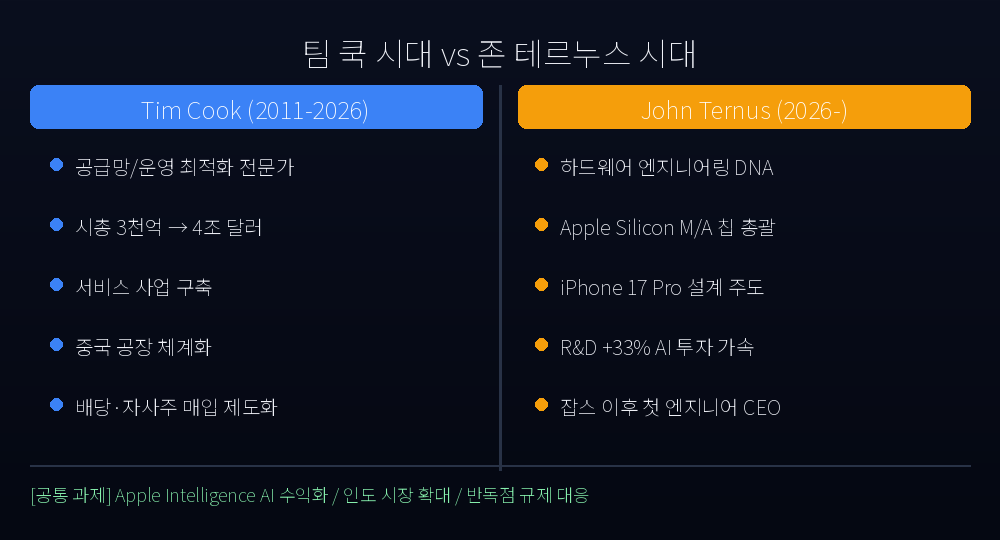
- Leadership Shift: Tim Cook steps down September 1, 2026. John Ternus, hardware engineering chief and architect of Apple Silicon, takes the CEO chair.
- Macro Wildcard: The Fed held rates at 3.5–3.75% but four officials dissented — the most since 1992. Kevin Warsh takes over May 15 with a hawkish policy bias.
The Numbers Don’t Lie
Let me put the quarter in context with what actually moved:
iPhone revenue: $56.99B (+22% YoY) — a March-quarter record. The iPhone 17 cycle is running hotter than any iPhone cycle since the iPhone 6 supercycle of 2014–2015. Apple Intelligence features, particularly improved Siri and on-device AI capabilities, appear to have broken the upgrade fatigue that plagued the iPhone 14 and 15 cycles.
Services: $30.98B (+16% YoY) — another all-time high. This matters for valuation. Services carries gross margins north of 70%, versus ~35% for hardware. Every dollar shifting to Services structurally expands blended margins. Services is no longer a footnote; it’s now 28% of total revenue.
Greater China: +28% YoY — this is the number that surprised me most. Huawei’s Mate 60 series reentry into the premium segment in 2023 was expected to permanently reclaim double-digit share. The data says otherwise. Apple Intelligence’s rollout in Mandarin, combined with the iPhone 17’s camera improvements, appears to have reversed that narrative in one quarter.
R&D: $11.42B (+33% YoY) — this is not an accounting artifact. This is the incoming CEO telegraphing priorities before he officially has the title. Ternus is spending.
Guidance: Q3 revenue growth guided at 14–17%, well above the 9.5% consensus. That’s an aggressive forward signal from a company that typically guides conservatively.
Cook’s Exit Is a Feature, Not a Bug
The market’s initial instinct on CEO transitions is almost always wrong. When Cook succeeded Jobs in 2011, AAPL traded sideways for months before running 10x over the following decade. The market feared the loss of Jobs’s product genius; it didn’t see Cook’s operational mastery coming.
The same framing error is likely being applied to Ternus now. The fear is: Ternus is a hardware guy in a software-services world. The reality: Apple’s next decade of value creation is at the intersection of proprietary silicon and on-device AI — and that’s exactly Ternus’s domain.
Consider the strategic logic:
- Apple Silicon (M1 through M4) gave Apple the highest-performance-per-watt chips in the consumer market, enabling privacy-first on-device AI without relying on cloud inference.
- The $100B buyback authorization (on top of cumulative $700B+ since 2012) signals the board’s confidence that current cash generation is robust enough to sustain both heavy R&D investment and aggressive capital returns simultaneously.
- R&D at $11.42B (+33%) is not a search for direction; it’s a bet that’s already been made on AI hardware.
This is Cook handing Ternus a clean house, a loaded balance sheet, and a clear product thesis. Contrast that with Jobs handing Cook a company with a broken supply chain and zero institutional investor credibility.
My read: The Cook→Ternus transition is strategically cleaner than the Jobs→Cook transition was in 2011. The 9-month runway before official handover on September 1 is by design — it gives Ternus time to signal without full accountability.
The FOMC Wildcard
Apple’s quarter landed against a deeply uncertain macro backdrop.
On April 29, the FOMC voted to hold rates in the 3.5–3.75% range for the third time in 2026. The headline was the vote itself: four dissents — the most since October 1992. More telling was the split in direction. Stephen Miran (Trump-appointed) dissented in favor of a 25bp cut. Three regional presidents (Hammack, Kashkari, Logan) dissented against the inclusion of an easing bias in the statement. The committee is not just divided on magnitude — it’s divided on direction.
Futures markets price only 10% probability of any rate cut in 2026. Effectively, the base case is a 3.5–3.75% regime for the rest of the year.
The bigger variable is May 15: Jerome Powell steps down, and Kevin Warsh assumes the chair. Warsh’s policy record and public statements point to:
- Sustained higher rates — he has consistently argued that the Fed cut too aggressively in 2024 and needs to rebuild credibility.
- Accelerated balance sheet reduction (QT) — Warsh views the Fed’s ~$7 trillion balance sheet as distortive and wants to reduce it faster than Powell’s pace.
For equity markets, Warsh’s hawkish tilt is a headwind, particularly for rate-sensitive growth and long-duration assets. The irony is that Apple, with its massive cash flow generation and $100B buyback, is relatively insulated from rate sensitivity compared to, say, small-cap tech or long-duration fixed income.
NXP Semiconductors (+25%) and Seagate (+11%) on their own earnings beats show that the earnings environment remains strong enough to absorb macro noise — for now.
The Competitive Context
Apple’s Greater China recovery (+28%) creates a direct read-through to Samsung’s premium smartphone position.
Samsung’s mobile division (MX) has been losing premium market share to Apple in Asia-Pacific consistently since 2022. Apple’s China rebound, driven by AI differentiation rather than price competition, suggests the premium gap is widening rather than narrowing. This is relevant for any investor holding Samsung alongside AAPL — these are increasingly zero-sum at the $800+ price tier in Asia.
On the supply chain side, Apple’s R&D acceleration means more custom silicon development, which benefits TSMC (the manufacturer) but creates margin pressure for commodity component suppliers. The announced chip supply constraints flagged for Q3 2026 suggest even Apple’s supply chain optimization hasn’t fully solved the leading-edge node bottleneck.

My Verdict and Positioning
On AAPL: Overweight, with a defined risk window.
The Q2 print removes near-term downside risk. The $100B buyback provides EPS floor support. Services margin expansion is structural. The forward guide at 14–17% growth is not sandbagging — Apple typically guides conservatively, so this likely means Q3 could surprise again.
The risk window is the 4-month CEO transition period (May–September 2026). Markets may reprice uncertainty as Ternus’s specific product roadmap becomes clearer. The first real test is likely Q4 FY2026 (October earnings) — the first quarter under full Ternus ownership.
My positioning: Hold current AAPL exposure through the September transition. Reassess after the first Ternus earnings call. The $100B buyback makes any significant drawdown a buying opportunity rather than an exit signal.
On Macro (Fed/Warsh): The 10% probability of a 2026 rate cut is priced in. The underpriced risk is a rate hike under Warsh — currently at 6% probability but asymmetrically impactful on long-duration equities and leveraged ETFs. I am not adding duration here.
Specific plays to watch:
- AAPL: Hold. The data supports the thesis.
- TQQQ / 3x leveraged NASDAQ products: Reduce exposure ahead of May 15 Warsh transition. Reinstate after the first FOMC meeting under Warsh provides policy clarity.
- Long-term Treasuries (TLT-equivalent): Avoid until Warsh’s QT pace is established.
- TSMC: Indirect beneficiary of Apple’s R&D acceleration. The iPhone AI silicon roadmap continues to demand leading-edge nodes.
Investment Disclaimer: This content is for informational purposes only and does not constitute financial advice, a solicitation, or a recommendation to buy or sell any security. Past performance is not indicative of future results. All investments involve risk, including the possible loss of principal. Please consult a qualified financial advisor before making investment decisions.