
TL;DR
- All four beat: Amazon, Microsoft, Alphabet, and Meta all exceeded Q1 2026 consensus estimates. S&P 500 and Nasdaq hit new all-time highs.
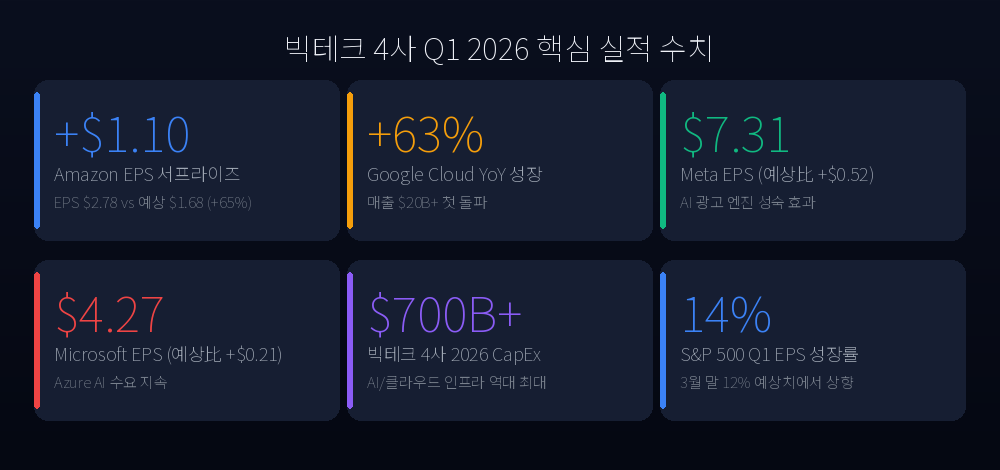
- AI is monetizing: Google Cloud surged 63% YoY to $20B+. AWS re-accelerated. Meta’s AI ad engine is driving margin expansion.
- The catch: Combined 2026 CapEx for these four companies now exceeds $700B — profits are rising, but free cash flow is under pressure.
The Numbers That Matter
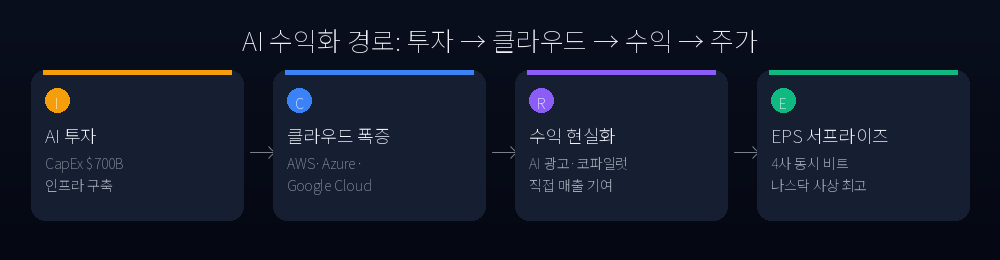
The Q1 2026 earnings season has delivered a definitive verdict: AI is no longer just a cost center — it is generating real, compounding revenue.
| Company | EPS (Actual) | EPS (Est.) | Beat |
|---|---|---|---|
| Amazon | $2.78 | $1.68 | +$1.10 (+65%) |
| Microsoft | $4.27 | $4.06 | +$0.21 (+5%) |
| Alphabet | $2.62 | $2.63 | -$0.01 (miss) |
| Meta | $7.31 | $6.79 | +$0.52 (+8%) |
Alphabet missed EPS by a penny but beat revenue by $2.7B — that’s a miss on optics, not fundamentals. Google Cloud’s $20B quarter at +63% growth is the real headline.
The S&P 500 closed at 7,230.12 on May 4, a new all-time high. Q1 EPS growth for the full index is now tracking at 14% YoY — revised up from 12% at end of March.
What Actually Changed This Quarter
Three structural shifts are worth tracking:
1. Cloud re-acceleration is not a blip. Google Cloud at $20B (+63%) and AWS beating estimates by $1.10/share are not one-quarter events. Enterprise AI adoption — Gemini-powered enterprise tools, Amazon Bedrock, Azure OpenAI — is converting into signed contracts with multi-year commitments. The lag between AI investment and cloud revenue recognition is closing.
2. Meta’s AI ad engine is compounding. Meta’s EPS of $7.31 vs. $6.79 expected reflects something deeper than revenue growth. Its AI-powered ad recommendation system is improving both CPM (cost per thousand impressions) and CTR (click-through rate) simultaneously. When both metrics rise together, revenue scales non-linearly. This is margin expansion in real time.
3. Microsoft’s Copilot flywheel is beginning to register. GitHub Copilot crossed significant enterprise subscription milestones. Azure AI workloads showed no deceleration. At $4.27 EPS, Microsoft is demonstrating that enterprise software + AI can maintain premium pricing power even in a rate-hold environment.
Actual vs. Consensus — The Magnitude Matters
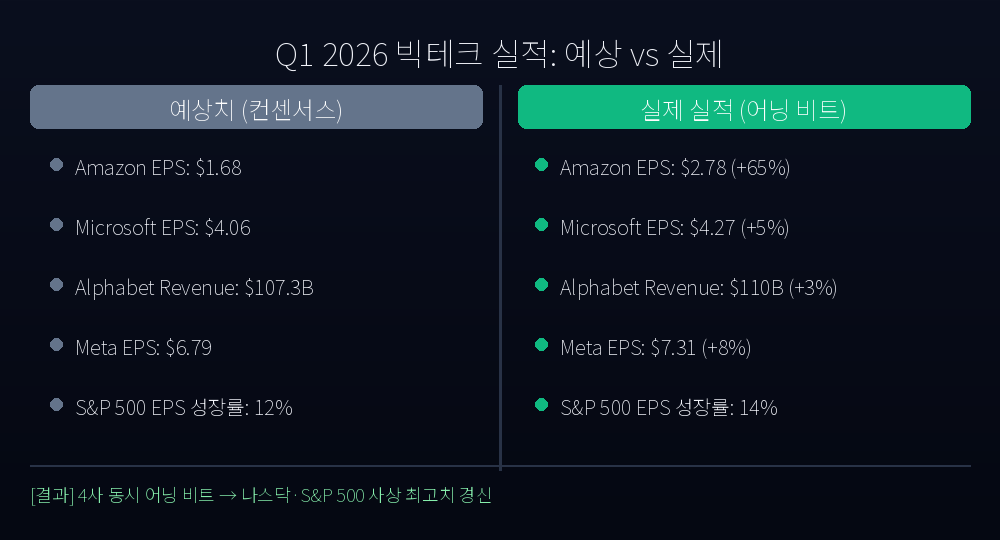
Amazon’s +65% EPS surprise is not a typical beat. When actual results deviate from consensus by this magnitude, it signals that sell-side models were fundamentally miscalibrated on cloud-AI dynamics. Institutional model revisions following this print will be significant.
The $700 Billion Problem Nobody Wants to Talk About
Here is where the story gets complicated.
These four companies are now guiding to combined 2026 CapEx in excess of $700 billion — a number that keeps increasing each quarter. Amazon, despite the massive EPS beat, is seeing free cash flow (FCF) compressed precisely because of this CapEx surge.
The bull/bear debate on this is clean:
Bull case: Today’s $700B in AI infrastructure CapEx is tomorrow’s moat. If AWS, Azure, and Google Cloud become the default compute fabric for global AI workloads, this expenditure yields the highest-ROI capital deployment in corporate history. The competitive barriers constructed today will be extremely difficult to replicate in 2028-2030.
Bear case: FCF compression limits shareholder return capacity (buybacks, dividends). In a rate-hold environment — Fed stuck at 3.50%-3.75% with no cuts in sight — high-multiple stocks require FCF growth to justify valuations. These companies are running counter to that requirement right now.
The market has voted. It is taking the bull side. But this is a bet on execution over a 3-5 year horizon, not a near-term trade.
Competitive Context
The CapEx arms race has implications beyond these four companies:
- NVIDIA remains the primary beneficiary of the compute buildout. $700B in infrastructure CapEx flows heavily through GPU procurement.
- Custom silicon is the counter-narrative. Amazon Trainium, Google TPUs, and Microsoft’s Maia chips are scaling. The long-run risk for NVIDIA is internal chip development reducing external GPU dependency — but this is 2028+ story.
- Hyperscaler consolidation: The gap between AWS/Azure/Google Cloud and tier-2 cloud providers is widening. Oracle Cloud and Snowflake are scaling, but the infrastructure moat is being built by players spending $700B — not $7B.
My Verdict: Bullish on AI Infrastructure, Cautious on Near-Term Multiples
Positioning:
The AI monetization thesis has now been empirically confirmed. Q1 2026 is the data point that validates the investment cycle began in 2023. The question is no longer “will AI generate revenue?” — it is “at what valuation does AI revenue growth justify current multiples?”
My current stance:
- Overweight AMZN: The +65% EPS surprise reflects AWS re-acceleration that the street was underestimating. The CapEx/FCF headwind is real, but the revenue trajectory is now on a steeper path.
- Hold MSFT: Azure + Copilot flywheel is intact. Premium multiple is warranted but limits near-term upside relative to AMZN.
- Hold GOOGL: Cloud at $20B is the real story. A one-penny EPS miss on $110B revenue is not a concern. Watch for further cloud margin expansion.
- Trim META on strength: The AI ad engine is operating excellently. However, at current multiples and with CapEx guidance increasing again, risk/reward favors a modest trim for tactical purposes.
Key risks to monitor:
- Fed rate-hold into late 2026 → high-multiple compression risk
- FCF trajectory: if CapEx continues rising faster than revenue, FCF yield deteriorates
- Custom silicon adoption: any acceleration reduces GPU moat and NVIDIA’s pricing power
- Powell succession (May 15): Kevin Warsh as incoming Fed chair introduces policy uncertainty
Actionable Framework
For investors holding tech-heavy positions post this earnings sweep:
- Rebalance if concentrated: All four stocks are near/at multi-year highs. Concentration risk is elevated.
- Watch the FCF line: EPS beats are impressive; FCF trend tells the real medium-term story.
- Semiconductor exposure: $700B CapEx = surging HBM and advanced memory demand. SK Hynix and Samsung remain key beneficiaries in the semiconductor supply chain.
- Next catalysts: Apple earnings (May 5-6), Fed May meeting, Powell handoff to Warsh (May 15).
Disclaimer: This article is for informational purposes only and does not constitute investment advice or a recommendation to buy or sell any security. All investment decisions should be made based on your own research and in consultation with a licensed financial advisor. Investing involves risk, including the possible loss of principal. Past performance is not indicative of future results.