
TL;DR
- The Beat: Q1 2026 revenue $56.3B (+33% YoY), adj. EPS $7.31 vs. $6.79 estimate. Operating margin held at 41%.
- The Shock: 2026 capex guidance raised to $125B–$145B (from $115B–$135B). $175B in market cap wiped in one session.
- My Verdict: The selloff was an overreaction to a legitimate concern. The core business is intact. This is a timing bet, not an existential one.
The Numbers That Moved the Market
Meta’s Q1 2026 print was, by conventional metrics, a strong beat.
| Metric | Q1 2026 | Consensus | Beat |
|---|---|---|---|
| Revenue | $56.31B | $55.45B | +$860M |
| Adj. EPS | $7.31 | $6.79 | +7.7% |
| Operating Income | $22.87B | — | — |
| Operating Margin | 41% | — | Held |
| Free Cash Flow | $12.4B | — | Solid |
Revenue growth of 33% YoY is the fastest clip since the pandemic boom of 2021. Ad impressions grew 19% YoY; average price per ad rose 12% YoY. The Family of Apps segment — which is 98%+ of total revenue — is not showing cracks. Costs rose 35% YoY, but margins held, which means operating efficiency is real.
None of that mattered to the market on April 29.
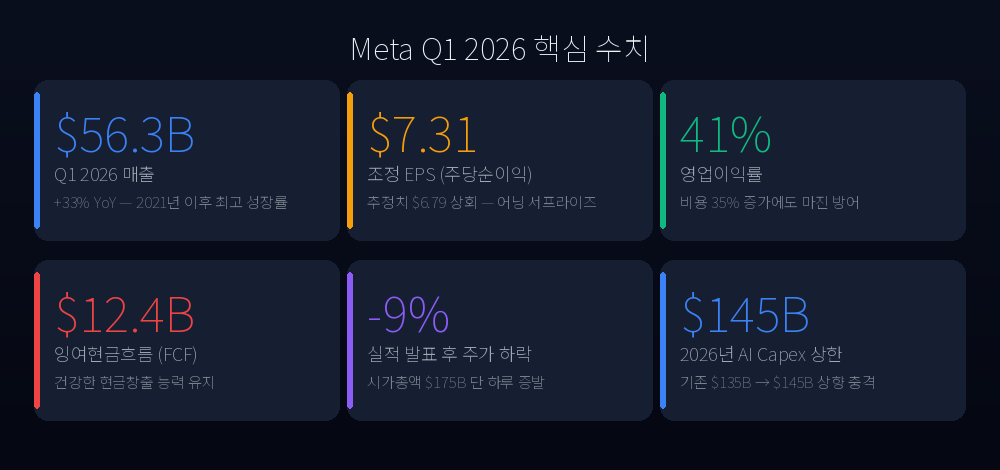
What moved the needle was the capex update: 2026 annual capex guidance raised to $125B–$145B, up from the prior range of $115B–$135B. The cited drivers were higher memory component pricing and additional data center construction. At the midpoint ($135B), this is roughly 2x the company’s estimated 2025 capex — and exceeds Meta’s projected annual free cash flow by nearly 3x.
The Zuckerberg quote: “We’re on track to deliver personal superintelligence to billions of people.” Visionary. But markets want a monetization timeline, not a manifesto.
What Changed, and What Didn’t
The capex hike is not a surprise in direction — only in magnitude. The $10B raise above the prior ceiling was the specific irritant. Here is what actually changed versus what the market feared changed:
What changed:
- 2026 capex ceiling: $135B → $145B (+$10B)
- Reason: Memory pricing (HBM, HBM3E costs rising as AI demand spikes) + additional data center footprint for “future-year capacity”
- Horizon Worlds VR confirmed shutdown on June 15 — $80B in cumulative Reality Labs losses officially written off
- New product: Muse Spark, Meta’s first proprietary LLM (replacing open-source Llama strategy). Planned paid API access for third-party developers
What didn’t change:
- Core advertising business trajectory: 33% growth, 41% margins
- User engagement metrics: strong (specific DAU/MAU data pending full filing)
- Capital allocation strategy: Zuckerberg remains convicted on the “personal superintelligence” thesis
The $175B single-day market cap loss is disproportionate to a $10B capex guidance raise — even on a discounted cash flow basis.
The Metaverse Parallel Is Overblown — But Not Entirely Wrong
The bear case comparison to the 2021–2024 metaverse spending cycle is the consensus narrative, and it deserves honest engagement.
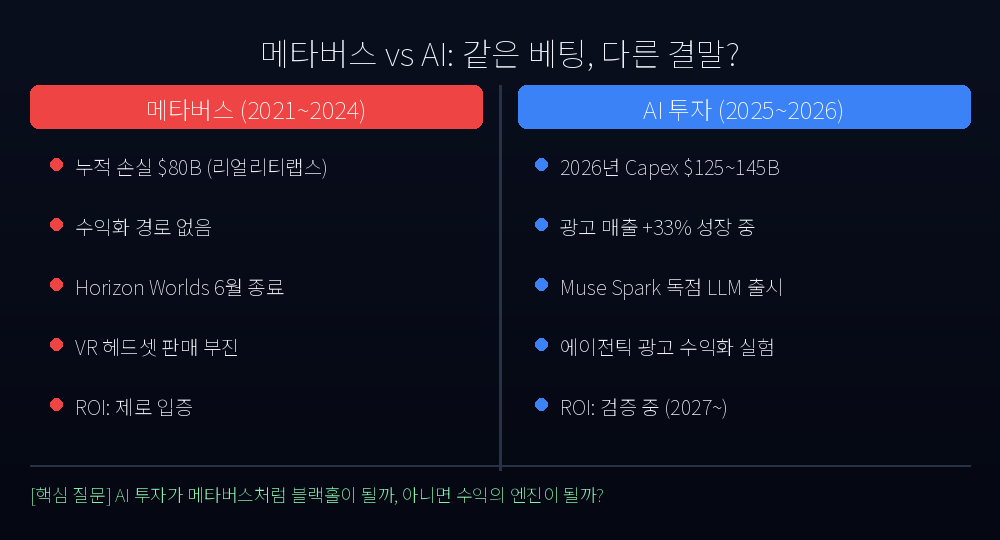
Where the parallel holds: Reality Labs burned $80B with zero identified revenue pathway at announcement. Zuckerberg made confident proclamations about VR being the next computing platform. It wasn’t. Investors who gave the benefit of the doubt on the metaverse thesis from 2021–2022 saw the stock drop 75% peak-to-trough.
Where the parallel breaks down: The current AI investment has an already-functioning feedback loop. AI-optimized ad targeting has already lifted ad impression volumes and CPMs. Reels monetization, which was cited as behind schedule in 2022–2023, now contributes meaningfully. The revenue machine is not broken while the new bet is being made — that is a fundamentally different risk profile than the metaverse era.
Muse Spark’s commercialization path (API licensing, enterprise AI tools) is at least coherent in a way that Horizon Worlds never was. “Agentic advertising” — where AI agents autonomously recommend and execute purchases on behalf of users — is Meta’s attempt to move beyond impression-based revenue. The ROI timeline is 2027 at the earliest, but the theoretical pathway exists.
Everyone Is Spending — Meta Is Not the Outlier
Meta is not an outlier. Across the Big Tech Q1 2026 earnings cycle:
- Alphabet: Strong results, significant AI infrastructure capex increase
- Apple: EPS +21.8% YoY, stock up 3.2% — differentiated by asset-light AI integration
- Qualcomm: +16% on the session after Q2 beat — AI at the edge is inflecting
- FOMC backdrop: Fed held at 3.50–3.75% on April 29, with 4 dissenting votes — most since 1992. 10-year yields at 4.39%. Rate cut probability for 2026 is near zero per Fed Funds futures.
The macro environment penalizes long-duration assets. Meta’s AI capex is a multi-year commitment, and with the risk-free rate at 4.39%, the discount rate applied to those future cash flows is not kind. This is the structural headwind that makes capex announcements so punishing right now — it’s not just about the number, it’s about the rate context.
Overweight on 12–18 Months, Cautious Right Now
The selloff priced in a scenario that hasn’t occurred: that Meta’s core business is impaired, that AI spending is burning cash without offsetting growth, and that management has lost financial discipline. None of those are true as of Q1 2026 data.
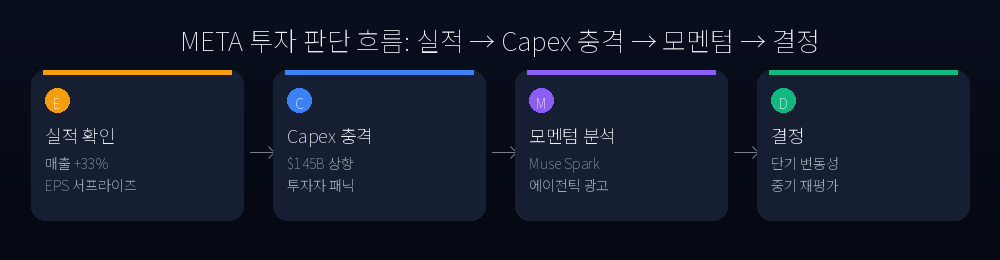
Where I’m positioned:
| Time Horizon | Stance | Trigger |
|---|---|---|
| 0–3 months | Neutral | Capex overhang persists. May 12 CPI and June 16–17 FOMC are the next macro catalysts |
| 3–12 months | Accumulate on weakness | Watch for Q2 2026 earnings (~late July) — Muse Spark API early data, ad revenue acceleration |
| 12–18 months | Overweight | 41% margins + AI advertising uplift + potential Muse Spark API revenue = re-rating catalyst |
Key risks to this thesis:
- Memory prices stay elevated longer than expected, pushing capex toward the $145B ceiling
- Muse Spark fails to gain API traction (the enterprise AI market is crowded: Anthropic, OpenAI, Google)
- A second “metaverse moment” where Zuckerberg pivots again, destroying credibility
The base case: Meta is not a broken compounder. It is a 41%-margin business being penalized for investing aggressively at the worst possible time in the rate cycle. When rates come down — or when Muse Spark shows its first revenue contribution — the multiple will expand.
The current price around $606 (post-selloff) may offer the entry point that Q1 earnings denied at the prior highs.
This analysis is for informational purposes only and does not constitute investment advice. All investment decisions should be made based on your own due diligence and risk tolerance.