
TL;DR
- Beat on all fronts: Revenue $10.25B (+38% YoY), EPS $1.37 vs $1.28 expected, data center +57%
- Guidance matters more: Q2 midpoint $11.2B vs $10.52B consensus — the market priced in continuation, not a peak
- Structural shift: Four of the top hyperscalers are now running AMD silicon. This is not a trial; it’s production deployment
The Numbers You Need to Know
AMD reported Q1 2026 results that beat on every line item that matters. Revenue came in at $10.25B against analyst expectations of $9.89B. Non-GAAP EPS of $1.37 beat the $1.28 consensus by 7%. The stock opened +16% the following day.
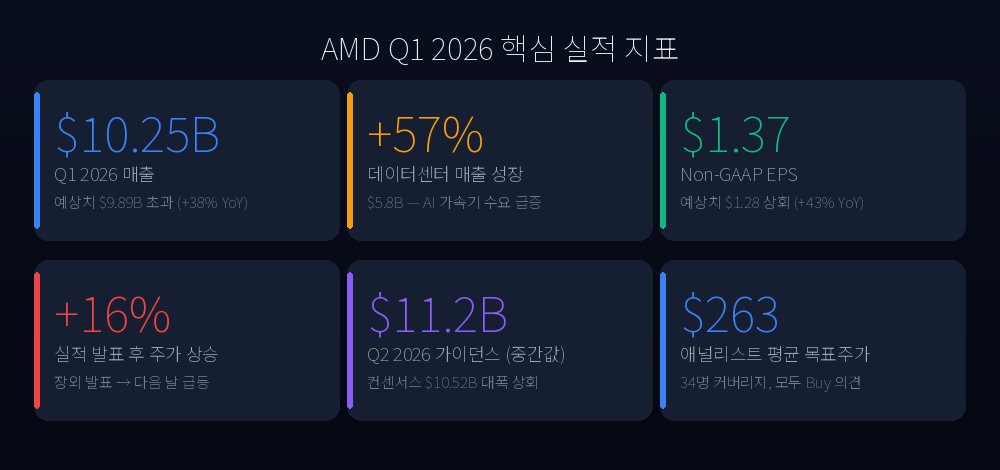
But the single most important data point was the Q2 2026 guidance: $10.9B–$11.5B, or approximately $11.2B at the midpoint. The Street was sitting at $10.52B. A beat of roughly $700M on forward guidance tells you something: AMD’s pipeline is not decelerating. The data center backlog is real and growing.
Data center revenue reached $5.8B in Q1, up 57% year over year. For context, that is a business segment growing at a rate that most standalone semiconductor companies would consider exceptional — and it is only one part of AMD’s portfolio. Server CPU market growth is projected to exceed 35% this year, and AMD management has publicly stated a target of reaching a 1:1 CPU market share ratio relative to its competition.
What Actually Changed in the AI Accelerator Market
Nvidia retains approximately 80% of the AI accelerator market, largely fortified by the CUDA software moat. That moat is real. Developers build on CUDA; switching costs exist. What changed is that hyperscalers have sufficient scale to absorb those switching costs and sufficient motivation to diversify their supply chains.
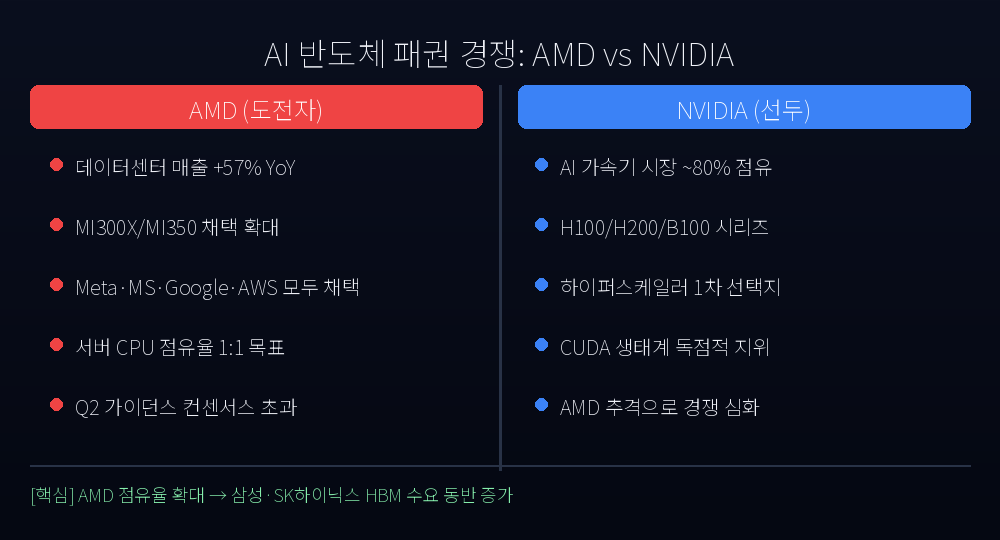
Meta, Microsoft, Google, and Amazon have all deployed AMD’s MI300X and are in qualification pipelines for the MI350 series. This is not preliminary testing. These are production-grade deployments in live inference and training clusters. The MI350, based on the CDNA 4 architecture, is expected to ship into hyperscaler pods in H2 2026 with meaningfully improved performance-per-watt relative to MI300X. When four of the world’s largest compute buyers simultaneously run non-Nvidia silicon in production, the narrative of “CUDA lock-in is impenetrable” becomes harder to sustain.
AMD’s data center segment has now printed year-over-year growth north of 50% in Q1 2026, following a period of sequential acceleration that began when the MI300X entered hyperscaler qualification in 2025. The pattern is not a single-quarter channel-fill event. This is a supply ramp matching genuine hyperscaler demand that is becoming visible in AMD’s P&L on a recurring basis.
The FOMC context is also worth noting. The Fed held rates at 3.50%–3.75% for the third consecutive meeting at its April 28–29 meeting, with futures markets pricing less than a 10% chance of movement in June. For growth-multiple stocks like AMD, a stable-to-declining rate environment compresses the discount rate applied to future earnings streams. It does not create the earnings — AMD’s operations do that — but it does mean the multiple on those earnings is not under compression pressure.
Samsung and SK Hynix Are the Quiet Beneficiaries Nobody Is Pricing In
The component underneath AMD’s AI accelerator growth that receives insufficient attention is HBM — High Bandwidth Memory. The MI300X and MI350 series require substantial HBM3 and HBM3E volumes per unit. The primary suppliers of this memory are Samsung Electronics and SK Hynix.
AMD data center revenue growing 57% year over year means AMD is producing more accelerators, which means more HBM demand. SK Hynix has been the more aggressive mover in HBM supply to AI customers. Samsung, which has faced qualification hurdles in Nvidia-facing HBM supply, has a clearer path with AMD. The structural demand pull from AMD’s accelerator ramp provides a multi-quarter tailwind for both Korean memory suppliers.
This connection — AMD → HBM → Samsung/SK Hynix — is one reason the Korean KOSPI semiconductor complex tends to move in sympathy with AMD earnings beats. EWY (the iShares MSCI South Korea ETF) holds Samsung at roughly 25% and SK Hynix at approximately 20%. It functionally operates as a Korea-adjusted proxy for the AI memory supply chain.
My Verdict: Overweight AMD, Remain Long Semiconductor Cycle
My read on this report is straightforward. AMD is executing a multi-year share capture in data center compute, and the trajectory is not plateauing. The combination of hyperscaler diversification intent, a competitive product in MI300X/MI350, and HBM supply chain leverage creates durable revenue growth above what the original consensus model assumed.
Positioning:
-
AMD direct: Constructive, but the +16% single-day move has absorbed a meaningful portion of the near-term beat. Entry at this level should be sized for a 6–12 month hold horizon with the MI350 ramp as the next catalyst in H2 2026. Average analyst target is $263; current price after the move implies single-digit upside to consensus, but the forward guide implies consensus will move higher.
-
Semiconductor ETF exposure (SOXL, SMH): AMD’s weighting in the Philadelphia Semiconductor Index is material. A 57% YoY data center beat from AMD, combined with ongoing NVDA strength and the Micron halo effect (MU also printed record highs this week), supports continued semiconductor sector outperformance. SOXL (3x leveraged) amplifies this but requires active risk management given its decay profile in sideways markets.
-
Korean memory (Samsung, SK Hynix via EWY): Maintain exposure. The structural HBM demand thesis is intact and AMD earnings reinforce it. Samsung’s path to clearing HBM qualification with AMD could be a incremental catalyst for Samsung specifically.
Risks to monitor:
- Macro: Oil-driven inflation keeps the Fed on hold longer, compressing growth multiples
- Execution: MI350 qualification delays at any hyperscaler would push revenue guidance lower in Q3
- NVDA competitive response: Blackwell series continues to set performance benchmarks; AMD needs to prove MI350 closes the gap in real workloads
The data as of this report supports staying long the AI semiconductor cycle with AMD as one of the cleaner expressions of hyperscaler diversification demand.
This post is for informational purposes only and does not constitute investment advice. All investment decisions carry risk. Past performance is not indicative of future results.