
TL;DR
- Blowout Quarter: AMD posted $10.25B revenue (+38% YoY), $5.78B in data center (+57% YoY), EPS $1.37 vs $1.30 estimate. Stock surged 18–19% to an all-time high near $420.
- Q2 Guide: $11.2B (+46% YoY, +9% QoQ) — another beat before the quarter even starts.
- The Structural Shift: AMD is eating Nvidia’s lunch in AI inference workloads, and Meta’s 6GW deal proves this isn’t a one-off.
- Supply Chain: SK Hynix HBM3E powers every MI300X shipped. AMD growth = SK Hynix order flow.
Numbers That Warrant a Second Look
AMD’s Q1 2026 print wasn’t just a beat — it was an acceleration in every metric that matters.
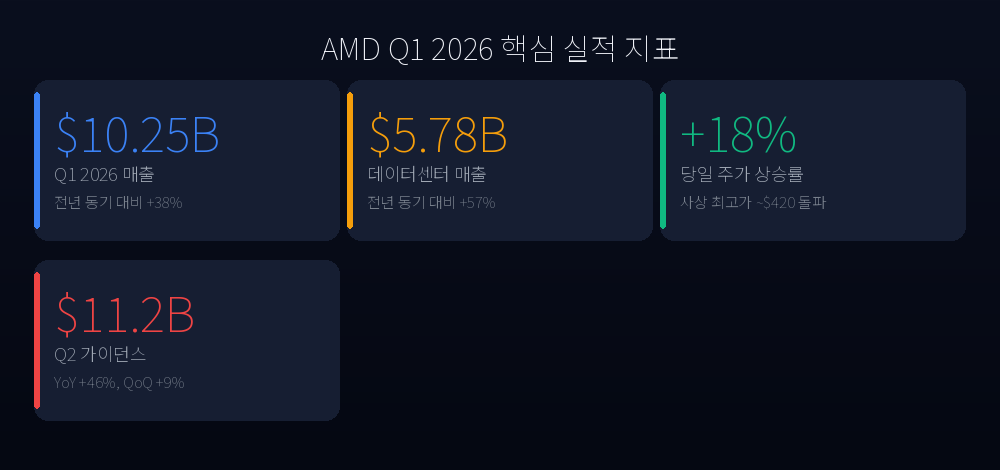
| Metric | Actual | Consensus | Beat |
|---|---|---|---|
| Revenue | $10.25B | ~$9.9B | +3.5% |
| Non-GAAP EPS | $1.37 | $1.30 | +5.4% |
| Data Center | $5.78B | ~$5.4B | +7.0% |
| Gross Margin | 55% | ~54% | +1pp |
| Q2 Guidance | $11.2B | ~$10.8B | +3.7% |
This is the third consecutive quarter AMD has raised guidance materially above the prior bar. Companies that do this aren’t riding luck — they’re sitting on structural demand that their own forecasters initially underestimate.
Context from the broader earnings season: 84% of S&P 500 Q1 reporters beat EPS estimates, with a blended growth rate of 15.1% vs the 5-year average of 7.3%. AMD is the top performer within an already strong cohort.
Inference Is the New Battleground — Here’s What Shifted
The conventional narrative is that Nvidia owns AI chips and AMD is a distant second. That’s still broadly true for training workloads, where Nvidia’s H100/H200 ecosystem lock-in is near-total.
But the competitive dynamic has shifted in inference — the workloads that power live AI services at scale. When you query ChatGPT, Claude, or Meta AI, that’s inference. As AI moves from R&D to production deployment, inference workloads grow faster than training, and the economics differ sharply: cost per query matters more than raw FLOPS.
AMD’s MI300X delivers comparable inference throughput to the H100 at lower per-unit cost and power draw. Meta, Microsoft, and Google are all deploying MI300X at scale as a Nvidia complement, not a replacement — but the mix is shifting.
Meta’s multiyear deal committing up to 6GW of AMD GPU capacity for AI data centers is the strongest signal yet. At $0.8–1.2B/GW in GPU capex terms, this is a $5–7B revenue commitment over multiple years. It changes AMD’s revenue visibility from “quarter to quarter” to “structural.”
The Competitive Picture
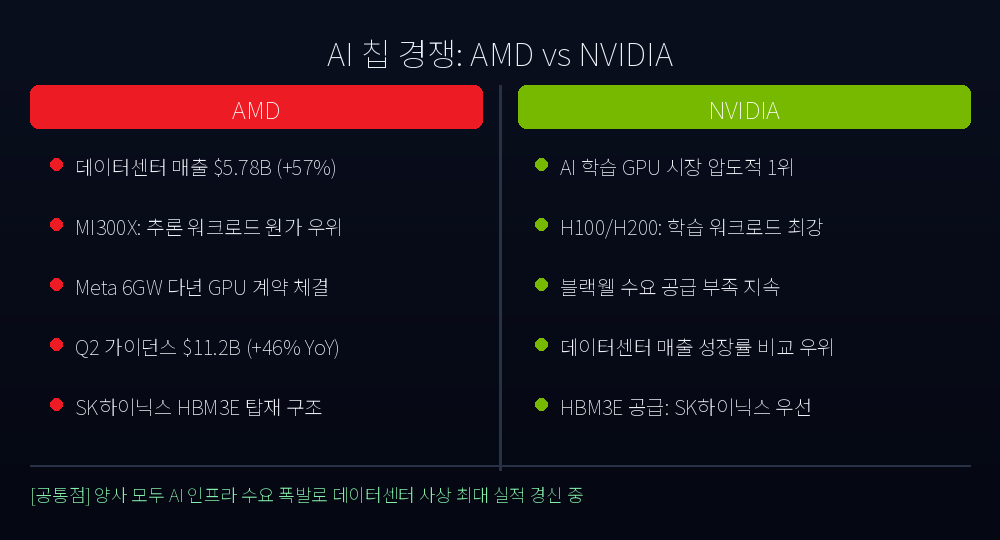
AMD is not threatening Nvidia’s training dominance in the near term. Nvidia’s CUDA ecosystem, software stack, and H200/Blackwell supply ramp give it a fortress position in model development infrastructure.
Where AMD wins: cost-sensitive inference at scale. Large-scale consumer AI services (recommendation engines, content moderation, real-time translation) run inference 24/7. At these volumes, a 20–30% cost advantage per query compounds dramatically into opex savings.
The upcoming MI350, due H2 2026, will feature HBM4 and is expected to deliver ~30% performance improvement over MI300X. If AMD secures Samsung’s HBM4 for MI350 supply (alongside SK Hynix), it will simultaneously reduce supply concentration risk and benefit both Korean memory players.
Key Nvidia risk to watch: Blackwell B200 supply normalization. If Nvidia clears its current backlog and floods the inference market with B200s, AMD’s cost advantage narrows. The pricing pressure could compress AMD’s data center margins below the current 55% gross margin level.
The SK Hynix Supply Chain Angle
This is the part most US-focused analysts miss.
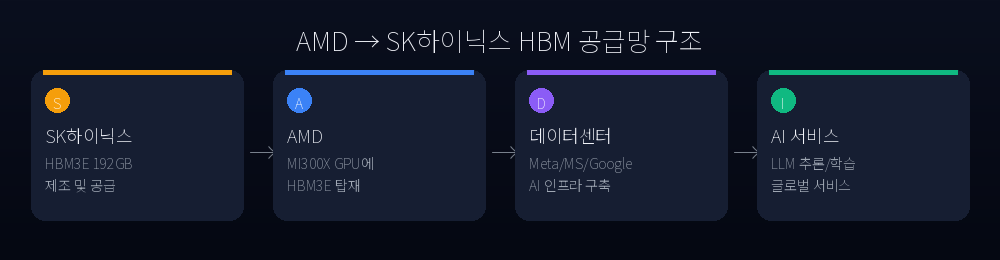
Every AMD MI300X GPU shipped contains SK Hynix HBM3E (192GB, 8-high stack). AMD’s 57% data center revenue growth in Q1 2026 translates into proportional HBM order growth for SK Hynix. The relationship is not just commercial — it’s architectural. MI300X was co-engineered with SK Hynix’s HBM3E spec.
Samsung is actively pursuing HBM4 certification for AMD’s MI350. Samsung began HBM4 mass production in February 2026 — the first vendor to do so globally. If certified for MI350, Samsung diversifies AMD’s memory supply chain and adds a second beneficiary among Korean semiconductor players.
From a portfolio standpoint: AMD earnings calls are now de facto earnings signals for SK Hynix. Investors watching Korean semiconductor names should be modeling AMD’s data center trajectory, not just Nvidia’s.
My Verdict: Overweight on Dips, Not at Today’s Price
AMD closed near $420, pricing in approximately 35x forward earnings based on Q2 guidance run-rate. Nvidia trades at ~40x — so AMD carries a relative discount, but neither is cheap in absolute terms.
Stance: Bullish on AMD’s 12-month structural thesis. Neutral on entry at current price.
The risk/reward math after an 18% single-session move argues for patience. Historical precedent for post-earnings gaps of this magnitude suggests a 5–15% mean-reversion pullback within 4–8 weeks is common, even when the fundamental thesis is intact. I would scale into AMD on weakness, targeting a $370–385 entry zone.
Catalysts to watch:
- Q2 2026 earnings (est. August): Will AMD actually deliver $11.2B? Any miss after guiding this high would be painful.
- MI350 launch + HBM4 supply confirmation (H2 2026): This determines the next leg of the data center story.
- US export control updates: AMD’s China data center revenue remains exposed. Any tightening hits the top line directly.
- Nvidia Blackwell ramp: Supply normalization could compress AMD’s inference pricing power.
For semiconductor ETF exposure (SOXL, SOXX, SMH), AMD’s performance this week broadly validates the AI infrastructure cycle thesis. The S&P 500 Q1 earnings season blended growth rate of 15.1% — nearly double the 5-year average — suggests the macro backdrop for semis remains constructive.
Positioning summary:
- AMD (direct): Scale in on pullback, $370–385 entry target, 12-month horizon.
- SK Hynix (KRX): Maintain overweight; AMD’s data center growth is a direct HBM order signal.
- SOXL: Reduce position after this week’s move; re-enter on 10%+ drawdown.
Disclaimer: This analysis is for informational purposes only and does not constitute investment advice or a solicitation to buy or sell any securities. All investment decisions should be made based on your own due diligence and risk tolerance. Past performance is not indicative of future results.