
TL;DR
- The US Commerce Department approved H200 chip sales to 10 Chinese tech firms — up to 75,000 chips each.
- Not one chip has actually shipped. Chinese companies pulled back after receiving guidance from Beijing.
- SK Hynix hit an all-time high of KRW 1.976M (+7.68%). The market is pricing the HBM supercycle, not China sales.
The Numbers That Matter
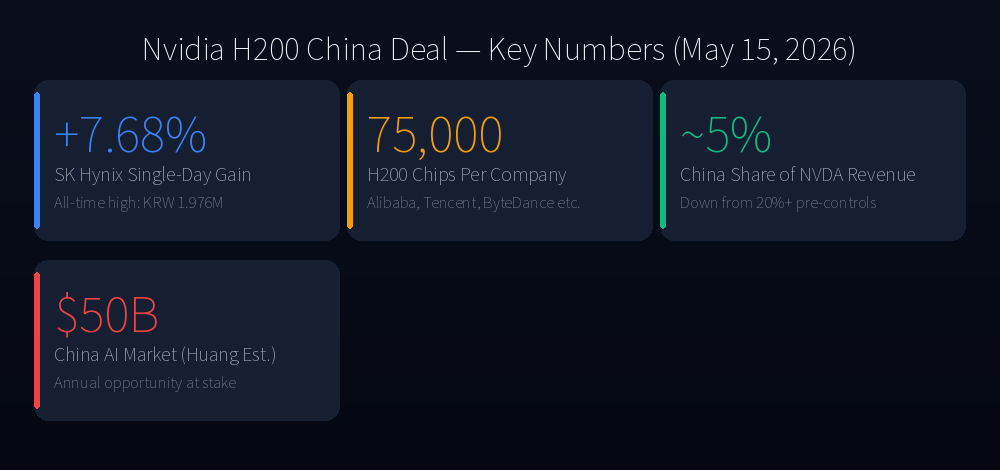
Before the narrative, the data:
- 10 Chinese firms approved to buy Nvidia H200 chips: Alibaba, Tencent, ByteDance, JD.com, plus Lenovo and Foxconn as distributors
- 75,000 chips per company maximum, subject to rigorous third-party verification
- 0 chips shipped as of May 15, 2026
- China’s share of Nvidia revenue: ~5% today, down from 20%+ before export controls
- Jensen Huang’s estimated China AI market size: $50 billion annually
- SK Hynix single-day move: +7.68%, intraday high of KRW 1.999M
The gap between the approval story and the shipment reality is the entire story.
What Actually Changed — and What Didn’t
Jensen Huang was initially left off Trump’s China delegation list. Trump saw the coverage, called Huang directly, and had him board Air Force One in Alaska. The optics: the highest-profile CEO of the AI era joining a geopolitical trade summit mid-flight.
The outcome: US Commerce formalized H200 export licenses for approximately 10 Chinese technology companies. The practical constraint — a cap of 75,000 units per buyer with mandatory third-party compliance auditing — was written into every approval.
What changed is the policy posture: H200 exports shifted from “presumption of denial” to “case-by-case approval” in January 2026, and this summit formalized the first actual approvals. What did not change: China’s incentive to buy. Beijing guided its domestic champions to hold off, prioritizing the Huawei Ascend chip ecosystem over reliance on US silicon.
The logic from Beijing is defensible. Supply chain sovereignty matters more than short-term AI compute access, especially when US export controls could tighten again at any political moment. The approved Chinese companies are not refusing out of principle — they are making a rational supply-chain risk calculation.
Result: approval on paper, no revenue on the income statement.
Why SK Hynix Hit an All-Time High Anyway
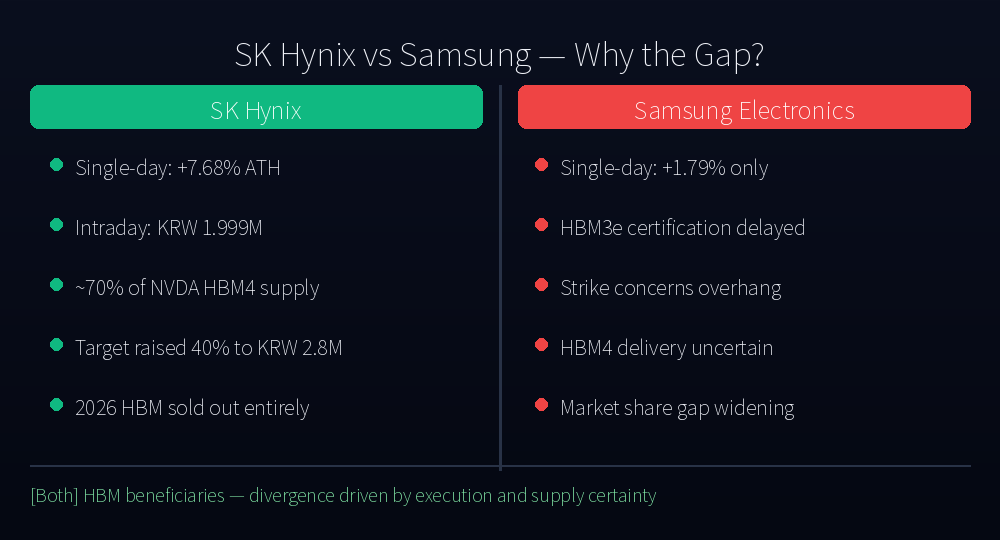
This is the more interesting market signal. Nvidia gained 2.3–3% on the day — expected. But SK Hynix surged 7.68% to an all-time closing high of KRW 1.976 million, briefly touching KRW 1.999 million intraday. Samsung Electronics, by comparison, gained only 1.79%.
The divergence is not random. It is structural.
SK Hynix supplies approximately 70% of Nvidia’s HBM4 demand. Its 2026 HBM production is entirely sold out — including for H100 and H200 derivatives as well as the Blackwell and Vera Rubin platforms. Whether China buys 750,000 H200s or zero, the orders flowing to SK Hynix do not shrink. If China does start buying, each H200 GPU requires 8 HBM3E dies, meaning 750,000 chips would require roughly 6 million additional HBM3E units — a demand event that would stress an already exhausted supply chain.
TrendForce data puts HBM3E price increases at approximately 20% for 2026, already baked into long-term supply agreements. The sell-side has responded: multiple brokers lifted SK Hynix targets to KRW 2.8 million — a 40% premium to current prices.
Samsung’s underperformance reflects two concrete overhangs: HBM3e certification for Nvidia remains delayed, and labor strike risks continue to create production uncertainty. The market is assigning a quality premium to execution clarity, and SK Hynix currently holds that premium unambiguously.
The HBM Supercycle Thesis — Does This Validate It?
The core argument for HBM supercycle bulls has always been that AI compute demand will outpace memory supply for a multi-year window. This week’s China news does not invalidate or confirm that thesis — it adds an option value on top of it.
The base case is already strong: Nvidia’s Blackwell architecture ships HBM3E, Vera Rubin will ship HBM4, and SK Hynix is sole or primary supplier for both. The marginal demand from China H200 exports is upside, not the thesis itself.
The structural risk that would break the supercycle thesis remains unchanged: an unexpected collapse in AI capex spending from hyperscalers (which showed no signs of slowing in Q1 2026 results across Meta, Google, Amazon, and Microsoft), or a faster-than-expected ramp of competing memory architectures from Samsung or Micron.
Neither is imminent. The supercycle has legs through at least 2027 on current data.
My Verdict / Positioning
SK Hynix: Overweight. The combination of sole-source HBM4 supply dominance, a sold-out 2026 production book, 20% price tailwinds, and the China upside option makes this the clearest trade in the semiconductor stack. The 40% gap to target (KRW 2.8M) is credible given the demand fundamentals. The main risk is a Samsung certification surprise that cuts into SK Hynix’s share — monitor quarterly.
Nvidia: Neutral-to-Bullish, but watch China execution. The stock is pricing approximately two-thirds of its pre-control China revenue returning over the next 12–18 months. If Chinese companies continue to hold off — which Beijing incentives suggest — that pricing assumption is too optimistic. I would wait for the first confirmed H200 shipments to China before adding here at current multiples.
Samsung Electronics: Watch. The HBM3e certification timeline is the single event that re-rates this stock. Positive surprise = meaningful catch-up rally. Delay continuation = continued underperformance vs. SK Hynix. Not a sell, but not a buy until that binary resolves.
The trade in one line: Long SK Hynix as the HBM infrastructure play, treat Nvidia China upside as a free option, and wait on Samsung for certification clarity.
Investment Disclaimer: This content is for informational purposes only and does not constitute investment advice or a solicitation to buy or sell any security. All investment decisions should be made based on your own due diligence and risk tolerance. Past performance does not guarantee future results.