TL;DR
- The Stat: CBRS raised $5.55B at $185/share, surged to $385 intraday on May 14, closed at $311 (+68%). Then fell 10% the next day alongside a broad chip selloff.
- The Tech: Cerebras’ Wafer Scale Engine (WSE) bets on one giant chip beating thousands of small GPUs — a direct architectural challenge to Nvidia’s H100/H200 clusters.
- My Verdict: Interesting technology. Unproven revenue model. I’m watching, not buying at current levels.
The Numbers That Matter
Cerebras priced at $185 — itself 37% above the initial $125–135 target range — after institutional demand ran more than 20x oversubscribed. This is not casual enthusiasm. This is structured capital allocation by funds that spent months in the diligence queue.
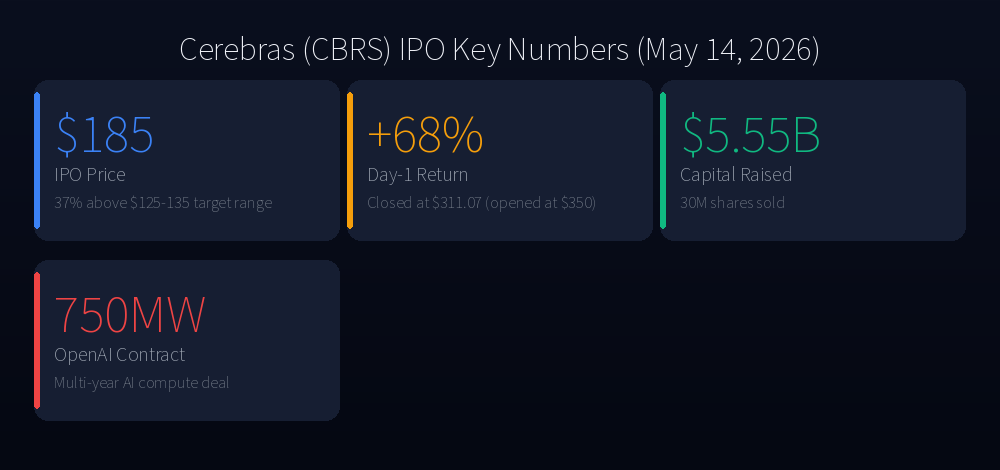
Day-one intraday high: $385. Day-one close: $311. Day-two close: ~$280 (down ~10%), dragged down by a broader tech selloff that sent the 10-year Treasury yield to 4.55% — its highest in a year — and hit Nvidia (-4.4%), AMD (-5.7%), and Micron (-6.6%) simultaneously.
Two data points worth noting for context:
First, Snowflake’s 2020 IPO surged 112% on day one, then spent the next 18 months retracing toward its IPO price before a multi-year recovery. IPO euphoria and fundamental value are two different conversations.
Second, $5.55B raised at a $26B market cap at IPO price implies a price-to-revenue multiple that only makes sense if Cerebras executes on a multi-year growth trajectory anchored by its OpenAI deal and future customer diversification.
What Cerebras Actually Built
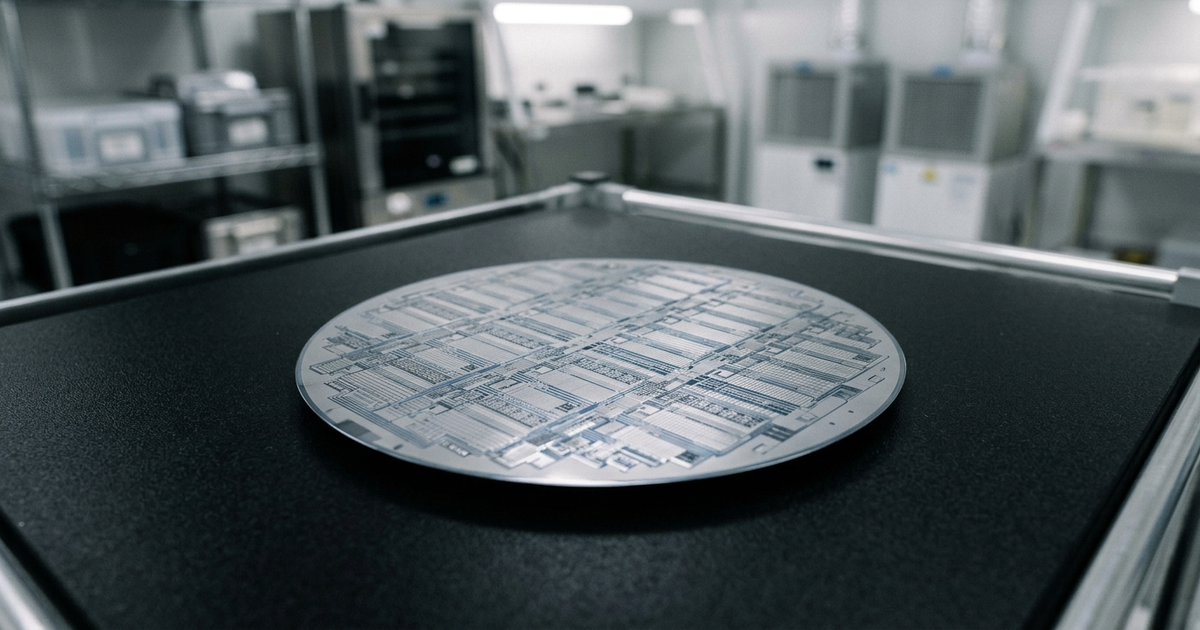
Nvidia’s architecture stacks hundreds of GPUs in parallel clusters. Data shuttles between chips constantly, creating latency. Cerebras took the opposite direction: put the entire compute and memory on one wafer-scale die — 56x the area of a standard GPU.
The result is a chip optimized for AI inference (running trained models, generating outputs), where Cerebras claims material speed and cost advantages over GPU clusters at equivalent tasks.
The anchor customer validating this claim: OpenAI, which signed a multi-year deal worth 750 megawatts of AI compute capacity — one of the largest AI infrastructure contracts ever publicly disclosed. Amazon (AWS) is also a partner.
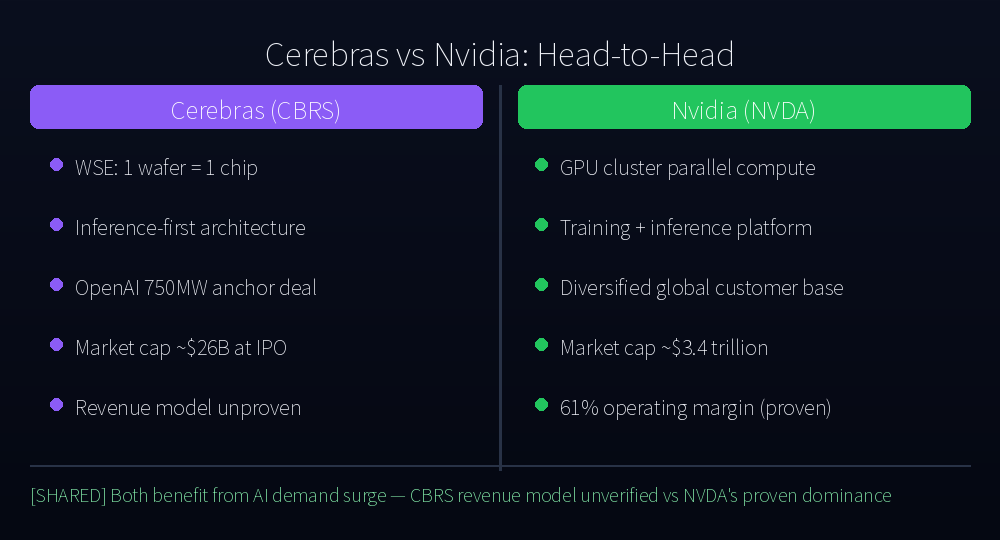
The competitive framing in sell-side coverage — “Nvidia killer” — is sensational but misleading. Nvidia dominates AI training workloads (H100, B200) and is increasingly competitive in inference. Cerebras is inference-specialized. The addressable market for AI inference is large and growing, but Nvidia is not standing still. Jensen Huang’s company has its own inference optimization stack (TensorRT, NIM microservices) that continues to close the gap.
Valuation Reality Check
At $311 day-one close, Cerebras traded at a market cap of approximately $34 billion. At $185 IPO price, $26 billion. Compare this to Nvidia at $3.4 trillion.
The relevant benchmark is not Nvidia’s absolute size but Nvidia’s revenue multiple. Nvidia trades at roughly 28x forward revenue (FY2027 consensus ~$120B). If Cerebras is expected to generate $2B in revenue within two years — which would be aggressive — $26B at IPO implies a 13x forward revenue multiple. Not insane for a high-growth AI hardware company, but it requires execution.
The profitability question is the bigger one. Nvidia posted 61% operating margins in Q4 FY2026. Cerebras has not disclosed comparable profitability metrics publicly. Hardware companies with concentrated revenue (high dependence on one or two customers like OpenAI) carry revenue concentration risk that deserves a valuation discount.
The 750MW OpenAI contract is real. But OpenAI is simultaneously investing in its own inference infrastructure and has a well-documented relationship with Microsoft Azure. Contract longevity is not guaranteed.
My Verdict: Watch, Not Buy at These Levels
The technology is architecturally interesting. The market timing is real — AI inference demand is exploding, and hyperscalers are actively seeking alternatives to full Nvidia dependency. Cerebras occupies a genuine niche.
But at $311 (day-one close), the risk/reward calculus does not favor aggressive entry for institutional-style positioning:
- The IPO premium is priced in. Early institutional allocants made 68% on paper in one day. Late retail buyers bear the full valuation risk.
- Revenue concentration in OpenAI creates a single-point-of-failure narrative that will suppress the multiple until diversification is demonstrated.
- The 10% day-two decline, while partly macro-driven, confirms price discovery is still ongoing.
My stance: Watch for two to three quarters of disclosed financials. If Cerebras posts gross margins above 40% and demonstrates customer diversification beyond OpenAI, the case for a position strengthens materially. Until then, Nvidia remains the higher-conviction AI semiconductor trade with a proven moat.
Traders looking for near-term exposure to the Cerebras narrative without direct single-stock risk might consider broad AI infrastructure ETFs (e.g., BOTZ, AIQ) that can add CBRS exposure after index inclusion.
Actionable Takeaway
Do not chase the IPO pop. The structural AI inference thesis is valid, but CBRS needs to prove it can monetize that thesis at scale. Monitor the next earnings report (likely Q3 2026) for gross margin trajectory and customer concentration data. Set a price alert in the $220–240 range — a level that would imply a modest re-rating toward fundamentals — before reassessing.
Disclaimer: This article is for informational purposes only and does not constitute investment advice or a recommendation to buy or sell any security. Investing involves risk, including the potential loss of principal. Past performance is not indicative of future results. Please consult a qualified financial advisor before making investment decisions.