TL;DR
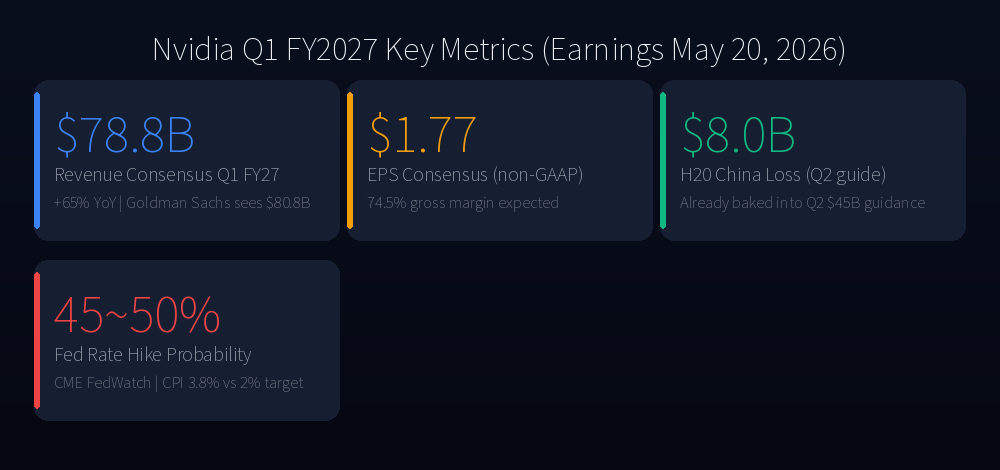
- The Print: Nvidia Q1 FY2027 results after bell on May 20. Consensus: $78.8B revenue (+65% YoY), $1.77 EPS non-GAAP, ~74.5% gross margin.
- The Wild Card: Kevin Warsh’s Fed has lifted rate-hike probability to 45–50% (CME FedWatch). CPI sits at 3.8%. The macro headwind is real.
- My Verdict: Beat is likely. But the tape reaction depends more on forward guidance and China commentary than the headline number.
The Numbers Wall Street is Watching
Goldman Sachs is modeling $80.8B in revenue — a $2B beat above consensus — with a Q2 guide of $87.7B. That would put Nvidia at a quarterly run rate exceeding $350B annualized, a figure that would have seemed absurd three years ago.
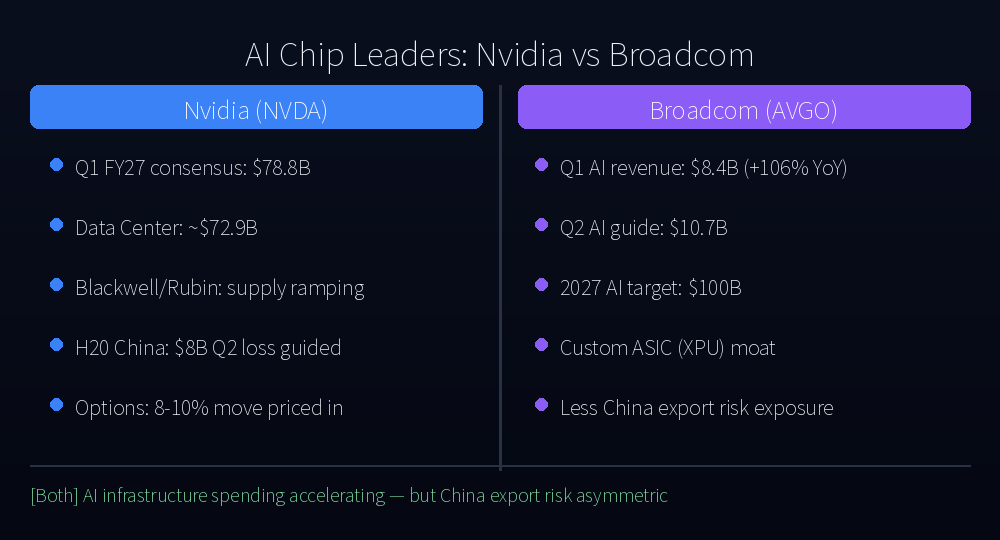
Data center is the engine. Consensus sits near $72.9B for the segment alone, with compute ($60.5B) dwarfing networking ($12.4B). The first full quarter of Blackwell shipments at scale is the story here. Supply constraints are said to be easing. If Jensen Huang confirms that on the call, that’s a green light for gross margin guidance recovery — which matters more to the stock than the headline beat.
What Changed Since Last Quarter
Two things flipped between Q4 FY2026 and now.
H20 charge impact is now fully disclosed. Last quarter, Nvidia took a $4.5B inventory write-down on H20 chips tied to U.S. export licensing requirements for China, collapsing gross margin from ~73% to 61%. The company already guided Q2 with an estimated $8B H20 revenue loss baked in. That’s not a new surprise — it’s a known number. The question is whether the floor is now set, or whether further China export restrictions are in the pipeline.
Warsh-era Fed risk didn’t exist last quarter. When Nvidia reported Q4 FY2026 in February, the Fed consensus was neutral-to-dovish. That’s changed. Kevin Warsh, who resigned from the Fed board in 2011 over disagreement with QE2, has taken the chair. Rate hike probability for 2026 sits at 45–50%. The 10-year yield is at 4.5% — its highest since June 2025. This is the macro variable that can override any earnings beat.
The Broadcom Comparison
Broadcom reported AI revenue of $8.4B in Q1, up 106% year-over-year, with Q2 AI guidance of $10.7B. Management has a long-range target of $100B in AI-related sales by fiscal 2027.
Broadcom’s XPU (custom ASIC) business is where the comparison matters. If hyperscalers accelerate their push toward custom silicon to reduce Nvidia dependency, Broadcom is the primary beneficiary. This isn’t a near-term threat to Nvidia’s data center dominance — the ecosystem lock-in via CUDA remains formidable — but it does compress the multiple over a 12–18 month horizon.
The China Variable — Most Asymmetric Risk
The base case is simple: $8B H20 loss is guided and priced in. If that’s the floor, gross margins recover to 74.5% and the stock holds.
The upside case: If there’s a diplomatic signal — even informal — that H20 export waivers are under discussion in U.S.-China trade talks, that $8B loss reverses into a surprise catalyst. Given the improving tone in bilateral discussions since April, this is a low-probability but high-impact scenario worth tracking.
The downside case: If Nvidia indicates that additional export controls are being considered for other China-facing products beyond H20, the forward guidance could disappoint even if Q1 beats.
On the conference call, listen for three phrases: “H20 demand return,” “Blackwell China-compliant variant,” and “gross margin recovery trajectory.” Those three answers will tell you more than the EPS headline.
My Verdict — Positioning Ahead of the Print
The earnings beat is likely. The real question is whether the tape can hold the gains.
Here is how I am positioning:
Scenario A — Beat + Strong Guide (50% probability): Revenue above $80B, Q2 guidance above $85B, and Huang’s commentary on Blackwell supply confirms no further bottlenecks. Stock moves +8% to +12%. Semiconductor supply chain names (SK Hynix, TSMC) gap up in Asian session.
Scenario B — Beat + Soft Guide (30% probability): Q1 numbers beat but Q2 guide comes in at or below consensus, or China commentary is cautious. Stock moves flat to -5%. Already a partial miss at current premium valuation (~40x forward earnings).
Scenario C — Beat + Fed Interference (20% probability): Q1 beats but Warsh Fed delivers an unexpected hawkish signal in the same 48-hour window. Growth multiple compression outweighs the earnings beat. This is the tail risk.
Given the options market pricing 8–10% move and an already-elevated stock (up ~20% in the past month), I am not adding exposure before the print. My base case is to size-up on any post-earnings dip in the $220–$225 range if guide is solid, accepting that near-term volatility is the entry price.
For triple-exposure instruments (3x ETFs): this is not the session to swing-trade. The asymmetric volatility at 3x amplification means a 10% Nvidia miss translates directly into a portfolio-damaging event.
Disclaimer: This article is for informational purposes only and does not constitute investment advice, a solicitation, or a recommendation to buy or sell any security. All investments involve risk, including possible loss of principal. Readers should conduct their own due diligence before making any investment decisions.