TL;DR
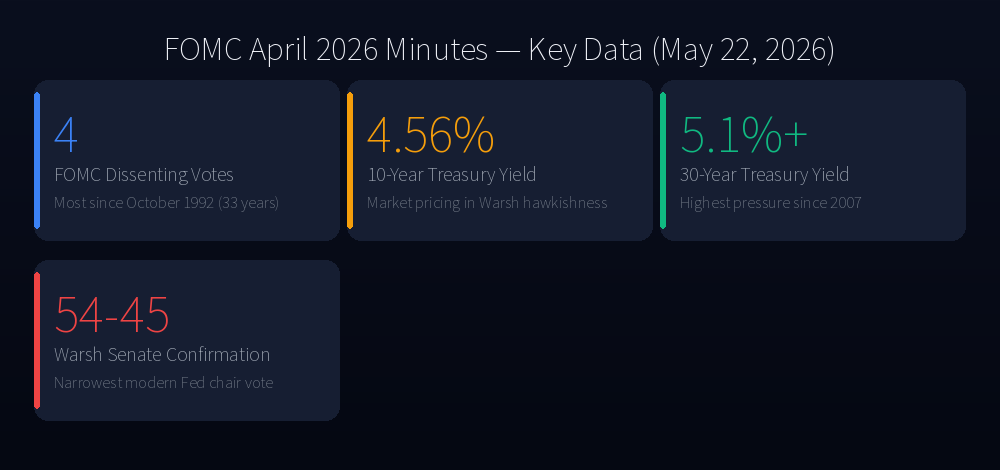
- 4 dissents in April FOMC — most since October 1992 (33 years).
- Split camp: 3 hawks opposed the easing bias; 1 dove (Miran) pushed for immediate cuts.
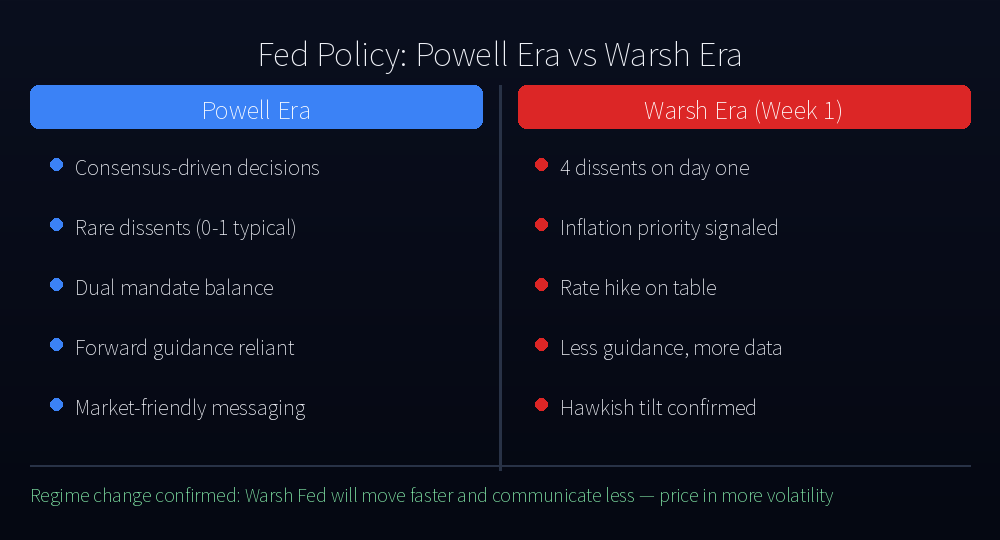
- Warsh era Fed will be less communicative, more data-reactive — and a rate hike is on the table.
- 10-year Treasury at 4.56%, 30-year above 5.1%. The bond market is already speaking.
The Number That Breaks 33 Years of Precedent
The April FOMC minutes, released today (May 22, 2026), contain a number the market should not ignore: 4 dissenting votes.
To put that in context, the last time four members simultaneously dissented from an FOMC decision was October 1992 — before the internet, before the euro, before three generations of smartphones. Typical FOMC decisions produce zero or one dissent. Four is institutional alarm.
The meeting itself was chaired by Jerome Powell for the last time. Kevin Warsh was confirmed as the 17th Fed Chair on May 15 in a 54-45 Senate vote — the narrowest confirmation in modern history. The minutes released today are effectively the transition document between eras.
Anatomy of the Dissent: Hawks vs. Dove
The four votes broke in opposite directions, which matters for how you interpret the signal.
Three Hawks: Against the Easing Bias
Three Fed governors voted against language in the statement that implied a future willingness to cut rates. Their read: with Iran-driven oil above $108 and core inflation still sticky, even the suggestion of future easing sends the wrong signal. This is not “we want rates higher now.” It is “stop telegraphing cuts when inflation is unresolved.”
One Dove: Miran Wants Cuts Now
Stephen Miran, the sole dissident from the other direction, argued the opposite. Labor market softness and weakening consumer demand justify an immediate cut. His dissent reflects the employment side of the dual mandate — the half that Warsh has signaled he is willing to subordinate to inflation control.
The divergence matters: this is not a monolithic Fed shifting hawkish. It is a Fed where four out of twelve members are pulling in different directions simultaneously. That is not consensus — it is dysfunction, and dysfunction generates volatility.
What Warsh Changes About Fed Communication
Under Powell, the Fed operated on a “speak early, speak often” doctrine. Forward guidance was the primary policy tool — markets were rarely surprised by actual decisions because they were telegraphed weeks in advance.
Warsh has stated clearly that he considers this approach a form of market dependency. His philosophy, consistent with his dissenting views during the 2008 crisis, is that the Fed should remain unpredictable and data-driven. Less guidance, faster moves.
Three key implications for portfolio positioning:
- Volatility will be structural, not episodic. Without advance warning of policy shifts, VIX will spend more time elevated. Options pricing for rate-sensitive equities needs a reset.
- The bond market becomes the primary signal. Warsh’s Fed will not explain its moves in advance. Treasury yields will lead, not confirm.
- Growth equity multiples face persistent compression. The risk-free rate at 4.56% and potentially climbing is a ceiling on how high long-duration equities can be valued.
The Rate Hike Case Is Not Hypothetical
Let me be direct: the market is now pricing a non-trivial probability of a rate hike in 2026 H2.
The Iran conflict has pushed oil to $108/barrel. Warsh’s inaugural week revealed a Fed that leans hawkish at the margin. The three dissenting votes in the minutes were not outliers — they represent the institutional direction Warsh is building toward.
The transmission mechanism for equity investors is straightforward:
- Rate hike → 10-year Treasury breaks 5% → discount rates reprice growth stocks lower
- Stronger dollar → international earnings compressed for US multinationals
- Consumer credit costs rise → discretionary spending contracts → earnings revisions follow
The June FOMC is the next decision point. Between now and then, watch:
- Core PCE data (May release)
- Oil price direction (Hormuz Strait developments)
- Warsh’s first formal speech as Chair
My Verdict: Position for Regime Change, Not a One-Time Shock
The consensus trade coming into 2026 was: rate cuts in H2, tech multiple expansion, Mag 7 re-rating higher. The April minutes, combined with the Warsh appointment and Iran inflation, are forcing a re-evaluation of that thesis.
My positioning view:
Underweight: Long-duration growth equities and 3x tech ETFs (TQQQ, SOXL). The volatility-drag risk in a rate-hike environment is not adequately priced.
Neutral with stop: Nasdaq (QQQ). The NVIDIA earnings beat provides near-term support, but if 10-year Treasuries break 4.75%, reduce exposure.
Overweight: Short-duration bonds (T-bills, 2-year), USD cash positions, and defensive quality (dividend growers, financials benefiting from a steeper yield curve).
Watch: Oil and energy sector. If the Warsh Fed fails to contain inflation via rates, oil-linked inflation becomes self-reinforcing — energy becomes the structural hedge.
The Fed just fractured in public. The correct response is not to panic out of equities. It is to stress-test your portfolio against a scenario that was previously assigned 5% probability and is now realistically 25-30%.
Actionable Checklist
Three things to do before the June FOMC:
- Reduce 3x ETF concentration. TQQQ, SOXL, NVDL — if these exceed 15% of your portfolio, trim to 10% or below. A 25bp rate hike wipes more than its magnitude from these vehicles via daily rebalancing.
- Reassess duration in bond holdings. 30-year Treasuries at 5.1% sound attractive but are deeply vulnerable to a further rate hike. Consider rotating to the 2-year and shorter end of the curve.
- Calendar the June FOMC. The first vote under Warsh’s actual leadership (not just his transition) sets the baseline for H2 2026. Position before the meeting, not after.
Disclaimer: This post is market analysis for informational purposes only. Nothing in this article constitutes investment advice or a recommendation to buy or sell any security. All investments carry risk of loss. Past performance does not guarantee future results.