TL;DR
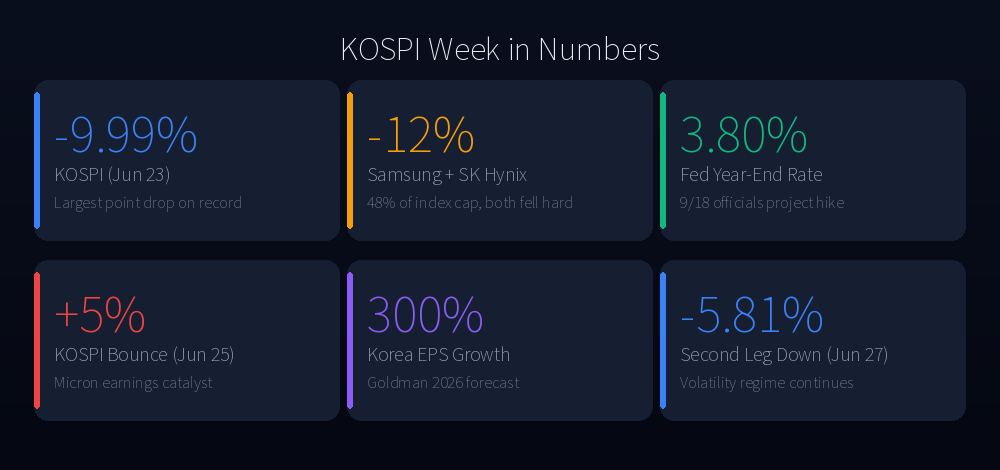
- The Event: KOSPI fell 9.99% on June 23, 2026 — the largest single-day point drop in its history. Circuit breaker triggered. Samsung and SK Hynix fell ~12% each.
- The Structure: Two stocks account for 48% of KOSPI’s market cap. That’s a 3x concentration premium over the S&P 500’s top two. When they fall, the index falls with nothing to catch it.
- My Verdict: The AI demand cycle is intact (Micron’s blowout Q3 confirms it). But KOSPI is now a high-beta, low-diversification vehicle — position accordingly.
What Happened on June 23
The opening bell in Seoul lasted about 30 minutes before the sidecar triggered. By 9:11am local time, KOSPI had fallen far enough to trip the circuit breaker — a full 20-minute halt. The last time this happened was the COVID crash of March 2020.
When trading resumed, sellers didn’t stop. KOSPI closed at 8,203.84, down 910.71 points, or 9.99%. It was the largest single-day point decline in South Korean stock market history. By any reckoning — point terms, percent terms, systemic signal — this was a significant event.
The proximate cause was a Wall Street overnight session. The Nasdaq dropped 2.21%. Micron fell 10%. Marvell lost 8%. SanDisk dropped 11%. The sell-off was driven by anxiety about AI infrastructure overcapitalization — specifically, whether hyperscaler capex commitments can sustain demand at current memory pricing.
Why KOSPI Crashed Harder Than Nasdaq
The Nasdaq fell 2.21%. KOSPI fell nearly 10%. That 5x amplification is not random noise — it’s a structural feature.
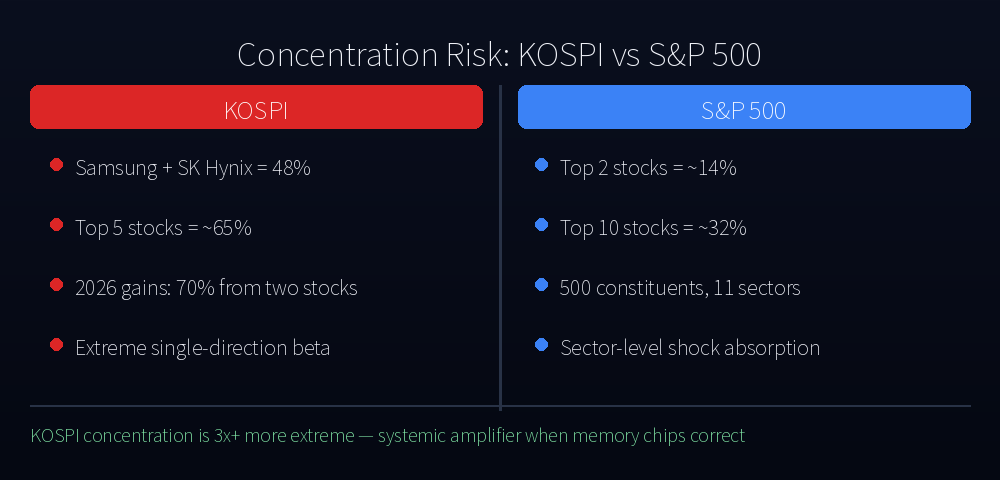
Samsung Electronics and SK Hynix together account for approximately 48% of KOSPI’s total market capitalization. They drove roughly 70% of the index’s gains in 2026 before the crash. The arithmetic is simple: when two stocks representing nearly half the index fall 12% each, the index cannot absorb the hit.
Compare that to the S&P 500, where the top two stocks represent roughly 14% of the index weight. The S&P’s top 10 account for about 32%. KOSPI’s top two alone exceed that level.
The implication is straightforward but frequently ignored: KOSPI is not a diversified equity index in the conventional sense. It is a concentrated expression of global AI memory demand, with a Korean wrapper. Investors who hold KOSPI ETFs as “diversification” against US tech exposure are holding a different form of the same underlying bet.
The Fed Compounded the Damage
The semiconductor sell-off was the trigger. Fed Chair Kevin Warsh’s June 16 FOMC meeting was the accelerant.
In Warsh’s first press conference as Fed Chair, he held rates steady at 3.50–3.75%, but the updated dot plot was unambiguously hawkish. Nine of 18 FOMC participants projected a rate hike in 2026. The year-end median estimate moved from 3.4% (March projection) to 3.8% — a 40 basis-point upward shift.
For growth-oriented memory chip stocks, higher rates translate directly into higher discount rates on future cash flows. The valuation math gets worse. The AI infrastructure stocks that had been priced for a rate-cutting environment suddenly looked stretched in a 3.80% world. Warsh’s press conference was the first headwind that didn’t come from inside the chip sector.
Micron Proved the Bear Case Wrong — Then Volatility Returned
Two days after the crash, KOSPI was up 5%. SK Hynix gained 10%. Samsung recovered 5%.
The catalyst was Micron’s fiscal Q3 report, published June 24. Revenue came in at $41.46 billion. EPS was $25.11 against a consensus of $20.78 — a 21% beat. Management’s commentary confirmed that HBM (High Bandwidth Memory) demand for AI data centers remains robust and ahead of production capacity.
This matters because the bear thesis — that AI infrastructure demand is collapsing — doesn’t hold up against Micron’s actual order book. If the world’s largest memory buyer can confirm demand at this scale, the AI memory supercycle is not broken.
But markets have a short memory for good news. By June 27, KOSPI had given back all of that recovery, falling another 5.81% to 8,411. The pattern is now clear: the direction of travel is ambiguous, but the volatility regime is not.
How to Position Around This
On KOSPI as an asset: I am tactically neutral with a negative skew. The fundamental earnings story remains intact — Goldman Sachs maintains a 300% EPS growth forecast for Korea in 2026, driven by the memory supercycle, and keeps Korea as its highest-conviction Asia market. But the structural concentration and rate uncertainty create an asymmetric risk profile. A portfolio that is long KOSPI is, in practical terms, long HBM demand and short a Fed rate hike. Know what you own.
On individual names: Samsung Electronics and SK Hynix are operationally sound. HBM3E production ramps are proceeding on schedule. The issue is not business quality — it’s valuation sensitivity in a high-rate environment. Both stocks remain appropriate core holdings for semiconductor-cycle investors, but at reduced sizing versus a rate-cutting environment.
On the broader AI sell-off: The market is wrestling with the difference between capex commitment (hyperscaler spending) and revenue recognition (memory demand). Micron’s Q3 results suggest revenue recognition is tracking capex commitment closely. That is a fundamentally bullish signal for SK Hynix and Samsung. The noise around AI overcapitalization is real, but the signal from actual order books suggests premature pessimism.
Key risk events to watch: The next Fed FOMC is in September. Micron’s next earnings print will follow. These two events will determine whether the current volatility regime normalizes or intensifies.
My Verdict
KOSPI’s 10% single-day crash is best understood as a stress test that exposed a structural flaw, not a fundamental breakdown. The AI demand cycle is intact. Korean earnings growth for 2026 remains among the strongest globally. But the index design creates a compounding mechanism that turns a 2% Nasdaq sell-off into a near-10% KOSPI decline.
For a global equity portfolio: reduce KOSPI weight relative to peak, maintain individual positions in Samsung and SK Hynix, and treat the current volatility as an entry opportunity on sharp down days — but only with ample cash buffer to absorb a second leg lower if September’s Fed meeting delivers another hawkish surprise.
The volatility is not the story. The concentration is.
This content is for informational purposes only and does not constitute investment advice. Past performance is not indicative of future results. All data cited reflects publicly available sources as of publication date. Consult a qualified financial advisor before making investment decisions.