
TL;DR
- The Study: A Nature Medicine study (April 30, 2026) of 200,000 UK Biobank participants found that people with the same BMI can have up to 89-fold differences in chronic kidney disease risk, 42-fold differences in type 2 diabetes risk, and 47-fold differences in cardiovascular mortality over 10 years.
- The Tool: OBSCORE, a machine-learning model built from 20 key health indicators (drawn from 2,000+ candidates), predicts risk for 18 obesity-related complications far more precisely than BMI alone.
- The Paradox: The highest-risk individuals are not always those with the highest BMI — many are classified only as “overweight,” and some may fall in the “normal” BMI range with poor metabolic markers.
Two People, Same Scale Reading, Completely Different Futures
Imagine two colleagues who both step off a scale reading 165 pounds. Their BMIs are identical. Both get the same “overweight” label from their doctor. Both receive the same pamphlet about diet and exercise.
Ten years later, one has developed chronic kidney disease. The other is metabolically healthy.
What made the difference? BMI, it turns out, couldn’t tell you.
A landmark study published in Nature Medicine on April 30, 2026, now offers a more powerful answer. Researchers analyzed health data from 200,000 UK Biobank participants with overweight or obesity, evaluating more than 2,000 health variables to identify which combinations best predict future risk of 18 serious obesity-related complications.
The result — an AI-driven risk stratification tool called OBSCORE — reveals something that BMI-focused medicine has long obscured: people with the same BMI can face wildly divergent health futures.
What OBSCORE Found: The Numbers Are Staggering
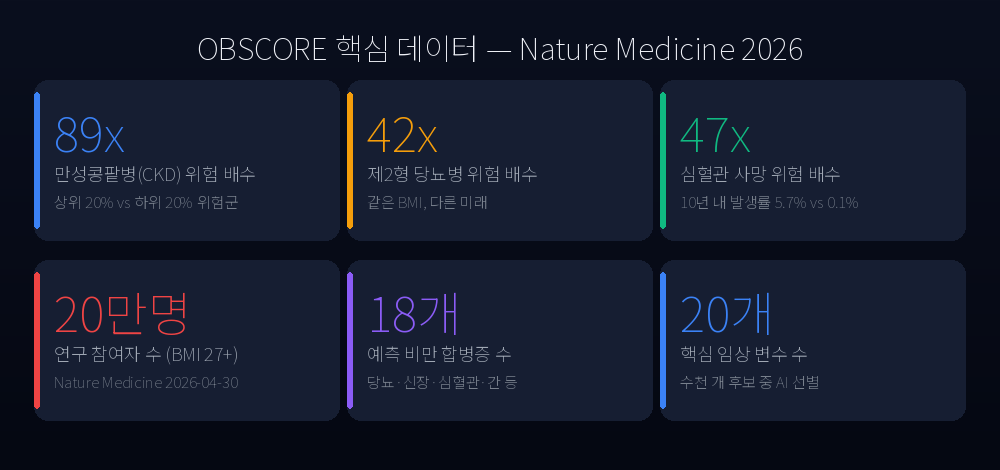
The researchers stratified participants into risk quintiles using OBSCORE and measured 10-year outcomes. The gap between the top and bottom 20% of predicted risk is enormous:
| Complication | Highest vs. Lowest Risk Group |
|---|---|
| Chronic kidney disease | 89-fold higher risk |
| Type 2 diabetes | 42-fold higher risk |
| Cardiovascular mortality | 47-fold (5.7% vs. 0.1% 10-year event rate) |
These are not marginal statistical differences. A 89x difference in kidney disease risk means that two people with identical BMIs can have fundamentally different clinical futures — and BMI alone provides almost no information about which group you fall into.
The researchers also found that the highest-risk individuals are not always those with the highest BMI. A considerable proportion of the highest-risk participants were classified as “overweight” rather than “obese” by conventional BMI standards. BMI, in other words, misses the most dangerous cases.
What OBSCORE Actually Measures (Beyond BMI)
The research team evaluated more than 2,000 health variables from UK Biobank participants and narrowed them down to 20 key indicators that collectively predict 18 different obesity-related complications.
These 20 indicators go well beyond BMI to include:
- Metabolic markers: Fasting glucose, HbA1c, HDL/LDL cholesterol, triglycerides
- Body composition: Waist circumference, body fat percentage
- Organ function: Liver enzymes (ALT, AST), kidney function (eGFR, creatinine)
- Cardiovascular markers: Blood pressure
- Lifestyle factors: Physical activity level, sleep quality, smoking status
- Contextual factors: Family history of metabolic disease, socioeconomic indicators
The 18 complications OBSCORE predicts include: cardiovascular disease, type 2 diabetes, chronic kidney disease, non-alcoholic fatty liver disease (NAFLD), sleep apnea, osteoarthritis, breast, colorectal, and endometrial cancers, hypertension, dyslipidemia, stroke, heart failure, atrial fibrillation, gout, polycystic ovary syndrome, gallbladder disease, and depression.
The model was validated not only in the UK Biobank but also in independent populations of both European and non-European ancestry, suggesting reasonable generalizability — though more diverse population studies are needed.
The Metabolic Paradox: When “Normal BMI” Isn’t Normal
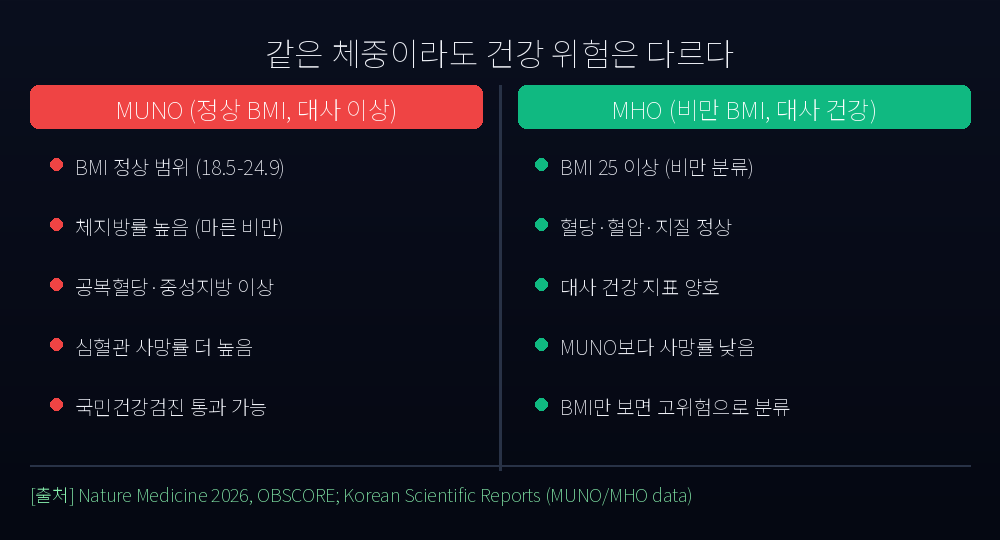
The OBSCORE findings amplify a paradox that metabolic researchers have documented for years: being classified as “obese” by BMI does not automatically mean being at high risk, and being “normal weight” does not mean being safe.
Researchers have identified two key groups that illustrate this:
MUNO (Metabolically Unhealthy Normal-weight): People with a BMI in the “normal” range (18.5–24.9) but with poor metabolic markers — elevated blood glucose, high triglycerides, low HDL cholesterol, elevated liver enzymes. Research in Korean national cohorts (Scientific Reports, 2016) found that MUNO individuals had higher all-cause and cardiovascular mortality than metabolically healthy individuals with obesity.
MHO (Metabolically Healthy Obese): People with a BMI classified as “obese” (≥30 in Western standards) but with normal glucose, blood pressure, and lipid profiles. These individuals — despite their BMI label — often face lower mortality risk than MUNO individuals.
The implication is profound: metabolic health markers matter more than the number on the scale. BMI was never designed to assess individual health risk, and OBSCORE’s 200,000-person validation now demonstrates this limitation at scale.
The OBSCORE Risk Prediction Framework

OBSCORE represents a shift from single-metric screening to multi-dimensional precision risk assessment. The model works by:
- Integrating 20 health indicators from routine clinical data — most of which are already collected in standard physical examinations and basic blood panels
- Applying machine-learning algorithms to weight each indicator’s contribution to risk for each of the 18 target complications
- Generating a personalized risk profile that places individuals on a risk spectrum for each complication
- Enabling risk-stratified intervention — so that highest-risk individuals can receive more intensive treatment regardless of their BMI category
The researchers suggest OBSCORE could complement (not replace) BMI in clinical practice, offering a more actionable picture of who needs aggressive weight management and what complications to prioritize preventing.
What This Means For You
If Your BMI Is in the “Normal” Range
Do not interpret a normal BMI as a health guarantee. If you have any of the following, you may be in a higher-risk metabolic profile than your BMI suggests:
- Waist circumference above 35 inches (women) or 40 inches (men) — or lower if you are of Asian ancestry
- Fasting glucose at or above 100 mg/dL
- Triglycerides at or above 150 mg/dL
- HDL below 50 mg/dL (women) or 40 mg/dL (men)
- Elevated liver enzymes (ALT/AST)
If Your BMI Is in the “Overweight” or “Obese” Range
Your metabolic marker profile matters enormously. If your blood glucose, blood pressure, and cholesterol are well-controlled, your actual 10-year disease risk may be lower than your BMI category implies — and your doctor may choose a different intervention strategy than for someone with the same BMI but poor metabolic markers.
General Evidence-Based Recommendations
Current evidence suggests the following lifestyle factors improve metabolic health markers regardless of weight:
- Regular physical activity — even 150 minutes of moderate activity per week is associated with meaningful improvements in insulin sensitivity, blood pressure, and lipid profiles
- Mediterranean-style diet — associated with reduced metabolic syndrome markers independent of weight loss
- Sleep quality — poor sleep is associated with insulin resistance and elevated inflammatory markers
- Stress management — chronic stress elevates cortisol, which drives visceral fat accumulation and metabolic dysfunction
These are lifestyle modifications that can improve your OBSCORE-relevant metabolic markers whether or not you lose weight — though weight management remains important for mechanical complications (sleep apnea, joint stress).
Caveats and Study Limitations
Fair reporting requires noting what OBSCORE cannot yet claim:
-
UK Biobank population: The derivation cohort is predominantly of European ancestry in the UK. While the researchers tested for generalizability in non-European populations, Korean, East Asian, and other population-specific validation studies are needed.
-
OBSCORE is a research tool, not yet a clinical product: It is not currently available as a clinical screening tool for general healthcare use. Validation for regulatory and healthcare system implementation requires additional research.
-
Observational study design: The study identifies associations between baseline health markers and future complications. It does not yet prove that intervening based on OBSCORE scores improves outcomes — that requires prospective randomized trials.
-
The 20 features require comprehensive baseline data: Not all 20 indicators are collected in routine checkups worldwide. Implementation would require expanded health assessments.
The Broader Picture: What This Means for Medicine
OBSCORE represents a broader shift in how we think about obesity. For decades, the medical field has treated obesity primarily as a weight problem, measured by BMI, managed primarily through weight reduction.
The OBSCORE study reframes obesity as a heterogeneous condition — one where two people with the same BMI can have almost nothing in common in terms of their actual health risk profile, the complications they are most likely to develop, and the interventions most likely to help them.
If validated further and implemented in clinical practice, OBSCORE-style tools could mean that future obesity management is not “lose weight because your BMI is high” but rather “here are the three specific complications you are most likely to develop in the next 10 years, and here is the personalized plan to address them.”
That would be a fundamental change in how preventive medicine works.
Medical Disclaimer: This content is for informational purposes only and is not a substitute for professional medical advice, diagnosis, or treatment. Always seek the advice of your physician or other qualified health provider regarding obesity, metabolic health, or disease risk assessment. Do not make clinical decisions based solely on this article.
References
- “A data-driven risk stratification framework for clinical obesity.” Nature Medicine, April 30, 2026. Queen Mary University of London. (n=200,000, UK Biobank)
- “Data-driven prioritization of high-risk individuals for weight loss interventions.” Nature Medicine, 2026.
- “OBSCORE — a tool to identify individuals at highest risk of obesity-related complications.” Science Media Centre, 2026.
- “Your BMI Doesn’t Predict Which Obesity Complications You’ll Get. A New AI Tool Might.” STAT News, April 30, 2026.
- “Obesity, metabolic health, and mortality in adults: a nationwide population-based study in Korea.” Scientific Reports, 2016.
- “2024 Obesity Fact Sheet in Korea.” Journal of Obesity & Metabolic Syndrome, 2024. (Korean Society for the Study of Obesity)