TL;DR
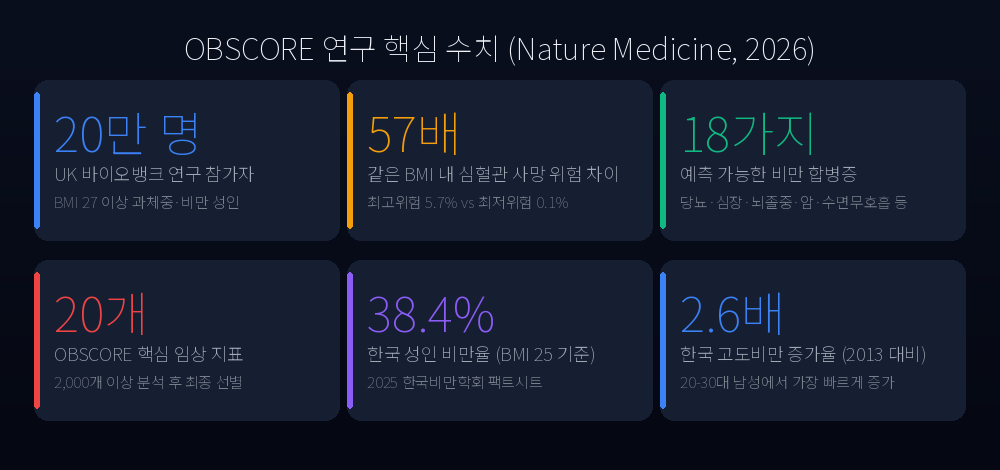
- The Study: A Nature Medicine study (April 30, 2026) of 200,000 adults found that people with identical BMIs can have up to a 57-fold difference in 10-year cardiovascular mortality risk.
- The Tool: OBSCORE uses 20 routine clinical features — blood sugar, cholesterol, waist circumference, and more — to predict individual risk across 18 obesity-related complications.
- The Twist: The highest-risk individuals are not always those with the highest BMI. A significant proportion of “overweight” (not obese) people fall into the highest-risk group.
- What You Can Do: Most of the 20 OBSCORE features are already measured in standard check-ups. You can start assessing your profile today.
The Same Weight, Vastly Different Futures

Imagine two people walking into the same clinic on the same day. Both are 5’7” (170 cm) and weigh 172 lbs (78 kg). Their BMI: 27.0. Their doctor looks at the same number for both.
But according to a landmark study published in Nature Medicine on April 30, 2026, one of these patients may have a 5.7% chance of dying from cardiovascular disease in the next ten years — while the other’s risk is just 0.1%. That’s a 57-fold difference, hidden behind identical BMI readings.
This finding, from a research team at Queen Mary University of London, is the culmination of an analysis of approximately 200,000 UK Biobank participants with overweight or obesity (BMI ≥27). The team evaluated more than 2,000 health measures — blood tests, body measurements, lifestyle factors, and molecular data — before distilling them to 20 key predictive features that collectively form a model called OBSCORE.
The message to medicine is clear: a single number derived from a 180-year-old formula is leaving critical information on the table.
Why BMI Has Always Been a Blunt Tool
Body Mass Index was developed in the 1840s by Belgian mathematician Adolphe Quetelet as a population-level statistical tool — explicitly not designed for individual health assessment. It cannot distinguish muscle from fat, cannot identify where fat is located (visceral vs. subcutaneous), and tells us nothing about blood glucose, blood pressure, or lipid levels.
Yet BMI became the de facto gatekeeper for obesity treatment eligibility, insurance coverage, and clinical trial enrollment. This creates two systematic failures:
Undertreatment: An overweight patient with high visceral fat, elevated liver enzymes, and a family history of heart disease gets told, “You’re not obese yet, so let’s wait and see.” Their actual risk is high, but BMI doesn’t reveal it.
Overtreatment (or unnecessary alarm): A higher-BMI patient who is metabolically healthy — low blood sugar, excellent cholesterol, no inflammation — gets steered toward aggressive interventions based on a number that doesn’t capture their actual risk profile.
The OBSCORE study puts hard numbers on exactly how large these misclassification gaps are.
What OBSCORE Measures — and What It Predicts
The OBSCORE model predicts an individual’s 10-year risk across 18 obesity-related complications:
- Type 2 diabetes
- Hypertension
- Dyslipidemia
- Coronary artery disease
- Heart failure
- Stroke
- Atrial fibrillation
- Peripheral artery disease
- Chronic kidney disease
- Non-alcoholic fatty liver disease (NAFLD)
- Sleep apnea
- Osteoarthritis
- Gout
- Depression
- Asthma
- Endometrial cancer
- Colorectal cancer
- Cardiovascular mortality
The 20 clinical features driving these predictions are not exotic:
- Basic characteristics: Age, sex
- Lifestyle: Smoking status, family history of heart disease, self-rated overall health, presence of a longstanding illness
- Self-reported symptoms: Chest pain, abdominal pain, joint pain
- Blood tests: Blood glucose (HbA1c), cholesterol (LDL/HDL), liver enzymes (ALT/AST), kidney function (eGFR/creatinine)
- Physical measurements: Systolic and diastolic blood pressure, waist circumference, waist-to-hip ratio
Critically, the team validated OBSCORE in two independent external cohorts: the Genes & Health study (a diverse South Asian/Bangladeshi British population) and the EPIC-Norfolk cohort (a community-based European population), confirming the model’s generalizability across diverse groups.
The Counterintuitive Finding: BMI Rank ≠ Risk Rank

The most striking result isn’t the average prediction accuracy — it’s what happens when you look at who sits in the highest-risk tier.
When the researchers stratified participants by OBSCORE score within the same BMI category, the 10-year cardiovascular mortality rates ranged from 5.7% (highest-risk group) to 0.1% (lowest-risk group) — a 57-fold spread. And the highest-risk group was not uniformly composed of those with the highest BMIs.
A considerable proportion of individuals predicted to be at highest risk were people living with overweight (BMI 27–29.9) rather than obesity. Conversely, many individuals with higher BMIs fell into the lower-risk tiers.
This has direct clinical implications. As the researchers note, OBSCORE could help doctors identify which people living with overweight or obesity may benefit most from:
- Early pharmacological intervention (including GLP-1 agonists)
- Closer cardiometabolic monitoring
- Intensive lifestyle modification programs
Rather than prioritizing treatment by BMI rank alone, clinicians could redirect limited resources toward the patients who actually face the steepest risk curves.
What This Means For You
You likely already have most of the data OBSCORE needs. Here’s how to act on it:
1. Pull your last blood test results. Look for: fasting blood glucose or HbA1c, LDL and HDL cholesterol, liver enzymes (ALT/AST), and creatinine or eGFR. If any of these are trending toward abnormal ranges — even if you’re told they’re “borderline” — that’s relevant signal.
2. Measure your waist circumference, not just your weight. Waist circumference is a far better proxy for visceral (metabolic) fat than BMI. For people of European descent, risk increases above 35 inches (88 cm) for women and 40 inches (102 cm) for men. For East Asians and South Asians, these thresholds are lower (85 cm for women, 90 cm for men).
3. Take your symptom history seriously. Recurring chest pain, unexplained abdominal discomfort, or persistent joint pain all appear in OBSCORE’s predictive features. These aren’t just inconveniences — they may be early signals of developing complications.
4. Document your family history. A first-degree relative with early-onset heart disease (before age 55 in men, 65 in women) significantly elevates your cardiovascular risk score in OBSCORE. If you don’t know your family history, it’s worth finding out.
5. Use the OBSCORE online calculator as a reference point. The research team has published an interactive version at omicscience.org/apps/obscore. You can input your clinical values to generate a risk profile. Treat it as a conversation starter with your doctor, not a diagnosis.
Important Caveats
Balanced reporting on this study requires acknowledging its limitations:
Population representation: The UK Biobank, while large, skews toward healthier, more educated, predominantly White British participants — a well-documented limitation. The external validation in the Genes & Health cohort (South Asian populations) is encouraging, but validation in East Asian populations (including Korean cohorts) is still needed.
Scope: OBSCORE was built on data from people with BMI ≥27. It does not apply to individuals in the normal-weight range.
Correlation, not causation: OBSCORE identifies patterns associated with future complications — it doesn’t tell us why those associations exist or whether intervention will change outcomes. A high score indicates elevated risk, not a predetermined fate.
Implementation gap: Moving from a published model to integration in electronic health records and clinical workflows takes years. Most patients won’t encounter OBSCORE in their next check-up. The value right now is in the conversation it enables between patient and clinician.
The Bottom Line
The OBSCORE study, published in Nature Medicine on April 30, 2026, makes a compelling scientific case that the era of BMI-as-sole-arbiter of obesity risk should end. By analyzing 200,000 individuals across 2,000+ health variables, it demonstrates that a 20-feature clinical model can stratify risk in ways that BMI cannot — revealing a 57-fold difference in cardiovascular mortality within what BMI treats as a single category.
The broader implication is a shift toward precision obesity medicine: treating the individual’s actual physiological risk profile rather than their body weight relative to height. As GLP-1 medications become more widely available and precision tools like OBSCORE mature, the question “What is your BMI?” may gradually give way to “What does your full risk profile look like?”
That’s a more useful question — and likely a more honest one.
This content is for informational purposes only and is not a substitute for professional medical advice, diagnosis, or treatment. Always seek the advice of your physician or other qualified health provider with any questions you may have regarding a medical condition.
| Source: “A data-driven risk stratification framework for clinical obesity.” Nature Medicine, April 30, 2026. | 2025 Korean Society for the Study of Obesity Fact Sheet | Diabetes & Metabolism Journal, “Clinical and Preclinical Obesity in Korean Adults from 2014 to 2023,” 2026. |