
TL;DR
- The Study: A Nature Medicine study of ~200,000 adults (BMI 27+) shows BMI cannot predict which obesity complications a person will develop. Published April 30, 2026.
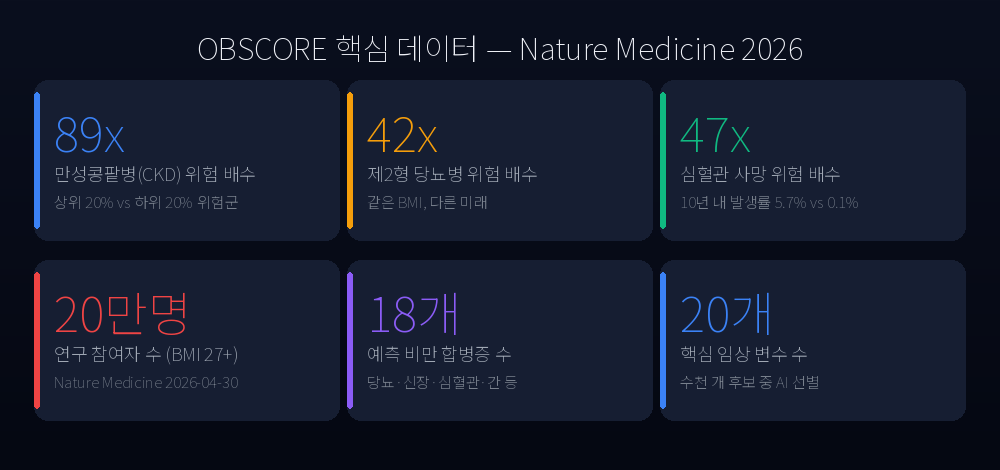
- The Finding: Individuals at the top 20% of predicted risk are 89 times more likely to develop chronic kidney disease than those in the bottom 20% — despite potentially having the same BMI.
- The Action: The 20 variables that power the OBSCORE model are already measured in routine blood panels. Here’s what to look for in your next checkup results.
Two People, Same Weight, Completely Different Futures
Two people walk into a clinic. Both are 5’10”, both weigh 185 pounds, both have a BMI of 26.5. Their doctor recommends the same advice: lose some weight, get more exercise.
Ten years later, one develops chronic kidney disease. The other remains healthy.
What made the difference? Not their weight.
On April 30, 2026, researchers from Queen Mary University of London published a landmark study in Nature Medicine that quantified exactly how misleading BMI can be as a clinical tool. Using data from approximately 200,000 adults with a BMI over 27, they developed and validated OBSCORE — an AI-powered risk stratification model that predicts the 10-year risk of 18 distinct obesity-related complications. The magnitude of the differences it reveals is striking.
Why BMI Has Always Been a Blunt Instrument
BMI — your weight in kilograms divided by your height in meters squared — was designed in the 1830s as a population-level statistical measure, not an individual clinical tool. Yet for decades, it has served as the primary screening criterion for obesity-related health risk.
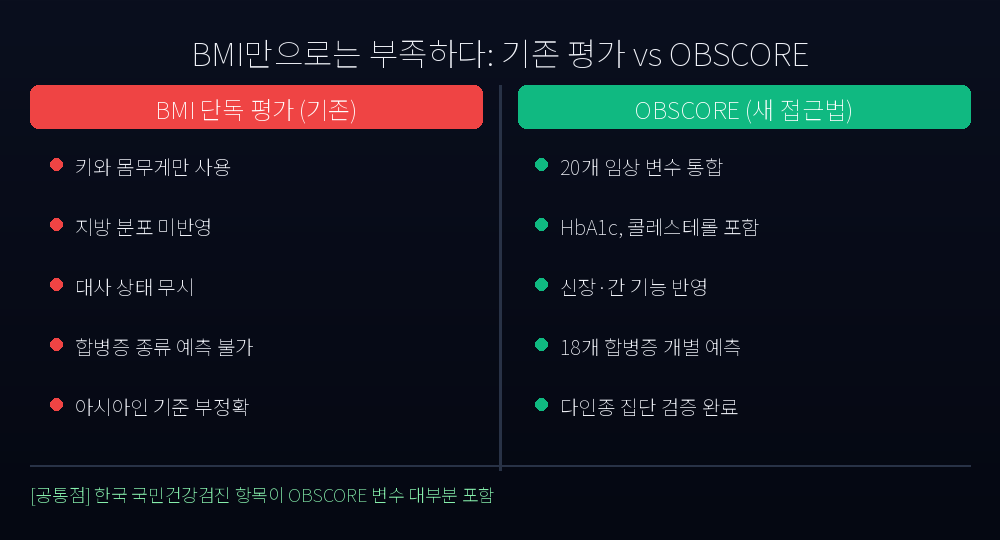
The problem is structural. BMI doesn’t distinguish between muscle and fat. It says nothing about where fat is distributed in the body — visceral (organ-surrounding) fat carries far greater metabolic risk than subcutaneous fat. It ignores blood sugar regulation, kidney function, liver enzymes, and lipid profiles. Two people with identical BMIs could have dramatically different metabolic health.
This isn’t a minor academic quibble. Multiple large-cohort reviews have found that using BMI alone misclassifies a significant proportion of individuals as metabolically healthy when they are not — and vice versa, flagging metabolically healthy individuals as high-risk. The limitations are especially pronounced in Asian populations, where cardiovascular and diabetes risk rises at BMI thresholds well below the standard Western cutoff of 30.
The OBSCORE study makes the stakes concrete: the current approach of treating everyone with a high BMI as similarly at risk leads to inefficient use of clinical resources and missed opportunities for early intervention in people who genuinely need it.
What OBSCORE Actually Does
The research team applied machine learning to a dataset of approximately 200,000 individuals with overweight or obesity, testing thousands of clinical, molecular, and lifestyle variables as potential predictors of future disease. What emerged were the 20 most informative features — all measurable from standard clinical tests and routine health records.
The core variables include:
- Glycemic markers: HbA1c (glycated hemoglobin)
- Lipid panel: Total cholesterol, HDL cholesterol
- Kidney function: Serum creatinine
- Liver function: Alanine aminotransferase (ALT)
- Metabolic markers: Uric acid
- Physical measurements: Waist-to-height ratio, blood pressure
- Lifestyle factors: Smoking status, demographic data
From these inputs, OBSCORE generates individual risk predictions for 18 conditions: type 2 diabetes, chronic kidney disease, cardiovascular disease, fatty liver disease, sleep apnea, osteoarthritis, and more. Critically, the model was externally validated in both European-ancestry and non-European-ancestry cohorts, suggesting it generalizes across diverse populations.
The Numbers That Should Rethink How We Screen for Obesity
The effect sizes in this study are not marginal. They suggest we may be systematically misallocating clinical attention.
Chronic kidney disease (CKD): Individuals in the top 20% of OBSCORE-predicted risk were 89 times more likely to develop CKD over 10 years than those in the bottom 20%. These are people who might share the same BMI bracket.
Type 2 diabetes: The risk ratio was 42-fold. The difference between the highest- and lowest-risk quintiles dwarfs anything a BMI-based stratification could reveal.
Cardiovascular mortality: 10-year event rates were 5.7% in the highest-risk group versus 0.1% in the lowest — a 47-fold spread. In practical terms: in a room of 100 high-BMI people, current screening would treat them similarly. OBSCORE would identify that roughly 6 of them face a cardiovascular mortality risk 57 times higher than others in the same room.
These are not incremental improvements over BMI. They represent a fundamentally different level of clinical information.

What This Means For You
OBSCORE is not yet available as a clinical tool your doctor can order. But the variables it uses are already measured in standard health panels worldwide. Here’s how to get more from the bloodwork you’re likely already having done.
1. Look at your HbA1c number. An HbA1c of 5.7% or above places you in the pre-diabetes range. This matters even if your fasting glucose is normal and your doctor hasn’t flagged it. Research consistently shows that pre-diabetes combined with low HDL cholesterol substantially amplifies 10-year kidney disease risk compared to either risk factor alone — a combination that OBSCORE is specifically designed to detect.
2. Check your creatinine and estimated GFR (eGFR). An eGFR below 60 indicates stage 2 or worse CKD. Even a creatinine value at the upper end of the “normal” range warrants attention — trending upward over consecutive years is more informative than any single data point.
3. Know your HDL. HDL below 40 mg/dL for men and 50 mg/dL for women is an independent cardiovascular risk factor that compounds with other metabolic abnormalities. Aerobic exercise is the most evidence-backed intervention for raising HDL, with established evidence showing average HDL increases of 3–5 mg/dL after 12 weeks of moderate-intensity training in multiple controlled trials.
4. Calculate your waist-to-height ratio. Divide your waist circumference by your height (both in the same unit). A ratio above 0.5 indicates central adiposity and is a stronger predictor of metabolic disease than BMI. This is a 30-second calculation you can do at home.
5. Think in combinations, not individual values. OBSCORE’s core insight is that risk emerges from patterns across multiple markers, not from any single outlier. HbA1c at 5.6% + low HDL + elevated uric acid + elevated blood pressure, each individually within “normal,” can combine to create a meaningfully elevated composite risk.
Caveats Worth Knowing
The OBSCORE study is rigorous, but it has real limitations that any careful reader should note.
The model has not yet been validated in East Asian populations specifically — the primary cohorts were European and broadly Western. Given that Asians develop obesity-related complications at lower BMI thresholds (guidelines in countries like Korea and Japan define obesity at BMI 25 rather than 30), the specific risk thresholds may differ from those derived in this study.
OBSCORE does not incorporate genetic data. Individuals with strong familial risk for conditions like familial hypercholesterolemia or BRCA-associated metabolic syndromes may have risks that the model underestimates.
Finally, this is a population-level risk tool, not a diagnostic instrument. A high OBSCORE score is a signal to discuss with a physician — it is not a diagnosis of future disease, and its predictions carry confidence intervals that the published paper acknowledges are substantial in individual-level predictions.
The Bigger Picture: Precision Obesity Medicine
The OBSCORE study is one signal in a broader shift in how medicine approaches overweight and obesity. The field is moving away from the question “how much does this person weigh?” toward “which specific risks does this person carry, and which interventions will actually move the needle for them?”
A companion paper in the same Nature Medicine issue used OBSCORE to model which individuals would benefit most from weight-loss interventions — finding that prioritizing treatment based on OBSCORE risk, rather than BMI alone, substantially improved the clinical yield of interventions.
In the near future, wearable continuous glucose monitors, smartwatch-based heart rate variability data, and routine genomic screening may all feed into models like OBSCORE to create genuinely individualized risk profiles. For now, what we have is a tool that says: the variables your annual blood panel already measures tell a much richer story than your BMI ever could. The question is whether clinicians and patients will start reading that story.
This content is for informational purposes only and is not a substitute for professional medical advice, diagnosis, or treatment. Always seek the advice of your physician or other qualified health provider with any questions you may have regarding a medical condition.
Source: Caleyachetty et al., “A data-driven risk stratification framework for clinical obesity,” Nature Medicine, April 30, 2026. Study population: approximately 200,000 adults with BMI ≥27. Predicted 10-year risk for 18 obesity-related complications using 20 clinical variables.