
TL;DR
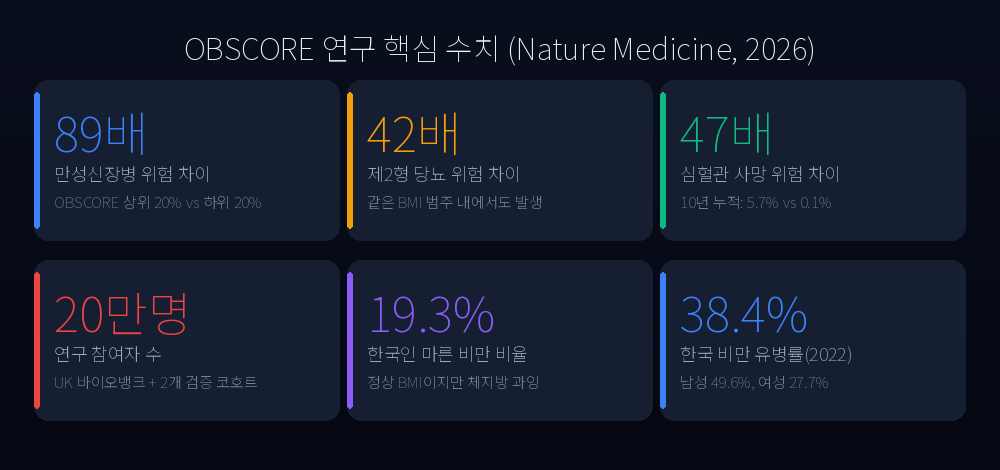
- The Study: A 200,000-person analysis in Nature Medicine (April 2026) found that people with identical BMI values can have an 89-fold difference in chronic kidney disease risk.
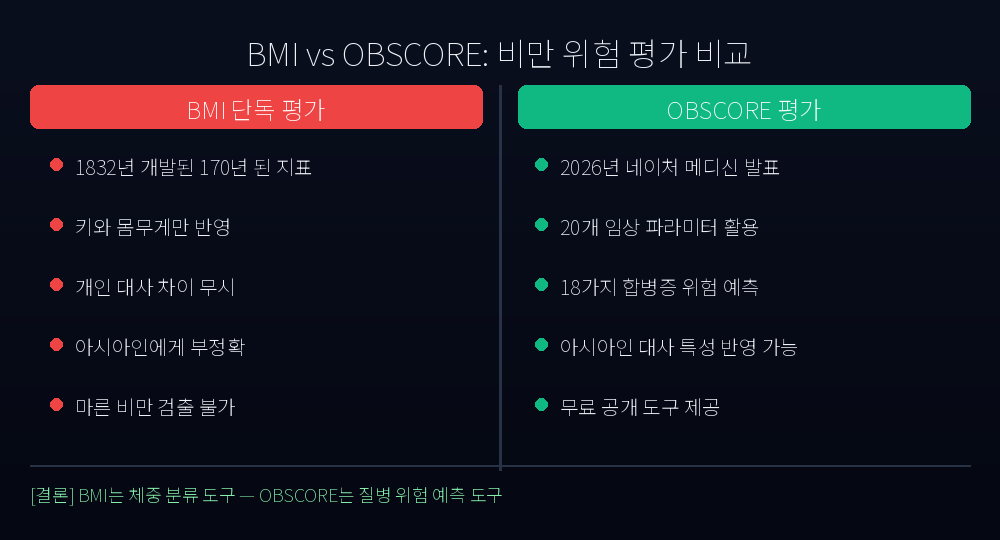
- The Tool: OBSCORE uses 20 routine clinical parameters to predict 10-year risk of 18 obesity-related complications — and it’s free.
- The Implication: BMI was never designed to predict disease risk. A new generation of metabolic risk tools may soon change how doctors screen patients.
Same Weight, Vastly Different Futures
Imagine two people standing side by side. Same height, same weight, same BMI of 26. Statistically indistinguishable by the most commonly used clinical metric for obesity.
Ten years later, one of them is 89 times more likely to have been diagnosed with chronic kidney disease.
That is the central finding of a landmark study published April 30, 2026 in Nature Medicine, one of the world’s highest-impact medical journals. Researchers from Queen Mary University of London and the Berlin Institute of Health at Charité analyzed health data from approximately 200,000 adults with overweight or obesity in the UK Biobank — one of the world’s largest biomedical databases. Results were externally validated in two independent cohorts: the Genes & Health study and the European Investigation into Cancer (EPIC) - Norfolk study.
The conclusion: BMI is fundamentally inadequate as a standalone predictor of individual disease risk.
Why BMI Has Always Been a Blunt Instrument
The body mass index was devised by Belgian statistician Adolphe Quetelet in 1832. He was studying population-level weight distributions — not individual health outcomes. BMI was never intended to be a clinical tool for predicting whether a specific person would develop diabetes, kidney disease, or die of heart failure.
Yet that’s precisely how it’s been used for nearly two centuries.
What BMI doesn’t capture:
- Body fat percentage versus lean muscle mass
- Visceral fat distribution (the metabolically dangerous abdominal fat)
- Blood glucose, triglycerides, HDL cholesterol, and other metabolic markers
- Insulin resistance — a key driver of type 2 diabetes and cardiovascular disease
- Inflammatory markers and genetic predispositions
The new Nature Medicine study makes the inadequacy concrete. A considerable proportion of people identified as being at the highest OBSCORE risk were not those with the highest BMI — they were individuals classified as merely overweight, whose combination of metabolic and clinical factors placed them in the danger zone.
Conversely, some individuals with BMI values in the obese range (≥30) were placed in low-risk categories because their metabolic environment was actually favorable.
How OBSCORE Works
The research team evaluated more than 2,000 clinical, lifestyle, blood test, molecular, and health indicators using interpretable machine learning. From that universe of variables, they identified just 20 routinely collected health measures — the kind available from a standard blood panel and clinical assessment — that could accurately stratify individuals by their risk of developing 18 obesity-related complications over a 10-year horizon.
The result is OBSCORE: an open-access, no-login tool available at omicscience.org/apps/obscore/.
The Risk Ratios That Caught Attention
When researchers divided participants into five risk quintiles by OBSCORE score, the spread was striking:
| Complication | Top 20% vs Bottom 20% Risk |
|---|---|
| Chronic Kidney Disease | 89-fold higher |
| Type 2 Diabetes | 42-fold higher |
| Cardiovascular Mortality | 47-fold higher |
| 10-year cardiovascular mortality rate | 5.7% vs 0.1% |
(Source: Nature Medicine, April 30, 2026, Queen Mary University of London / Berlin Institute of Health at Charité)
To put those numbers in perspective: a 47-fold difference in cardiovascular mortality risk between two people who might receive the same clinical advice based on their BMI alone.
The 18 Complications OBSCORE Predicts
OBSCORE covers cardiovascular complications (including mortality), metabolic complications (type 2 diabetes, fatty liver disease), renal complications (chronic kidney disease), and mechanical complications (sleep apnea, joint disease), among others.
What This Means For You
Here is where the research translates into action. If your BMI-based classification has told you everything is fine — or that you’re in trouble — consider this your invitation to look deeper.
1. Get your metabolic numbers, not just your weight
The 20 parameters OBSCORE uses are largely standard blood panel values: fasting glucose, HbA1c, HDL and LDL cholesterol, triglycerides, liver enzymes, blood pressure, kidney function markers (creatinine, eGFR), and basic demographic data. Your annual physical should capture most of these. Ask your doctor for a copy.
2. Use OBSCORE as a starting conversation, not a verdict
The tool is available free of charge and requires no medical expertise to access. Input your values, note your risk categories, and bring the output to your next medical appointment. Current evidence suggests it may help identify high-risk individuals earlier than BMI alone — but it is a screening tool, not a diagnostic.
3. Pay particular attention if you are of East Asian descent
This matters. The World Health Organization’s standard BMI obesity threshold is 30 kg/m². Asian countries, including South Korea and Japan, apply lower cutoffs (≥25 for obesity) because research has shown that people of Asian descent tend to carry proportionally higher body fat and more visceral fat at the same BMI compared to people of European descent. Obesity-related metabolic complications can therefore appear at BMI values that Western charts would classify as “overweight” or even “normal weight.”

A 2023 study published in PMC (PMC10454074) found that 19.3% of Korean adults have “normal-weight obesity” — a BMI in the healthy range combined with excess body fat and elevated metabolic risk. This phenomenon makes risk tools like OBSCORE particularly relevant for East Asian populations.
4. Track waist circumference alongside BMI
Waist circumference is a stronger proxy for visceral fat than BMI. Clinical thresholds linked to increased metabolic risk: men ≥102 cm (WHO) or ≥90 cm (Asian populations); women ≥88 cm (WHO) or ≥85 cm (Asian populations). Multiple studies indicate that waist circumference may outperform BMI as a predictor of cardiovascular events and type 2 diabetes.
5. Even modest weight loss has measurable metabolic impact
Current evidence suggests that reducing body weight by 5–10% may produce clinically meaningful improvements in blood pressure, fasting glucose, and lipid profiles — regardless of absolute BMI level. (Source: multiple meta-analyses in American Journal of Clinical Nutrition) The target isn’t a number on a scale; it’s a constellation of metabolic markers trending in the right direction.
Caveats and Limitations
This is a significant study, but context matters.
Population diversity: The UK Biobank skews heavily toward individuals of European descent. External validation in ethnically diverse populations — including East Asian, South Asian, and African cohorts — is needed before OBSCORE can be confidently generalized globally. The researchers acknowledge this limitation.
Observational design: This is a cohort study, not a randomized controlled trial. OBSCORE demonstrates associations, not causation. High OBSCORE risk does not guarantee disease; low OBSCORE risk does not guarantee health.
Data requirements: OBSCORE’s predictive power depends on having all 20 input parameters. Incomplete data may limit the tool’s reliability for some users.
Clinical integration is early-stage: OBSCORE is a research-grade tool. Incorporating it into routine clinical practice will require further validation, health system integration, and clinician training. It is not yet endorsed as a replacement for any established clinical risk assessment.
The Broader Shift: Beyond BMI
This study joins a growing body of work questioning BMI’s dominance in clinical medicine. The World Obesity Federation, several national medical societies, and a 2023 joint statement from major obesity research groups have all called for more nuanced assessments that incorporate body composition, metabolic markers, and functional outcomes.
What is different about OBSCORE is the scale of validation (200,000 participants, two external cohorts), the accessibility of the tool (free, no login), and the specificity of the predictions (18 distinct complications, not a generic “obesity risk”).
If the research holds up — and independent replication studies are an important next step — tools like OBSCORE could meaningfully change how clinicians and patients think about obesity-related risk screening.
Bottom Line
Your BMI tells you where your weight falls on a population distribution chart. It was designed for that purpose, and it does that job adequately.
What it was never designed to do is tell you whether you are heading toward kidney failure, a heart attack, or a diabetes diagnosis — or whether you’re metabolically protected despite your weight.
That’s the gap OBSCORE is built to address. The numbers behind it are striking. The tool is free. The only remaining question is whether your next doctor’s appointment will include a conversation about it.
This content is for informational purposes only and is not a substitute for professional medical advice, diagnosis, or treatment. Always seek the advice of your physician or other qualified health provider with any questions you may have regarding a medical condition.
Sources
- Nature Medicine (April 30, 2026): “A data-driven risk stratification framework for clinical obesity” — Queen Mary University of London / Berlin Institute of Health at Charité
- QMUL Press Release, April 2026: “New tool helps to identify people at highest risk of obesity-related diseases”
- PMC10454074: “Normal-Weight Obesity and Metabolic Syndrome in Korean Adults” (2023)
- WHO (2004, PubMed 14726171): “Appropriate body-mass index for Asian populations”
- Korean Society for the Study of Obesity: 2024 Obesity Fact Sheet
- American Journal of Clinical Nutrition: Multiple meta-analyses on modest weight loss and metabolic outcomes