TL;DR
- The Study: A 6,941-person cohort study published in Nature Communications (2026) found that gut microbiome diversity is significantly associated with sleep quality, social jet lag, and chronotype.
- The Numbers: 137 gut bacterial species linked to sleep characteristics; 35.6% of associations validated in an independent cohort.
- The Takeaway: Poor sleepers consistently show fewer beneficial bacteria (Faecalibacterium, Lactobacillus) and more inflammatory taxa — and dietary changes may offer a new lever for improving sleep.

When You Can’t Sleep, Your Gut May Already Know Why
Most sleep advice targets the brain: dim the lights, silence your phone, cool your bedroom. But a major study published in 2026 suggests the more urgent intervention may be happening lower down — in your digestive tract.
Researchers from the Lifelines Dutch Microbiome Project analyzed gut microbiome data and sleep characteristics for 6,941 adults, making it one of the largest studies ever to examine the sleep-microbiome connection directly. Their conclusion: the diversity and composition of gut bacteria are strongly linked to how well people sleep, when they naturally want to sleep, and how much their sleep patterns drift between weekdays and weekends.
The findings add significant weight to the gut-brain axis hypothesis — the idea that the microbial ecosystem in your gut communicates with your brain in ways that shape cognition, mood, and yes, sleep.
What the Data Actually Shows
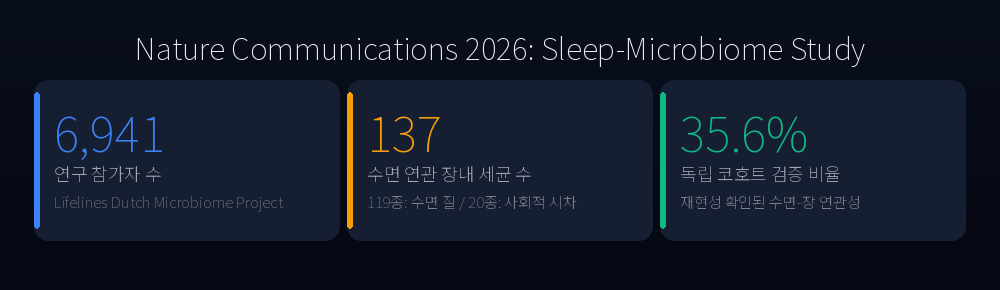
The study drew participants from the Lifelines Dutch Microbiome Project: 6,941 adults with a mean age of 51 years (SD 11.55), 59.4% female, mean BMI 26. Sleep was assessed using validated instruments — the Pittsburgh Sleep Quality Index (PSQI), the Epworth Sleepiness Scale (ESS), and the Munich ChronoType Questionnaire (MCTQ).
On sleep quality: Using PSQI scoring, 74.9% of participants were classified as good sleepers, 22.4% as poor sleepers, and 2.7% as very poor sleepers — meaning roughly one in four participants had measurable sleep problems.
On microbial associations: 137 gut bacterial species showed statistically significant associations with sleep characteristics. Of these, 119 species were linked to sleep quality, 20 to social jet lag, and 24 to chronotype. Critically, 35.6% of these associations replicated in an independent validation cohort, lending them considerable credibility.
On diversity: Lower alpha diversity — fewer distinct species in the gut — was consistently associated with poorer sleep quality, a later chronotype, and greater social jet lag. Beta diversity (differences in microbial community composition between individuals) was also linked to both sleep quality and social jet lag.
On specific bacteria: Poor sleepers showed reduced levels of Faecalibacterium and Lactobacillus — both associated with gut health and anti-inflammatory effects — and increased Clostridium, a genus linked to inflammation.
One particularly striking finding: specific Clostridia species (UC5_1_1E11 and SGB14844) appear to mediate the relationship between coffee intake and social jet lag. In other words, how your gut microbiome is configured may partly determine whether your morning coffee shifts your sleep timing.
The Biology: How Gut Bacteria Talk to Your Brain at Night
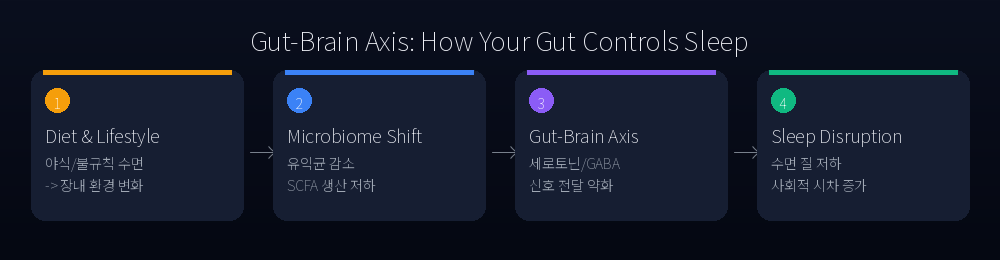
Understanding why this connection exists requires a brief tour of the gut-brain axis — the bidirectional communication network linking your digestive system to your central nervous system via the vagus nerve, hormonal signals, and immune pathways.
Serotonin production: Approximately 90–95% of the body’s serotonin is produced in the gut (per Johns Hopkins Medicine). Serotonin is the direct precursor to melatonin, the hormone that regulates the sleep-wake cycle. If gut bacteria that support serotonin synthesis are depleted, downstream melatonin production may be affected.
Short-chain fatty acids (SCFAs): Beneficial gut bacteria ferment dietary fiber to produce SCFAs — including butyrate, propionate, and acetate. These compounds activate GABA receptors in the nervous system, promoting a calming effect that supports sleep onset. A 2026 systematic review in the Journal of Sleep Research found that sleep deprivation significantly reduces SCFA-producing bacterial taxa.
Inflammation and sleep architecture: Gut dysbiosis — an imbalance in microbial communities — increases intestinal permeability and allows inflammatory cytokines into the bloodstream. These signals reach the brain and disrupt sleep architecture, particularly suppressing slow-wave sleep (deep sleep), which is critical for physical restoration and memory consolidation.
Circadian entrainment: Gut bacteria themselves follow circadian rhythms. Irregular eating schedules — particularly late-night meals — disrupt microbial circadian timing, reducing the production of sleep-supportive metabolites during the hours they’re most needed.
The Comparison: What Good and Poor Sleepers’ Guts Look Like
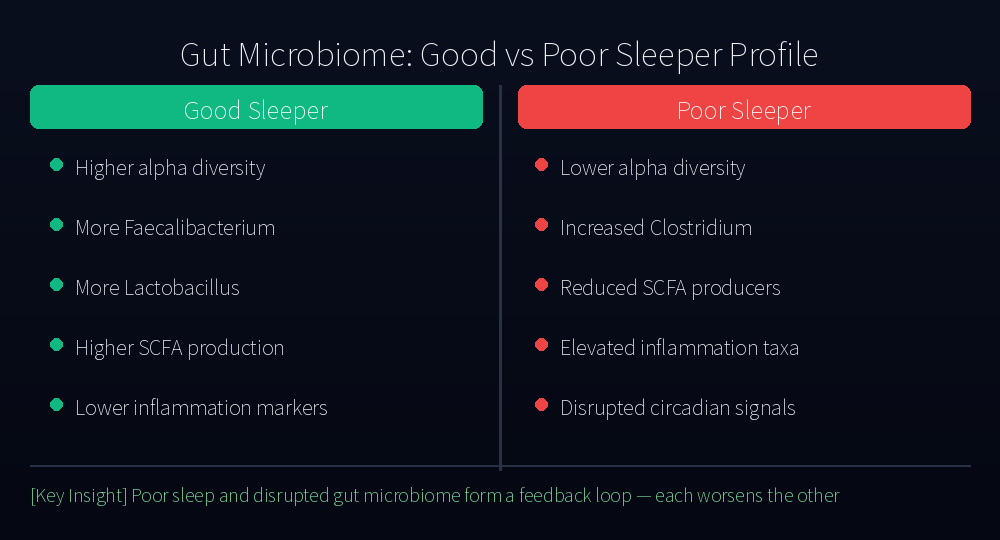
The gut microbiome profile associated with good sleep is strikingly different from that of poor sleepers. Good sleepers tend to have higher microbial diversity, more Faecalibacterium and Lactobacillus, greater SCFA production, and lower levels of inflammatory bacteria. Poor sleepers show the inverse: depleted diversity, reduced beneficial species, and enriched inflammatory taxa.
This isn’t merely correlation. A 2024 PMC review of gut microbiota and sleep mechanisms notes that the relationship is likely bidirectional: poor sleep disrupts the gut ecosystem, and a disrupted gut ecosystem degrades sleep quality. Breaking this cycle requires intervening at the diet level.
Caveats: What This Study Cannot Tell You
The researchers are careful about what their data can and cannot support, and so should we.
This is an observational cohort study. It establishes association, not causation. We cannot conclude from this data alone that improving gut microbiome diversity will directly improve sleep — though experimental evidence from intervention studies does point in that direction.
Sleep was measured by self-report questionnaires rather than polysomnography (PSG), which limits precision. Self-reported sleep quality can diverge from objectively measured sleep architecture, particularly for variables like slow-wave sleep percentage.
The cohort is drawn from Dutch adults — predominantly European, with a specific dietary and genetic background. Gut microbiome composition varies significantly across ethnicities, geographies, and dietary traditions. Extrapolating these findings to Asian, African, or Latin American populations requires caution and further study.
Finally, 35.6% replication in an independent cohort is notable, but it also means 64.4% of associations did not independently replicate — a reminder that many findings in microbiome research are context-dependent and require further validation.
What This Means For You
The research suggests several evidence-based dietary and lifestyle strategies that may support both gut microbiome health and sleep quality. These are not treatments for sleep disorders — anyone with serious sleep problems should consult a physician.
Eat 30+ plant foods per week. The American Gut Project and the ZOE PREDICT cohort both found that people eating 30 or more distinct plant foods per week had significantly higher gut microbial diversity than those eating fewer than 10. This doesn’t require exotic ingredients — variety is the key. Herbs, spices, nuts, seeds, legumes, and whole grains all count.
Stop eating 2–3 hours before bed. Time-restricted eating (TRE) aligns food intake with the body’s circadian rhythms and supports microbial circadian entrainment. A 2022 Cell Metabolism study found that maintaining a 10-hour eating window improved sleep quality and glycemic stability. Avoiding late-night meals is the most accessible entry point.
Anchor your wake time — especially on weekends. Social jet lag — the mismatch between your social schedule and your biological clock — is directly linked to reduced microbial diversity in this study. The Stanford Sleep Research Center recommends fixing your wake time within one hour across all seven days of the week. The consistency matters more than the specific hour.
Eat fermented foods daily. Fermented foods — kimchi, miso, yogurt, kefir, sauerkraut — deliver live beneficial bacteria and support microbial diversity. A 2021 Stanford study published in Cell found that a high-fermented-food diet increased microbiome diversity and reduced immune inflammatory markers over 10 weeks. Whole-food fermented sources are preferred over probiotic supplements, which vary widely in strain composition and viability.
Consider fiber first. Before reaching for probiotic supplements, prioritize prebiotic fiber — the food that supports beneficial bacteria already present in your gut. Diverse plant foods, legumes, and whole grains feed SCFA-producing species like Faecalibacterium, which this study associates with better sleep.
The Bigger Picture
This study is part of a rapidly expanding body of evidence repositioning the gut as a key regulator of sleep biology. The implications extend beyond individual behavior: understanding the microbiome-sleep axis opens new possibilities for personalized nutrition, probiotic therapy targeting sleep, and chronobiologically informed dietary guidelines.
For the roughly 25% of adults who struggle with sleep quality, the gut may represent a largely unexplored therapeutic frontier. More randomized controlled trials — particularly in diverse, non-European populations — are needed before specific microbiome interventions can be formally recommended for sleep improvement.
What the current evidence does support is simpler: dietary diversity, fermented foods, consistent meal timing, and stable sleep schedules are all individually supported by research. The gut-sleep connection gives us one more reason to take those basics seriously.
This content is for informational purposes only and is not a substitute for professional medical advice, diagnosis, or treatment. Always seek the advice of your physician or other qualified health provider with any questions you may have regarding a medical condition or sleep disorder.
Sources
- The interplay of sleep characteristics with health factors and gut microbiome. Nature Communications, 2026. doi:10.1038/s41467-026-68791-9
- Sleep Deprivation Alters Gut Microbiome Diversity and Taxonomy: A Systematic Review and Meta-Analysis of Human and Rodent Studies. Journal of Sleep Research, 2026. doi:10.1111/jsr.70125
- Exercise as a modulator of gut microbiota for improvement of sleep quality: a narrative review. Frontiers in Neuroscience, 2025.
- Gut microbiota and sleep: Interaction mechanisms and therapeutic prospects. PMC, 2024.
- Sonnenburg et al. Gut-microbiota-targeted diets modulate human immune status. Cell, 2021.