TL;DR
- The Study: A 6,941-person cohort study published in Nature Communications (February 2026) links social jet lag and poor sleep quality to lower gut microbiome diversity.
- The Surprise: Drinking more coffee may worsen social jet lag through specific gut bacteria — a counterintuitive finding with real implications.
- The Action: Three evidence-based interventions you can start this weekend to protect your sleep-gut axis.
Sleeping In on Weekends May Be Wrecking Your Gut
Most people think of “catching up on sleep” as harmless — even restorative. The science says otherwise.
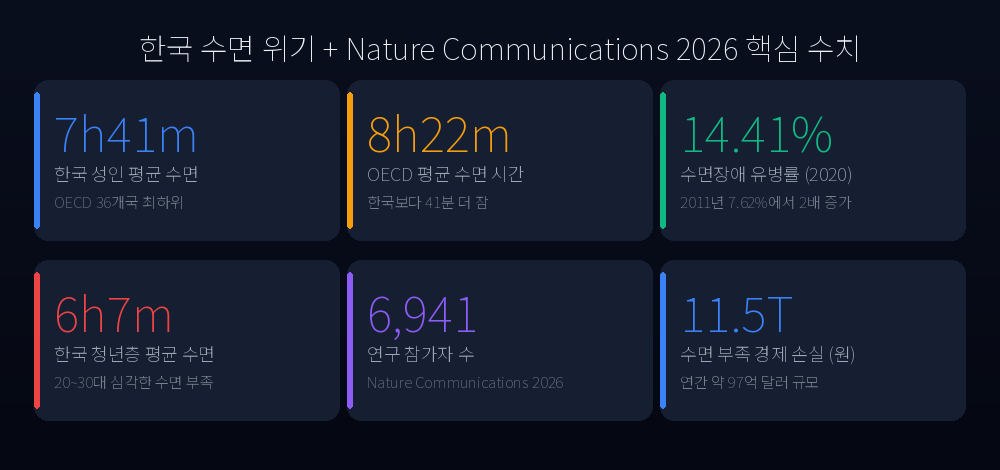
A large-scale study published in Nature Communications in February 2026 found that people who experience significant misalignment between their weekday and weekend sleep schedules — a phenomenon researchers call social jet lag — have measurably lower diversity in their gut microbiomes. The study analyzed data from 6,941 participants in the Lifelines Dutch Microbiome Project (DMP), one of Europe’s largest population-based microbiome cohorts.
The finding matters because gut microbiome diversity is not a niche concern. A diverse gut microbiome is consistently associated with better immune function, metabolic health, mental health, and — as this study highlights — sleep quality itself.
What Is Social Jet Lag?
Social jet lag refers to the mismatch between your biological clock and your social clock. If you wake at 7 a.m. on weekdays but sleep until 10 a.m. on weekends, you have three hours of social jet lag — the equivalent of flying to a time zone three hours away and back every single week.
The mechanism is straightforward but underappreciated. Your body calibrates its circadian rhythm using cues from light, meal timing, and activity. When those cues shift dramatically between weekdays and weekends, the internal clock never fully stabilizes. The gut’s microbial community — which also operates on circadian rhythms — takes the hit.
A 2023 study in the European Journal of Nutrition (ZOE PREDICT 1 cohort) found that even a 90-minute difference in sleep midpoint was associated with significant changes in gut microbiome composition. The 2026 Nature Communications study now extends this finding to a much larger sample, linking social jet lag to both alpha diversity (the variety of species within an individual’s gut) and beta diversity (differences in composition between individuals).
The Gut-Brain Axis: How Sleep Disrupts Your Microbiome
The 2026 study goes beyond correlation by identifying a plausible biological pathway.
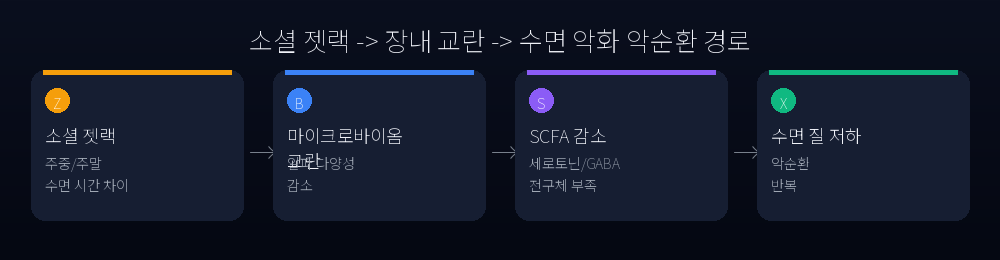
When sleep timing becomes irregular, gut bacteria lose their own circadian rhythms. This disruption cascades into several measurable changes:
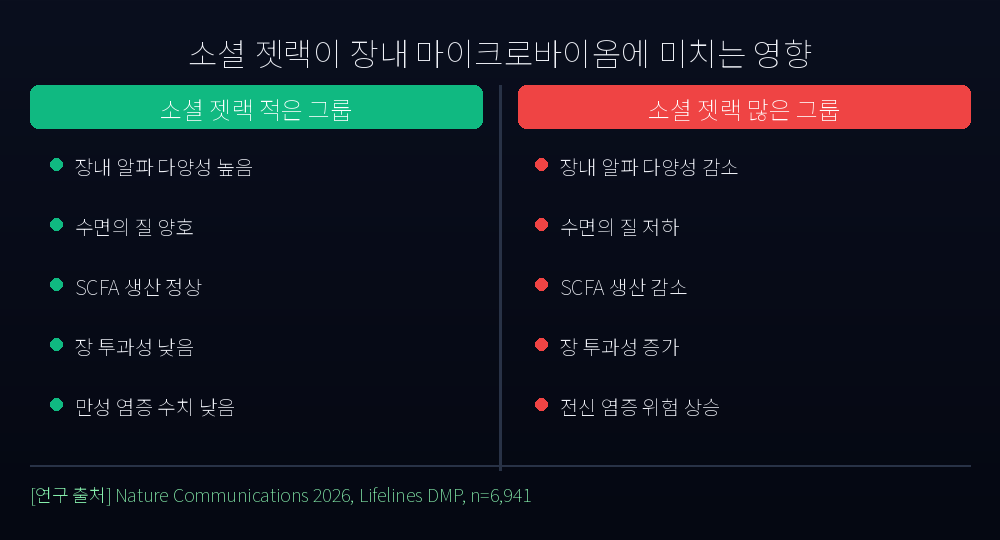
Short-Chain Fatty Acid (SCFA) Production Falls: SCFAs are the primary energy source for gut epithelial cells and act as precursors for sleep-promoting neurotransmitters including serotonin and GABA. Less SCFA means less of the raw material your body uses to generate sleep signals.
Intestinal Permeability Increases: Disrupted microbial rhythms weaken the gut lining. This allows bacterial endotoxins to enter the bloodstream, triggering low-grade systemic inflammation — itself a driver of poor sleep.
Alpha Diversity Drops: The study found a clear, statistically significant association: participants with worse sleep quality, later chronotypes, and greater social jet lag consistently showed lower gut microbiome alpha diversity compared to those with regular sleep patterns.
The loop closes on itself. Poorer gut health impairs sleep quality, which further disrupts the microbiome, which further degrades sleep. This is the self-reinforcing cycle the 2026 research describes.
The Coffee Finding: A Counterintuitive Discovery
One of the more surprising results from the Nature Communications study concerns coffee. The researchers identified two species in the Clostridia class — bacterium UC5_1_1E11 and an unclassified species SGB14844 — that appear to mediate the relationship between coffee consumption and social jet lag. Higher coffee intake was associated with greater abundance of these bacterial species, which in turn was associated with worse social jet lag. This microbial pathway accounted for 8.3% of the total association between coffee intake and social jet lag.
This does not mean coffee is harmful in a broad sense — the evidence on moderate coffee consumption and overall health outcomes remains largely favorable. What it suggests is that when and how much you drink matters, particularly in people already prone to circadian disruption.
The current evidence supports limiting caffeine intake after 2 p.m. A 2013 study in the Journal of Clinical Sleep Medicine found that consuming caffeine even six hours before bedtime significantly reduced total sleep time.
What This Means For You
The study is observational, which means it demonstrates association, not causation. Here is what the current evidence reasonably supports — and what it does not:
What the evidence supports:
1. Consistent Wake Times Matter More Than Total Sleep Hours The American Academy of Sleep Medicine (AASM) recommends maintaining consistent wake times, even on weekends, as the most effective tool for stabilizing circadian rhythms. If you must sleep in, keep it within 60 minutes of your weekday wake time.
2. Cut Caffeine After 2 P.M. With a half-life of roughly five to six hours, a coffee at 3 p.m. still leaves significant caffeine in your system at 9 p.m. Shifting your last cup to before 2 p.m. is the single lowest-effort change with a well-documented sleep benefit.
3. Eat Fermented Foods Daily The study found that dietary factors mediate the sleep-microbiome relationship. Fermented foods — yogurt, kefir, kimchi, miso — provide both probiotics and prebiotics. A 2021 Cell study (Sonnenburg lab, Stanford) found that a high-fermented-food diet increased microbiome diversity and reduced inflammatory markers over ten weeks.
4. Add Walnuts or Almonds as a Regular Snack Nut intake was identified in the Nature Communications study as a food most strongly associated with social jet lag reduction and a marker of healthful dietary patterns. A daily handful (~30g) of walnuts also provides omega-3 fatty acids, which research has linked to melatonin production.
5. Get Morning Light Within 30 Minutes of Waking Light is the dominant zeitgeber — the environmental cue that resets the circadian clock. Five to ten minutes of outdoor light exposure in the first half-hour after waking has been shown to stabilize circadian phase, reduce social jet lag, and improve sleep onset timing.
What the evidence does NOT yet support: Taking probiotic supplements as a direct sleep intervention. While the gut-sleep link is now well-established, robust randomized controlled trials showing that specific probiotic supplements improve sleep quality in otherwise healthy adults are still limited.
Study Caveats: What the Research Cannot Tell Us
The 2026 Nature Communications study is among the most rigorous investigations of the sleep-microbiome relationship to date, but several important limitations apply:
Observational Design: The study cannot establish that social jet lag causes lower gut diversity. People with pre-existing gut microbiome imbalances may independently be more prone to irregular sleep patterns.
European Cohort: The Lifelines DMP participants are predominantly Dutch. Extrapolation to other populations — including those with very different dietary patterns — requires caution until replication studies are conducted.
Bidirectional Complexity: The gut-brain axis is genuinely bidirectional. The study acknowledges this complexity but cannot disentangle the precise direction or magnitude of causal effects.
The research direction is clear: consistent sleep schedules and a fiber-rich, fermented-food diet appear to protect gut microbiome diversity. That message holds even as the mechanistic details continue to be refined.
This content is for informational purposes only and is not a substitute for professional medical advice, diagnosis, or treatment. Always seek the advice of your physician or other qualified health provider with any questions you may have regarding a medical condition.
Source: “The interplay of sleep characteristics with health factors and gut microbiome.” Nature Communications, February 2026. Lifelines Dutch Microbiome Project (DMP), n=6,941. DOI: 10.1038/s41467-026-68791-9.