TL;DR
- The Study: ILUSTRO Cohort 4B (Nature Medicine, March 2026) treated 71 patients with HER2-negative, CLDN18.2-positive advanced gastric or gastroesophageal junction (GEJ) adenocarcinoma using a first-line triplet of zolbetuximab + mFOLFOX6 + nivolumab.
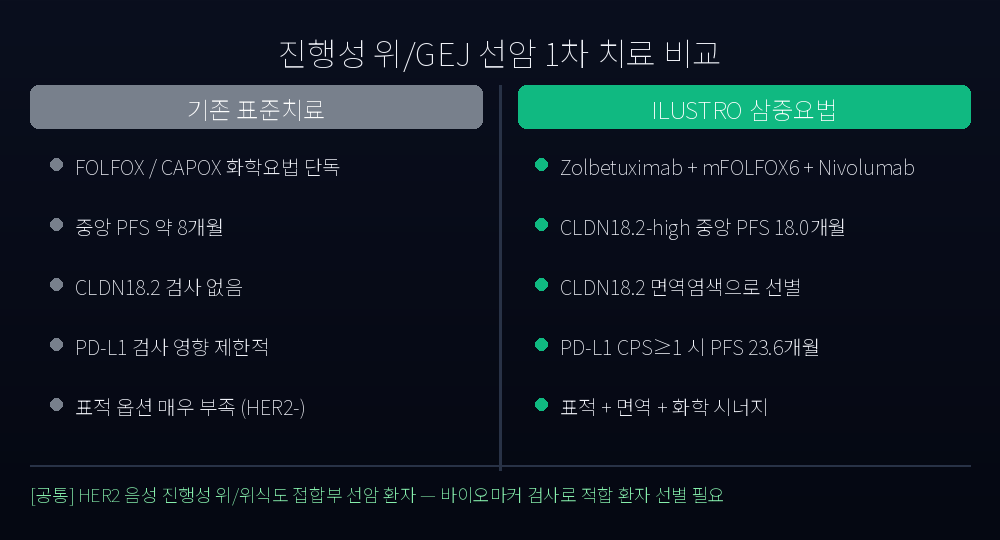
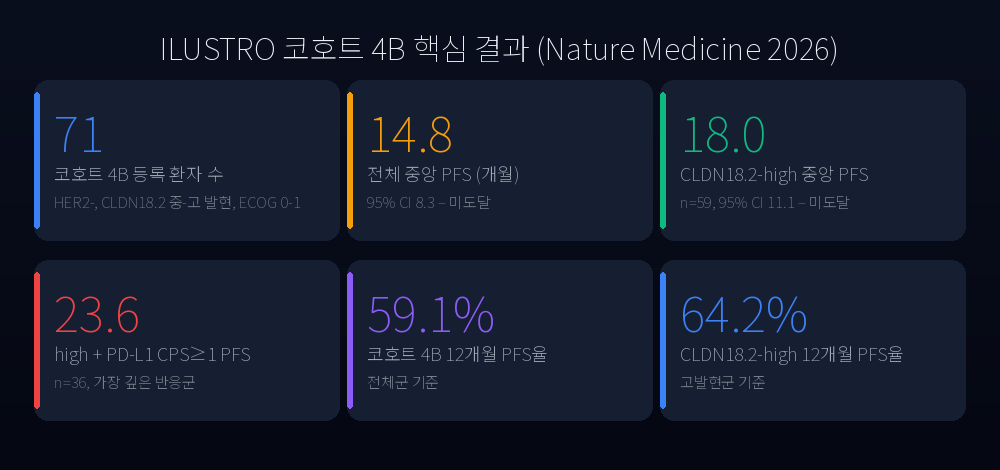
- The Finding: Median PFS was 14.8 months overall, 18.0 months in the CLDN18.2-high subset (n=59), and 23.6 months when patients also had PD-L1 CPS≥1 (n=36). Historical PFS with chemotherapy alone is roughly 7-8 months.
- The Caveat: This is a single-arm phase 2 — randomized phase 3 verification is required before practice changes.

The Key Finding
A phase 2 trial published in Nature Medicine in March 2026 reports that biomarker-selected patients with advanced gastric and gastroesophageal junction adenocarcinoma achieved a median progression-free survival (PFS) more than double what is typically seen with chemotherapy alone. The ILUSTRO Cohort 4 data, presented at the 2026 ASCO Gastrointestinal Cancers Symposium and now formally published, mark the first time a triple-combination of an anti-CLDN18.2 antibody, oxaliplatin-based chemotherapy, and a PD-1 inhibitor has been tested in this setting.
Across all 71 patients in the efficacy expansion (Cohort 4B), median PFS was 14.8 months (95% CI 8.3 to not estimable) at a median follow-up of 11.5 months. The 12-month PFS rate was 59.1%. In patients whose tumors were CLDN18.2-high (n=59), median PFS reached 18.0 months. In a more selected group with both CLDN18.2-high status and PD-L1 combined positive score (CPS) ≥1 (n=36), median PFS climbed to 23.6 months — a number rarely seen in this disease.
Deep Dive: How the Triplet Works
CLDN18.2 — A Stomach-Specific Antigen
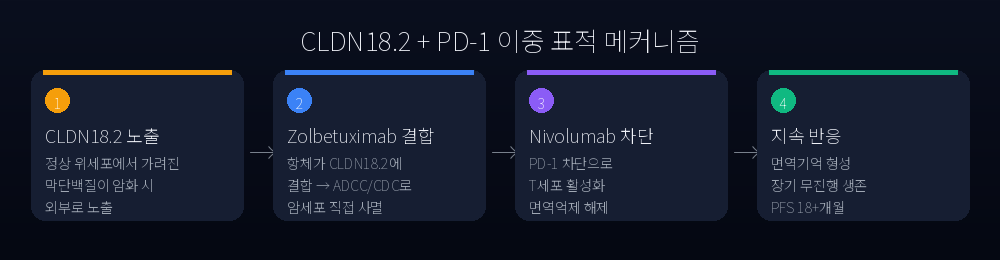
Claudin 18.2 is a tight-junction membrane protein normally restricted to the apical surface of gastric mucosal cells, where it sits buried within intact junctional complexes. During malignant transformation, cell polarity collapses and CLDN18.2 becomes accessible on the tumor cell surface. Crucially, CLDN18.2 expression is retained in gastric-origin tumors even after metastasis, making it a durable target across primary and metastatic sites.
Zolbetuximab is a chimeric IgG1 monoclonal antibody that binds CLDN18.2. Once bound, it recruits two cytotoxic effector arms: antibody-dependent cellular cytotoxicity (ADCC), in which natural killer cells engage the Fc region and lyse the tumor cell, and complement-dependent cytotoxicity (CDC), in which the complement cascade is activated to puncture the cell membrane.
Why Add a PD-1 Blocker
Nivolumab binds the PD-1 receptor on T cells and blocks its engagement with tumor-expressed PD-L1. The mechanistic rationale for adding nivolumab to zolbetuximab + chemotherapy is that the first two components generate immunogenic cell death — releasing tumor antigens that prime new T-cell responses — while PD-1 blockade simultaneously prevents those T cells from being switched off in the tumor microenvironment. The fact that PFS climbed further in the PD-L1 CPS≥1 subgroup is consistent with this hypothesis, though that analysis was exploratory and pre-specified, not powered for definitive conclusions.
Methodology Transparency
ILUSTRO is a global, open-label, multi-cohort phase 2 trial. Cohort 4 enrolled patients with previously untreated, locally advanced unresectable or metastatic gastric/GEJ adenocarcinoma with HER2-negative status, ECOG performance status 0 or 1, and CLDN18.2 expression by immunohistochemistry. Cohort 4A served as a safety lead-in (n=12), followed by Cohort 4B as the efficacy expansion (n=71). The expansion was designed to enroll roughly 50 patients with high CLDN18.2 expression, providing 70-76% power to detect an improvement in median PFS from 8.5 to 12 months versus historical zolbetuximab + chemotherapy controls (one-sided alpha = 0.15).
PFS was assessed by RECIST 1.1 and reported as a single-arm point estimate — there is no randomized comparator within the study. The 23.6-month PFS observed in the CLDN18.2-high + PD-L1 CPS≥1 subgroup came from a pre-specified subset analysis (events 13/36 = 36.1%), and confidence intervals are wide.
How This Compares to Prior Trials
The treatment landscape for HER2-negative advanced gastric cancer has been frustratingly thin. Historical median PFS with FOLFOX or CAPOX chemotherapy alone is roughly 7-8 months. The pivotal phase 3 GLOW and SPOTLIGHT trials (both 2023) established that adding zolbetuximab to chemotherapy extends PFS to roughly 8-9 months in CLDN18.2-positive patients. Anti-PD-1 therapy added to chemotherapy (CheckMate-649, KEYNOTE-859) modestly improves survival, with the largest benefit concentrated in PD-L1-high tumors.
ILUSTRO’s contribution is to combine all three mechanisms — direct CLDN18.2-targeted killing, cytotoxic chemotherapy, and PD-1 checkpoint blockade — in a biomarker-selected population. The 18-month median PFS in the CLDN18.2-high subset is roughly double the historical benchmark for any single approach.
Caveats: What the Trial Did Not Prove
Three caveats deserve attention before this becomes a standard-of-care discussion.
Single-arm, no randomization. ILUSTRO Cohort 4B does not include a contemporaneous randomized control. Comparisons to historical PFS benchmarks are informative but susceptible to patient selection differences, supportive-care advances, and biomarker-testing artifacts. The 14.8-month and 18.0-month figures cannot yet be directly contrasted with a randomized alternative.
Overall survival is immature. With a median follow-up of 11.5 months, OS data are early. A PFS gain may or may not translate into OS gain depending on subsequent-line therapies and the durability of response. Longer follow-up is essential.
Selection effects. Enrolled patients had ECOG 0-1, were HER2-negative, and had at least moderate CLDN18.2 expression. Real-world patients are sicker, have more comorbidities, and present with a wider distribution of biomarker statuses. The safety profile in Cohort 4B was manageable and consistent with prior zolbetuximab experience, with no new signals — but infusion reactions, nausea/vomiting (common with zolbetuximab), and immune-related adverse events (immune pneumonitis, thyroid dysfunction, hepatitis) from nivolumab all require active monitoring.
A phase 3 randomized trial is needed before this regimen can be considered a new standard. Until then, ILUSTRO Cohort 4B is a strong hypothesis-generating signal — not a verdict.
What This Means For You
If you or a family member has been diagnosed with advanced or metastatic gastric or gastroesophageal junction cancer, here is what is practically actionable from this evidence base, framed as questions to bring to your oncologist.
Ask about molecular profiling at diagnosis. Standard practice in advanced gastric cancer now requires testing for HER2, PD-L1 CPS, and microsatellite instability (MSI). CLDN18.2 testing by immunohistochemistry is increasingly available and was the gating biomarker in ILUSTRO. The mechanism: each marker maps to a different drug class. Without the test, treatment selection is essentially blind. Approximately 38% of gastric/GEJ adenocarcinomas show CLDN18.2 immunohistochemistry intensity of 2+ or higher.
Discuss zolbetuximab eligibility if CLDN18.2-positive and HER2-negative. Zolbetuximab (brand name Vyloy) was approved by the U.S. FDA in October 2024 for CLDN18.2-positive, HER2-negative advanced gastric/GEJ adenocarcinoma in combination with chemotherapy, based on the GLOW and SPOTLIGHT phase 3 trials. The mechanism: ADCC and CDC against CLDN18.2-expressing tumor cells. Adding immunotherapy as a triplet is not yet a standard option outside trials, but the conversation about clinical trial enrollment is now reasonable.
Treat Helicobacter pylori infection if positive. The mechanism: H. pylori is classified as a Group 1 carcinogen by IARC, driving chronic inflammation and intestinal metaplasia. A 2020 Cochrane review of randomized trials concluded that eradication therapy reduces gastric cancer incidence by roughly 30-40% in asymptomatic infected populations. Standard triple or quadruple therapy lasts 10-14 days and is well-tolerated.
Reduce dietary salt intake. The mechanism: high sodium intake damages gastric mucosa, promotes H. pylori colonization, and is consistently associated with elevated gastric cancer risk in cohort studies. Practical target: under 2,000 mg sodium/day, per WHO. Reduce processed meats, pickled and salt-cured foods, and high-sodium soups and sauces.
Consider clinical trial enrollment. The mechanism: trial enrollment provides access to therapies not yet approved, often at no out-of-pocket drug cost. For advanced gastric cancer with CLDN18.2 expression, ongoing phase 3 trials of zolbetuximab-based combinations are actively recruiting. Discuss timing carefully with your oncologist, because eligibility windows often close after first-line therapy.
This content is for informational purposes only and is not a substitute for professional medical advice, diagnosis, or treatment. Always seek the advice of your physician or other qualified health provider with any questions you may have regarding a medical condition.
References
- Nature Medicine, 2026. “First-line zolbetuximab plus mFOLFOX6 and nivolumab in unresectable CLDN18.2-positive gastric or gastroesophageal junction adenocarcinoma: a phase 2 trial.” DOI: 10.1038/s41591-026-04306-9
- Shah MA, et al. GLOW trial. Nature Medicine, 2023.
- Shitara K, et al. SPOTLIGHT trial. Lancet, 2023.
- Janjigian YY, et al. CheckMate-649. Lancet, 2021.
- Rawla P, Barsouk A. Epidemiology of gastric cancer. Prz Gastroenterol, 2019.
- Ford AC, et al. Helicobacter pylori eradication therapy to prevent gastric cancer in healthy asymptomatic infected individuals. Cochrane Database, 2020.