
TL;DR
- The Study: In RASolute 302, a global phase 3 trial published alongside NEJM phase 1/2 data in May 2026, oral daraxonrasib roughly doubled median overall survival in previously treated RAS-mutated pancreatic ductal adenocarcinoma (PDAC) - 13.2 vs 6.7 months, hazard ratio 0.40.
- The Mechanism: It is the first drug to engage the active, GTP-bound “ON state” of RAS via a cyclophilin A molecular-glue tri-complex - a target shape biologists called “undruggable” for three decades.
- The Caveat: Any-grade rash hit 91% of patients. Long-term resistance, first-line randomized data, and access cost remain open questions.
A New Drug Doubled Survival in Pancreatic Cancer. That Almost Never Happens.
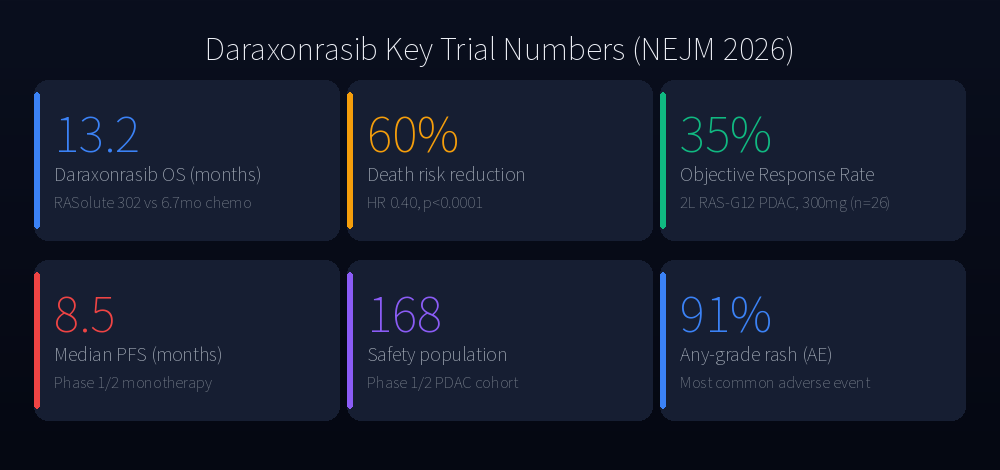
On May 7, 2026, the New England Journal of Medicine published phase 1/2 data on daraxonrasib (RMC-6236) in advanced RAS-mutated PDAC (Wolpin et al., NEJMoa2505783). The same drug was then reported in the global phase 3 RASolute 302 trial: median overall survival of 13.2 months on daraxonrasib versus 6.7 months on standard chemotherapy, with a hazard ratio of 0.40 and p<0.0001. That is a 60% reduction in the risk of death.
To understand why oncologists are framing this as a category-redefining result rather than a routine drug approval, you need a reference point. Since the FDA approved gemcitabine in 1996, second-line median OS for metastatic PDAC has hovered between 6 and 8 months. The 2011 FOLFIRINOX and 2013 nab-paclitaxel regimens improved first-line survival modestly but never broke the second-line ceiling. A near-doubling has not happened in this disease for roughly thirty years.
Deep Dive: Why RAS Was “Undruggable” for 30 Years
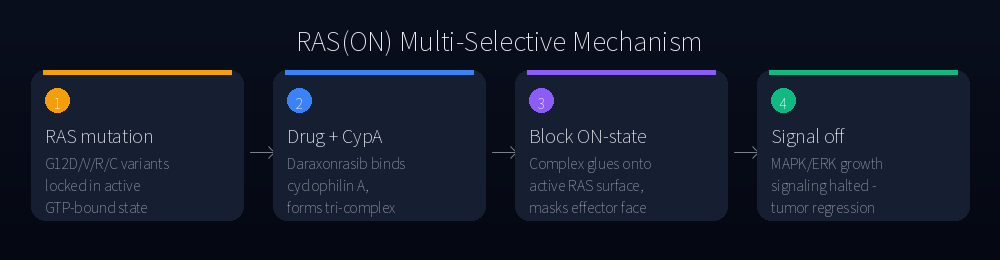
RAS proteins are master switches for cellular growth signaling. They cycle between an inactive GDP-bound OFF state and an active GTP-bound ON state. Mutated RAS gets stuck in the ON state, broadcasting growth signals continuously. More than 90% of pancreatic adenocarcinomas are driven by KRAS mutations - the highest RAS dependency of any major cancer.
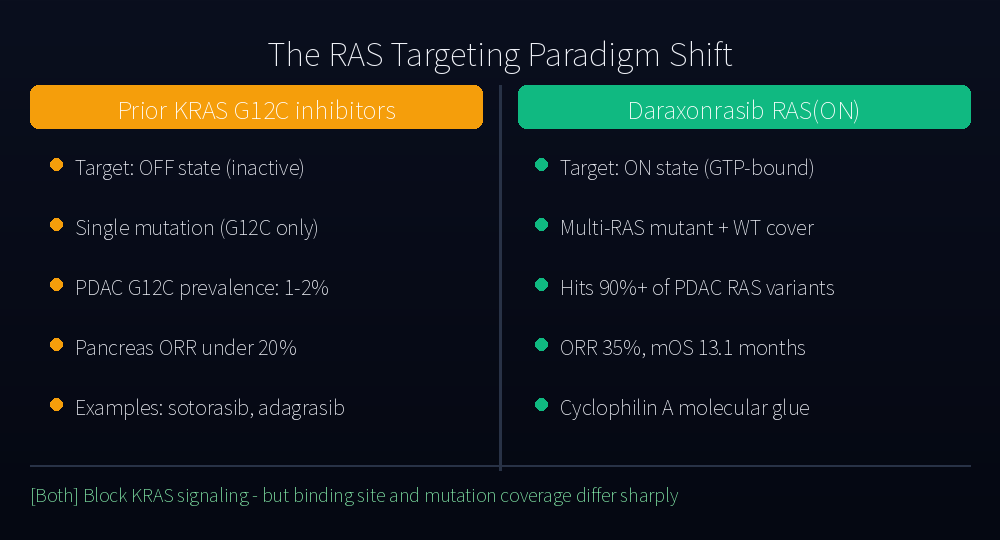
The drug-development problem was structural. RAS has a smooth, featureless surface with no obvious binding pocket large enough for a small molecule. The first breakthrough came in 2021 when sotorasib received FDA approval for KRAS G12C-mutated lung cancer, but it relied on a very specific trick - covalently binding to the cysteine residue introduced by the G12C mutation in the inactive OFF state.
That approach hit a wall in pancreatic cancer. The KRAS mutation distribution in PDAC is roughly G12D 41%, G12V 30%, G12R 17%, with G12C accounting for only 1-2% (Bryant et al., 2014; Waters & Der, 2018). A drug fitted to G12C is the wrong key for 98% of PDAC patients. Predictably, sotorasib and adagrasib produced sub-20% objective response rates in PDAC subsets - clinically meaningful for a few patients, irrelevant for the field.
Daraxonrasib differs on two architectural axes:
- It binds the ON state, not the OFF state. This matters because PDAC tumors are signaling-addicted to active RAS; reducing the OFF-state pool was always a partial intervention.
- It is multi-selective across RAS variants rather than a single-mutation lock. The drug works as a molecular glue: it first complexes with cyclophilin A, an abundant intracellular chaperone, and the resulting tri-complex then docks onto the active RAS surface and blocks downstream RAF/MEK/ERK signaling. That single mechanism covers G12D, G12V, G12R, G12C, plus wild-type RAS - addressing the dominant PDAC mutation landscape rather than a 1-2% slice of it.
Methodology Transparency: What the Trials Actually Showed
The NEJM paper reports a phase 1/2 dose-escalation and expansion study in 168 PDAC patients receiving 10 to 400 mg orally once daily. The phase 3 dose was set at 300 mg. Within the second-line, RAS-G12 mutation, 300 mg cohort (n=26):
- Objective Response Rate: 35% (95% CI 17-56%)
- Median Progression-Free Survival: 8.5 months (95% CI 6.7-10.5)
- Median Overall Survival: 13.1 months (95% CI 10.9-NE)
In a first-line cohort with median follow-up of 13.7 months, ORR was 47%, disease control rate 92%, and 6-month PFS 71%.
RASolute 302 is the confirmatory step. It enrolled previously treated metastatic PDAC patients with RAS mutations and randomized 1:1 to daraxonrasib or investigator’s choice chemotherapy (regimens such as FOLFIRI or modified FOLFOX). The trial used overall survival and progression-free survival as co-primary endpoints. The reported hazard ratio of 0.40 with p<0.0001 in the intent-to-treat population means the chance that this magnitude of benefit occurred by chance is vanishingly small. Detailed subgroup analyses by mutation subtype and full primary results are scheduled for plenary presentation at ASCO 2026.
Safety - The Honest Picture
Among 168 PDAC patients dosed at 300 mg or below, treatment-related adverse events occurred in 96% (any grade) and 30% (grade 3+). The most frequent events were:
- Rash: 91%
- Diarrhea: 48%
- Nausea: 43%
- Vomiting: 31%
- Stomatitis or mucositis: 31%
- Fatigue: 20%
- Paronychia: 13%
Rash at 91% is materially higher than EGFR-targeted therapies (typically 70-80%) and reflects daraxonrasib’s partial inhibition of wild-type RAS in normal tissues. Dose modifications were common, and chronic management of skin toxicity will be a real-world implementation issue.
Caveats That Headlines Will Skip
- Phase 1/2 second-line monotherapy data rest on 26 patients; the ORR confidence interval (17-56%) is wide.
- First-line data look strong but follow-up is short and the comparator was historical, not randomized.
- Long-term resistance pathways - likely involving secondary RAS mutations or bypass signaling - have barely been characterized.
- Patients with non-G12 RAS variants (Q61, A146) are underrepresented; subgroup efficacy remains open.
What This Means For You
Pancreatic cancer remains one of the deadliest cancers globally, with five-year survival hovering around 12-13% in the United States and similar rates in most developed countries. A randomized doubling of second-line OS is rare enough that even cautious oncologists are using the word “transformative.” But translating a trial result into a personal decision requires several specific actions, not headline-driven panic or hope.
-
Confirm RAS mutation testing if you or a family member has PDAC. This is not yet routine in many centers because no targeted therapy was previously useful. That is changing fast. Tissue-based or ctDNA (liquid biopsy) testing can identify the specific KRAS variant; the typical turnaround is 7-14 days. Knowing whether you carry G12D, G12V, G12R, or G12C will determine eligibility for daraxonrasib trials and any future RAS(ON)-class drug.
-
Map the trial landscape carefully. The RASolute 302 trial has completed enrollment, but expansion cohorts and combination studies (daraxonrasib with chemotherapy or with immune checkpoint inhibitors) are actively recruiting in the United States, Europe, and parts of Asia. ClinicalTrials.gov listings under “daraxonrasib” or NCT identifiers tied to Revolution Medicines are the authoritative source. Major academic cancer centers - Dana-Farber, MD Anderson, Memorial Sloan Kettering, Mayo Clinic - are leading sites.
-
Do not abandon current effective therapy. If your current regimen is controlling disease with tolerable side effects, switching to a trial drug carries opportunity cost. Trial enrollment timing usually aligns with documented progression or unacceptable toxicity on standard therapy.
-
Plan for skin toxicity if you start treatment. Prophylactic skincare protocols (gentle cleansers, fragrance-free moisturizers twice daily, sun protection SPF 50+, doxycycline 100 mg twice daily for high-grade rash management as used in EGFR-inhibitor protocols) reduce severity. A dermatology consult before starting is increasingly standard.
-
Discuss familial risk assessment. A first-degree relative with PDAC raises individual lifetime risk roughly 6.4-fold (National Familial Pancreatic Tumor Registry, 2018), and BRCA1/BRCA2, PALB2, ATM, CDKN2A, and Lynch syndrome carriers face elevated baseline risk. The American Gastroenterological Association recommends annual MRI/MRCP or endoscopic ultrasound surveillance for patients meeting high-risk criteria starting at age 50 or 10 years before the youngest affected relative’s diagnosis. Early detection still beats every drug we have.
The Bigger Picture
Daraxonrasib’s broader significance is that it falsifies a 30-year assumption: RAS is not undruggable, just badly aimed at. The RAS(ON) tri-complex platform is already producing sister molecules - RMC-6291 for G12C, RMC-9805 for G12D, and others targeting effector pathways. If these confirm, the next 5-10 years will likely see RAS-mutated cancers move from a uniformly grim prognosis category toward something resembling the targeted-therapy revolution that transformed chronic myeloid leukemia after imatinib.
For pancreatic cancer specifically, the wall has not fallen. A 60% reduction in death risk still leaves a disease where most patients die within two years of diagnosis. But for the first time since 1996, the trend line has bent. That is worth treating as a serious, sober milestone - neither a miracle nor a footnote.
This content is for informational purposes only and is not a substitute for professional medical advice, diagnosis, or treatment. Decisions about cancer therapy, clinical trial enrollment, or genetic risk management should be made in consultation with a qualified oncologist or genetic counselor.