
TL;DR
- The study: A single intravenous infusion of VERVE-102, an in vivo base-editing therapy targeting PCSK9, lowered LDL cholesterol by an average 53% (max 69%) at the 0.6 mg/kg dose in 14 patients with familial hypercholesterolemia or premature coronary disease. Reported in Nature Medicine, May 2026.
- Why it matters: Instead of cutting DNA (the classic CRISPR approach), the therapy flips a single base — A to G — to permanently silence the PCSK9 gene in liver cells. Zero treatment-related serious adverse events were reported.
- The caveats: 14 people. Short follow-up. Permanent and irreversible. Not yet approved. The data are a signal, not a verdict.
A One-Time Infusion That Permanently Rewrites a Cholesterol Gene
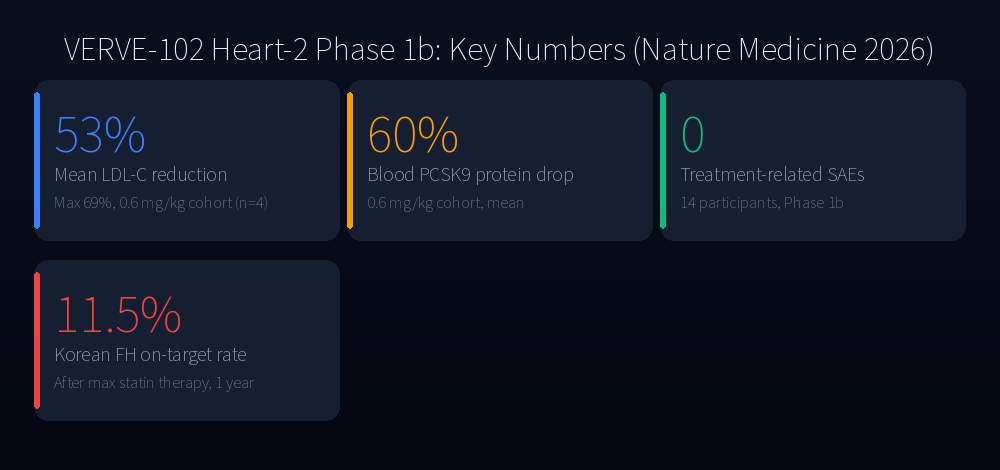
Patients with heterozygous familial hypercholesterolemia (HeFH) live with LDL cholesterol levels that simply do not respond well enough to statins. In Korea, a multicenter cohort study reported by the Korean Society of Lipid and Atherosclerosis found that only 11.5% of FH patients hit the LDL-C goal of less than 100 mg/dL on maximum statin-plus-ezetimibe therapy after one year (Kim et al., J Clin Lipidol, 2019). The picture in Europe and North America is similar.
That clinical gap is what makes the Heart-2 Phase 1b trial of VERVE-102 — developed by Verve Therapeutics and summarized in a May 2026 Nature Medicine editorial — significant. The trial enrolled 14 adults with HeFH and/or premature coronary artery disease and gave each one a single intravenous infusion. The results, by dose cohort:
- 0.3 mg/kg: Mean LDL-C reduction of 21%, mean PCSK9 protein reduction of 46%.
- 0.45 mg/kg: Mean LDL-C reduction of 41%, mean PCSK9 protein reduction of 53%.
- 0.6 mg/kg: Mean LDL-C reduction of 53%, maximum reduction of 69%, mean PCSK9 protein reduction of 60%.
There were zero treatment-related serious adverse events (SAEs) and no clinically significant lab abnormalities. One Grade 2 infusion reaction occurred and resolved with acetaminophen (Verve Therapeutics, Heart-2 Phase 1b readout, April 14, 2025).
Deep Dive — Mechanism: Why “A to G” Matters
Here is the full pathway, end-to-end, because this is where base editing departs from classic CRISPR.
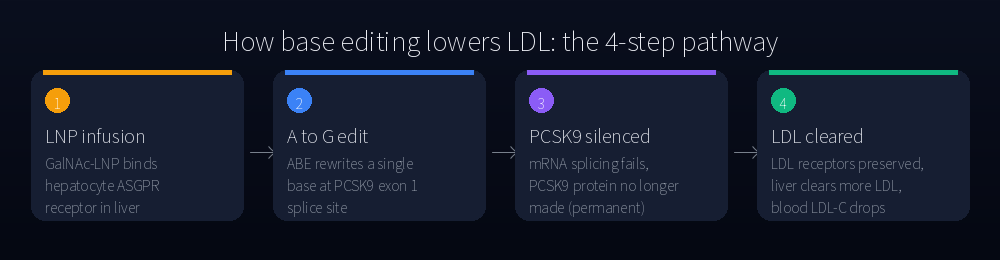
- Targeted delivery to the liver. VERVE-102 is a lipid nanoparticle (LNP) decorated with GalNAc (N-acetylgalactosamine). GalNAc binds with high specificity to the asialoglycoprotein receptor (ASGPR), which is densely expressed on hepatocytes. Result: the drug concentrates in liver cells and largely spares other tissues (Springer & Dowdy, NEJM 2018; Verve mechanism review, Tandfonline, 2024).
- Payload release inside the cell. Once internalized, the LNP releases two cargos: mRNA encoding an adenine base editor (ABE) and a single guide RNA (sgRNA).
- Find the target. The ABE-sgRNA complex scans the hepatocyte genome and locates the canonical splice site in exon 1 of the PCSK9 gene.
- Edit a single letter. Crucially, ABE does not cut the DNA. It deaminates the target adenine, converting it to inosine, which the cell’s replication machinery reads as guanine. The net effect is a precise A-to-G edit at one position (Anzalone et al., Nature 2019; Komor et al., Nature 2017).
- Permanent gene silencing. The corrupted splice site causes PCSK9 mRNA to be processed incorrectly, blocking production of functional PCSK9 protein.
- LDL receptors live longer; LDL clears faster. Normally, PCSK9 escorts the LDL receptor (LDLR) on hepatocyte surfaces to lysosomes for degradation. Without PCSK9, more LDLR remains at the cell surface, more LDL particles are pulled out of the blood, and circulating LDL-C drops.
Why does this matter relative to classic CRISPR? Cas9 nucleases create double-strand breaks that the cell rejoins, which can produce large deletions or chromosomal translocations as off-target events. Base editors leave the backbone intact and change a single letter — a chemically narrower edit. In Heart-2, zero SAEs across 14 dosed participants is a first-pass safety signal consistent with that mechanistic prediction. It is not proof of long-term safety.
Methodology — How the Data Were Generated
A few methodological points matter for interpreting the headline numbers.
- Design: Heart-2 is an open-label, single-arm, dose-escalation Phase 1b study (NCT05996940). Open-label means there is no placebo control, and dose-escalation means later cohorts received higher doses after safety review of earlier cohorts. This design is standard for first-in-human gene therapies but limits the strength of efficacy inference.
- Population: All 14 participants had clinically and/or genetically confirmed HeFH or premature CAD, with elevated LDL-C despite ongoing background lipid-lowering therapy. Generalizing to non-FH populations would require additional trials.
- Primary endpoint: Safety and tolerability. Secondary endpoints: change in blood PCSK9 protein and LDL-C. The 53% mean LDL-C reduction is a secondary endpoint, observed at a specific timepoint after a single infusion.
- Statistical caveat: With 4 participants in the 0.6 mg/kg cohort, confidence intervals around the 53% mean are necessarily wide. The dose-dependent gradient across cohorts (21% → 41% → 53%) lends biologic plausibility, but the precision of any single point estimate is limited.
Comparing the Four Cholesterol Paradigms
| Therapy | Frequency | Mean LDL reduction | Reversible | Status |
|---|---|---|---|---|
| Statin | Daily pill, lifelong | 30–50% | Yes (stop the pill) | First line, decades of safety data |
| PCSK9 mAb (evolocumab, alirocumab) | SubQ injection every 2–4 weeks | ~60% on top of statin | Yes | Approved; access often gated by cost |
| siRNA (inclisiran) | SubQ injection every 6 months | ~50% on top of statin | Slowly reversible (months) | Approved |
| Base editing (VERVE-102) | Single IV infusion | ~53% (Phase 1b, 0.6 mg/kg) | No | Investigational |
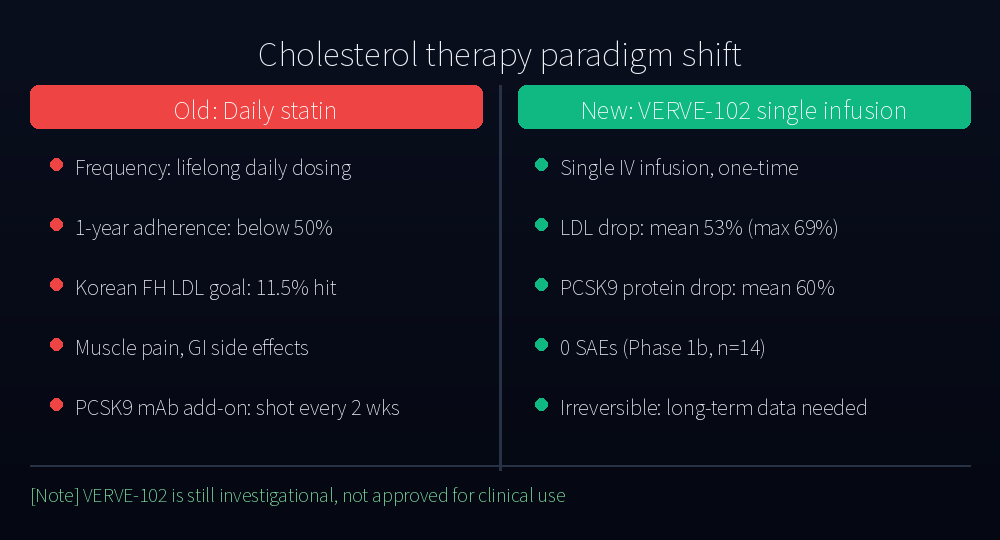
The trade-off becomes obvious: as you move from statin to base editing, the dosing burden falls and the depth-and-durability of effect rises, but so does the irreversibility — and the unknown long-term risk.
Caveats — What This Trial Doesn’t Tell Us Yet
- Sample size: 14 participants is enough to detect a safety signal only if it is common. Rare adverse events would require thousands of patients.
- Duration: PCSK9 loss-of-function carriers have lifelong low LDL with low cardiovascular risk and no clearly established harm (Cohen et al., NEJM, 2006). But induced editing in adults is not the same as a lifelong germline variant, and 12-month follow-up cannot rule out late effects.
- Irreversibility: An A-to-G edit cannot be undone with current technology. Any future safety concern cannot be addressed by “stopping the drug.”
- Population specificity: The trial selected patients with FH and/or premature CAD — a population where benefit likely outweighs risk. Whether base editing should be offered to broader populations with moderately elevated LDL is an open question.
- Cost and access: One-time gene therapies in the U.S. have launched at price tags from $500,000 to over $2 million. Even if pricing is far lower, payor coverage and patient access will determine real-world impact.
What This Means For You
If you (or a family member) have a personal or family history suggesting familial hypercholesterolemia — for example, premature heart attack or stroke before age 55 in a male or 60 in a female first-degree relative, plus baseline LDL-C above 190 mg/dL — these are the practical actions backed by current guidelines.
- Get a cascade-screening conversation with your doctor. The Dutch Lipid Clinic Network criteria and Simon Broome criteria are validated tools for identifying clinical FH; genetic testing for LDLR, APOB, and PCSK9 variants is available in many countries. Cascade screening of first-degree relatives can identify multiple cases per index patient (Wilemon et al., JACC, 2020).
- Confirm your individual LDL-C goal. Current guidelines (AHA/ACC 2018, ESC/EAS 2019, KSoLA 2022) place most patients with established atherosclerotic cardiovascular disease at an LDL-C target below 55 mg/dL (1.4 mmol/L). Check the most recent number on your lipid panel against your goal.
- Audit your statin adherence honestly. Adherence below 80% over the past month is associated with roughly 30% loss of cholesterol-lowering benefit (Lansberg et al., Vasc Health Risk Manag, 2018). If you have skipped doses or stopped due to side effects, raise it with your clinician — alternative statins, lower doses with add-on ezetimibe, or PCSK9 inhibitors are all options.
- Reduce saturated and trans fat first, before “low cholesterol food” marketing. A Cochrane review of 15 randomized trials (n=59,000) found that reducing saturated fat by replacing it with unsaturated fat lowered LDL by roughly 10–15% within weeks (Hooper et al., Cochrane Database, 2020). Dietary cholesterol per se has a smaller effect than once thought.
- Exercise — for LDL and beyond. A meta-analysis of aerobic plus resistance training shows LDL reductions of 6–10% with 150 minutes per week of moderate aerobic activity plus 2 sessions of resistance training (Kelley et al., J Lipid Res, 2014). The effect on LDL is modest, but the effect on overall cardiovascular risk via HDL, insulin sensitivity, and blood pressure is larger.
Bottom Line
A one-time DNA edit that durably lowers LDL by half is no longer a thought experiment — it is a 14-patient Phase 1b dataset published in a top-tier journal. That is a meaningful milestone in cardiovascular medicine. It is also early, irreversible, and not yet a treatment you can choose. Watch the Phase 2 and Phase 3 trials. In the meantime, the boring interventions — adherence, diet, movement, and screening of at-risk relatives — still deliver more measurable benefit, today, than any therapy on the horizon.
This content is for informational purposes only and is not a substitute for professional medical advice, diagnosis, or treatment. Always seek the advice of your physician or other qualified health provider.
References
- Verve Therapeutics. Positive Initial Data from the Heart-2 Phase 1b Clinical Trial of VERVE-102. April 14, 2025.
- Nature Medicine Editorial. Base editing milestone for familial hypercholesterolemia. Nature Medicine, May 2026.
- Anzalone AV et al. Search-and-replace genome editing without double-strand breaks or donor DNA. Nature, 2019.
- Komor AC et al. Programmable editing of a target base in genomic DNA without double-stranded DNA cleavage. Nature, 2017.
- Cohen JC et al. Sequence variations in PCSK9, low LDL, and protection against coronary heart disease. NEJM, 2006.
- Kim H et al. Target achievement with maximal statin-based lipid-lowering therapy in Korean patients with familial hypercholesterolemia. J Clin Lipidol, 2019.
- Hooper L et al. Reduction in saturated fat intake for cardiovascular disease. Cochrane Database Syst Rev, 2020.
- Kelley GA et al. Effects of aerobic exercise on lipids and lipoproteins. J Lipid Res, 2014.