
TL;DR
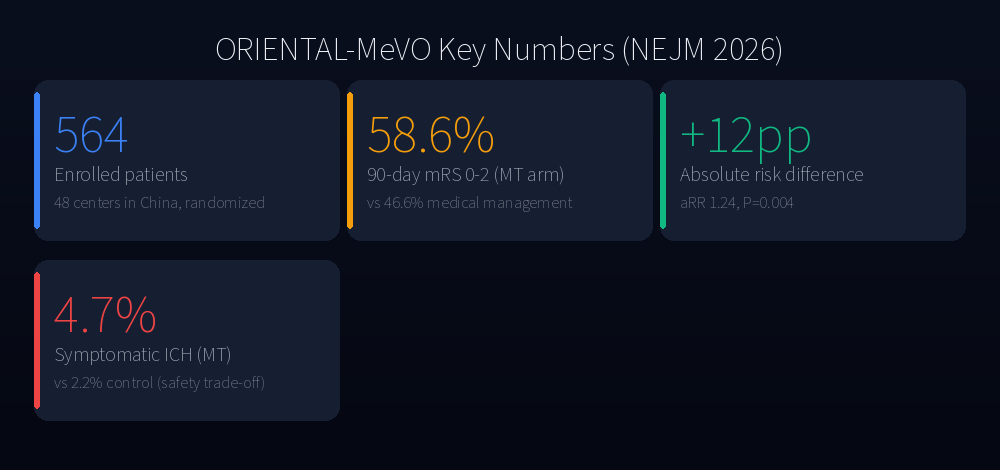
- The study: ORIENTAL-MeVO (NEJM, May 2026) randomized 564 patients at 48 Chinese centers and showed thrombectomy improved 90-day functional independence in medium-vessel occlusion (MeVO) stroke (58.6% vs 46.6%; aRR 1.24, P=0.004).
- The twist: Three Western randomized trials (ESCAPE-MeVO, DISTAL, DISCOUNT) had all been negative. The difference comes down to patient selection — the benefit was confined to patients with NIHSS scores of 8 or higher.
- The action: For stroke patients and families, the practical takeaway is unchanged but more urgent — recognize FAST signs, call emergency services within the 24-hour treatment window, and request transfer to a comprehensive stroke center.
Stroke Thrombectomy in Medium Vessels: NEJM 2026 Redraws the Line
For a decade, mechanical thrombectomy has been the standard of care for large-vessel occlusion (LVO) ischemic stroke. Whether the same procedure helps when the clot sits in the smaller, more peripheral branches — medium-vessel occlusions (MeVO), which cause 25 to 40 percent of all ischemic strokes — has been one of stroke medicine’s biggest open questions.
Between late 2025 and early 2026, three Western trials answered: no. ESCAPE-MeVO, DISTAL, and DISCOUNT all failed to show benefit. The field appeared to be settling on a “MeVO is too small to treat” conclusion. Then, in May 2026, the New England Journal of Medicine published ORIENTAL-MeVO from 48 centers in China — the first positive randomized result. The story is not just about whether thrombectomy works for MeVO. It is about how patient selection changes what “works” even means.
What is a Medium-Vessel Occlusion?
Cerebral arteries are graded by caliber. Large-vessel occlusions involve the internal carotid artery or the proximal middle cerebral artery (M1). Medium-vessel occlusions involve the M2 and M3 branches of the middle cerebral artery, plus comparable segments of the anterior cerebral artery (A2/A3) and posterior cerebral artery (P2). Distal-vessel occlusions are smaller still.
MeVO is a difficult target for three reasons. First, the catheters and stent retrievers must navigate sharper bends, raising the risk of vessel injury. Second, clinical severity varies widely — an M2 occlusion in the motor cortex produces high NIHSS scores; the same caliber clot in a non-dominant temporal branch may be nearly silent. Third, collateral circulation can rescue some patients without intervention, diluting the apparent benefit of thrombectomy in randomized trials.
Deep Dive: What ORIENTAL-MeVO Actually Found
ORIENTAL-MeVO was an open-label randomized trial with blinded outcome assessment. The investigators enrolled 564 patients across 48 Chinese centers (ClinicalTrials.gov NCT06146790). Inclusion required onset within 24 hours and a baseline NIHSS score of 6 or higher, signaling moderate to severe deficit. Patients were randomized 1:1 to thrombectomy plus best medical management or best medical management alone. The primary endpoint was the proportion achieving a modified Rankin Scale score of 0 to 2 — functional independence — at 90 days.
The headline numbers:
- Functional independence: 58.6% in the thrombectomy arm vs 46.6% in the control arm. Adjusted risk ratio 1.24 (95% CI 1.07–1.44), P=0.004.
- Symptomatic intracranial hemorrhage: 4.7% vs 2.2%. The procedure roughly doubled the risk of bleeding into the brain.
- All-cause mortality at 90 days: 11.1% vs 10.2%. Not statistically different.
A 12-percentage-point absolute improvement implies a Number Needed to Treat of about 8 — meaning roughly one in every eight patients treated will gain functional independence they would not otherwise have. This is weaker than the NNT of about 2.6 seen in pooled LVO trials (HERMES meta-analysis), but clinically meaningful for a condition where the alternative is often lifelong disability.
A critical subgroup finding shifts how the result should be read. Pre-specified analyses showed that the benefit was concentrated in patients with NIHSS scores of 8 or higher. Below that threshold, thrombectomy did not significantly outperform medical management — and the bleeding risk remained.
Why Three Western Trials Said No
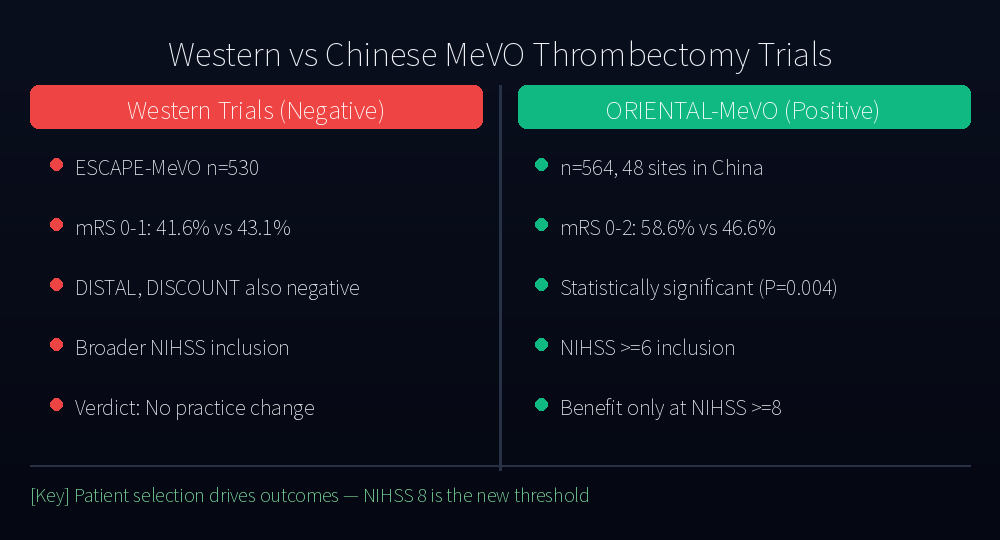
ESCAPE-MeVO randomized 530 patients across the United States, Canada, Germany, Hungary, and the United Kingdom. The primary endpoint was a modified Rankin Scale score of 0 to 1 at 90 days — a stricter bar than ORIENTAL-MeVO’s mRS 0 to 2. The result: 41.6% with thrombectomy versus 43.1% with medical management; adjusted risk ratio 0.95. No benefit. DISTAL and DISCOUNT reported the same direction.
Three methodological differences explain the divergence (Neuronews International coverage of ISC 2026 and Stroke, 2025):
- Inclusion threshold: ESCAPE-MeVO and DISTAL accepted patients with milder deficits. ORIENTAL-MeVO restricted to NIHSS 6 or higher, and the benefit emerged only above NIHSS 8.
- Outcome scale: A stricter primary endpoint (mRS 0–1 vs 0–2) reduces the statistical power to detect partial recovery. Patients shifted from severe disability to mild disability count in the broader scale.
- Operator experience and device selection: Some commentators have pointed to differences in catheter type and operator volume between regions, although the ORIENTAL investigators have not formally attributed the result to these factors.
The clinical implication is that the Western trials may not have been answering the question that mattered most. They asked “does thrombectomy help unselected MeVO patients?” — and the answer, fairly, was no. ORIENTAL-MeVO asked “does thrombectomy help moderately-to-severely affected MeVO patients?” — and the answer, fairly, was yes.
Mechanism: Why NIHSS 8 Marks the Line
Stroke severity is not a continuous slope. It reflects how much functional brain tissue is at risk in the ischemic penumbra — the band of stunned but salvageable cells around the infarct core. Higher NIHSS scores correspond to larger penumbras for a given vessel caliber, and a larger penumbra means more tissue that thrombectomy can rescue. In the symmetric calculation, the absolute risk of procedural complications (vessel injury, downstream embolization, intracranial hemorrhage) is roughly constant. Below a certain severity threshold, the rescue benefit no longer exceeds the procedural cost. ORIENTAL-MeVO’s data place that crossover near NIHSS 8.
This pathway is more nuanced than “bigger stroke means more upside.” It also depends on imaging biomarkers — collateral score, hypoperfusion volume, infarct core size — that emerged as decisive in LVO trial planning. The next generation of MeVO research will likely move beyond NIHSS to imaging-defined eligibility, much as DAWN and DEFUSE-3 did for LVO in the extended time window.
Caveats
- Population generalizability: ORIENTAL-MeVO enrolled an exclusively Chinese cohort. Differences in vascular anatomy, intracranial atherosclerosis prevalence, and clot composition between East Asian and European populations may not fully translate. Independent replication is needed.
- Single positive trial vs three negatives: One positive trial does not overturn three negatives. Most likely the field will move toward a unified interpretation — thrombectomy helps a defined subset of MeVO patients — rather than declaring blanket efficacy.
- The bleeding signal is real: A doubling of symptomatic ICH from 2.2% to 4.7% must be weighed for each individual patient. Anticoagulation use, age, and infarct core size all alter the risk-benefit balance.
- Trial population vs everyday clinic: Patients in trials often present faster and at higher-volume centers than the broader stroke population. Real-world effect sizes may be smaller.
What This Means For You
For most readers, the most useful response to this study is not new — it is more urgent. Because the new evidence depends on accurate stroke severity assessment within a narrow window, the value of fast, accurate hospital arrival has grown, not shrunk.
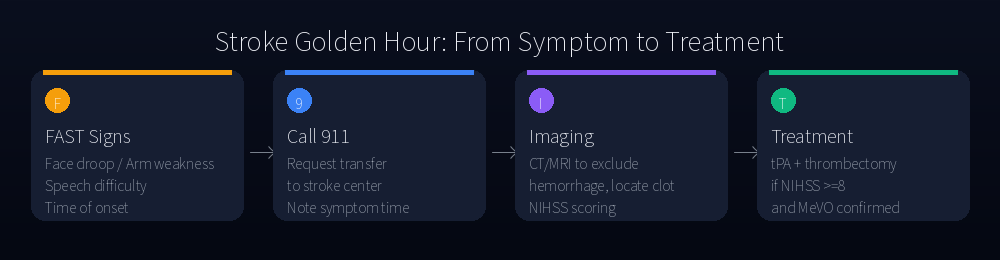
- Memorize FAST. Face drooping on one side, Arm weakness on one side, Speech difficulty, Time to call emergency services. Any single sign is enough. Mechanism: one hemisphere’s blood supply is interrupted, and the contralateral motor and language functions fail first. Note the time of onset to the minute if you can.
- Call emergency services — do not drive yourself. Ambulance teams can pre-notify a comprehensive stroke center, which reduces door-to-needle time by 30 to 60 minutes (Lancet Neurology, 2024 meta-analysis). Walk-in patients are routinely delayed.
- Ask for a comprehensive (not just primary) stroke center. Thrombectomy is performed only at comprehensive stroke centers. In the United States, the Joint Commission certifies these — confirm coverage in your region before you ever need it.
- Control the modifiable risks. Hypertension explains roughly 50% of attributable stroke risk worldwide (Lancet, INTERSTROKE 2010, updated 2023). Aim for systolic blood pressure under 130 mmHg if tolerated, and check it at the same time daily for six months to know your real baseline.
- Adhere to secondary prevention if you have already had one stroke or TIA. The first year after a stroke carries the highest recurrence risk. Stopping antiplatelet or anticoagulant therapy on your own raises recurrence two- to three-fold (JAMA Neurology, 2022).
The Bigger Picture
The deeper story in ORIENTAL-MeVO is that stroke care is following the same path as oncology, obesity medicine, and Alzheimer’s therapy: away from “does it work?” and toward “for whom does it work, and at what threshold?” Trial-by-trial, the most informative finding is rarely the primary endpoint. It is the subgroup analysis that tells you where the line falls. Patients and clinicians will spend the next decade getting better at reading those lines.
This content is for informational purposes only and is not a substitute for professional medical advice, diagnosis, or treatment. If stroke symptoms appear, call emergency services immediately. Always seek the advice of your physician or other qualified health provider regarding any medical condition.
References
- New England Journal of Medicine, Vol 394, Issue 19, 2026 — Endovascular Treatment of Medium-Vessel-Occlusion Strokes (ORIENTAL-MeVO; NEJMoa2514120).
- NEJM, 2025 — Endovascular Treatment of Stroke Due to Medium-Vessel Occlusion (ESCAPE-MeVO; NEJMoa2411668).
- Stroke, 2025 — Acute Management of Medium Vessel Occlusion Stroke: New Evidence and a Path Forward.
- Lancet Neurology, 2024 — Pre-hospital notification meta-analysis.
- Lancet, INTERSTROKE study, 2010 (updated 2023) — Global risk factors for stroke.
- OECD Health at a Glance 2025 — Mortality following ischaemic stroke.