
TL;DR
- The Study: MAESTRO-NASH (NEJM, 2024) — a 966-patient, 52-week phase 3 RCT — showed resmetirom resolved MASH in 29.9% of patients vs 9.7% on placebo, and improved fibrosis by at least one stage in 25.9% vs 14.2%.
- The Mechanism: It selectively activates the thyroid hormone receptor-beta (THR-β) in the liver, accelerating fatty acid oxidation directly inside hepatocytes — without the cardiac and bone side effects of conventional thyroid hormones.
- The Caveat: Approved only for F2-F3 fibrosis. Lifestyle change remains first-line, and ~70% of trial participants did not meet the resolution endpoint.
After 20 Years, the First Drug for MASH Arrives
On March 14, 2024, the U.S. Food and Drug Administration granted accelerated approval to resmetirom (brand name Rezdiffra) for adults with non-cirrhotic metabolic dysfunction-associated steatohepatitis (MASH, formerly NASH) and moderate-to-advanced fibrosis. It was the first drug ever approved for this condition.
For two decades, hepatologists had nothing to offer except “lose weight, cut alcohol, exercise more.” Off-label use of pioglitazone and vitamin E persisted, but no agent had a regulatory indication. The MAESTRO-NASH results, published in the New England Journal of Medicine in February 2024 (Harrison et al.), changed that.
Why MASH Was So Hard to Treat
A naming note: in 2023, the American Association for the Study of Liver Diseases (AASLD), the European Association for the Study of the Liver (EASL), and the Latin American Association for the Study of the Liver (ALEH) jointly renamed NAFLD/NASH to MASLD/MASH. This wasn’t cosmetic — it shifted the diagnostic logic from a diagnosis of exclusion (“not alcohol-driven”) to one of inclusion (“metabolically driven”), defined by the presence of cardiometabolic risk factors.
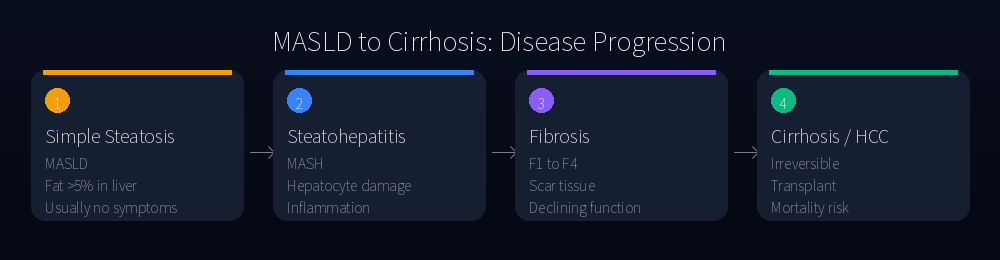
Where a patient stops on this spectrum determines their outcome. Simple steatosis (MASLD) is often reversible with weight loss. Once inflammation and hepatocyte ballooning develop (MASH), spontaneous reversal becomes uncommon. Once fibrosis reaches F3-F4, much of it is irreversible.
Why did prior drug candidates fail so consistently? Because MASH is not one disease — it is the convergence of insulin resistance, lipotoxicity, oxidative stress, and inflammation. Pioglitazone improved insulin resistance but caused weight gain. Vitamin E reduced oxidative stress but only modestly. Obeticholic acid (a farnesoid X receptor agonist) showed histologic benefit in the REGENERATE trial but was rejected by the FDA in 2023 due to pruritus and LDL elevation. Each single-pathway intervention hit a ceiling.
A Closer Look at the MAESTRO-NASH Data
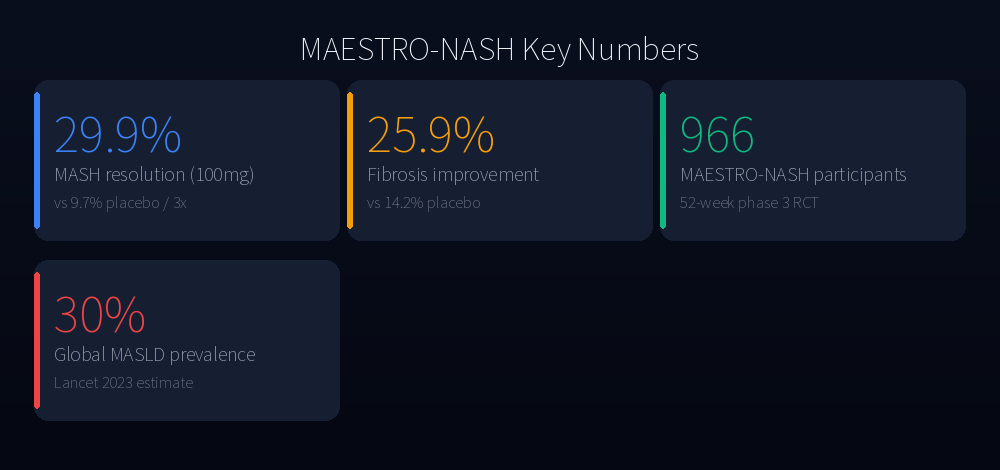
Study design (Methodology Transparency): MAESTRO-NASH was a multinational, double-blind, placebo-controlled phase 3 RCT. Investigators enrolled 966 patients with biopsy-confirmed MASH and fibrosis stage F1B, F2, or F3. Participants were randomized 1:1:1 to placebo, resmetirom 80 mg, or resmetirom 100 mg, taken orally once daily for 52 weeks. The two co-primary histologic endpoints (assessed by central, blinded pathologists) were:
- MASH resolution: disappearance of steatohepatitis on biopsy, with a ≥2-point reduction in the NAFLD Activity Score (NAS), and no worsening of fibrosis.
- Fibrosis improvement: a reduction of at least one stage in fibrosis without worsening of NAS.
Both co-primary endpoints met statistical significance versus placebo (P<0.001). At the 100 mg dose, MASH resolution was 29.9% (vs 9.7% placebo) and fibrosis improvement was 25.9% (vs 14.2% placebo). The MRI-PDFF subgroup showed a ≥30% reduction in liver fat fraction in roughly half of treated patients at the higher dose.
Competing hypotheses: The prevailing view had been that MASH, as a multifactorial disease, would require combination therapy. MAESTRO-NASH challenges this — a single, well-targeted intervention at the right metabolic node produced clinically meaningful histologic change. That said, the response rate (~30%) leaves a clear gap. The next frontier is phenotype-based selection: which patients respond, and why?
Deep Dive: Why a Thyroid Receptor Drug Works on Your Liver
This is where the story gets interesting. Resmetirom is a selective agonist of the thyroid hormone receptor-beta (THR-β). To non-specialists, the connection between thyroid signaling and liver fat is non-obvious.
Here is the full mechanistic pathway, step by step:
- Receptor selectivity: The thyroid hormone receptor has two isoforms. THR-β predominates in the liver; THR-α predominates in the heart and skeletal muscle. Conventional thyroid hormone (T3, levothyroxine) activates both, which is why “thyroid hormone for weight loss” causes tachycardia, muscle wasting, and bone loss — these are THR-α effects.
- Resmetirom’s design: Resmetirom (development code MGL-3196) binds THR-β with approximately 28-fold selectivity over THR-α. It also concentrates in the liver via organic anion transporting polypeptide (OATP) uptake.
- Downstream transcription: Activated hepatic THR-β upregulates genes encoding mitochondrial fatty acid β-oxidation enzymes (CPT1, ACAD family) and the LDL receptor.
- Lipid handling: Increased β-oxidation burns hepatic triglyceride stores. LDL receptor upregulation lowers serum LDL-C — a useful secondary effect in MASH patients, who carry high cardiovascular risk.
- Histologic outcome: Reduced lipotoxicity quiets hepatocyte injury, ballooning, and inflammation — the histologic features that define MASH.
Critically, the THR-β selectivity preserves the liver-specific benefit while sparing cardiac and skeletal muscle. In MAESTRO-NASH, thyroid function tests (TSH, free T4) and resting heart rate were not meaningfully different from placebo. Bone mineral density signals were also reassuring at 52 weeks, though longer follow-up is ongoing.
How does this contrast with the GLP-1 class (semaglutide) or dual GIP/GLP-1 agonists (tirzepatide), which have also shown MASH benefit? GLP-1 agents drive MASH improvement indirectly via weight loss and improved insulin sensitivity. Resmetirom drives improvement directly inside hepatocytes, with minimal weight change. The two approaches may eventually combine: a GLP-1 agent for systemic metabolic disease plus a THR-β agonist for residual liver-specific pathology.
A Note on Lean MASH and Why the Asian Pattern Matters
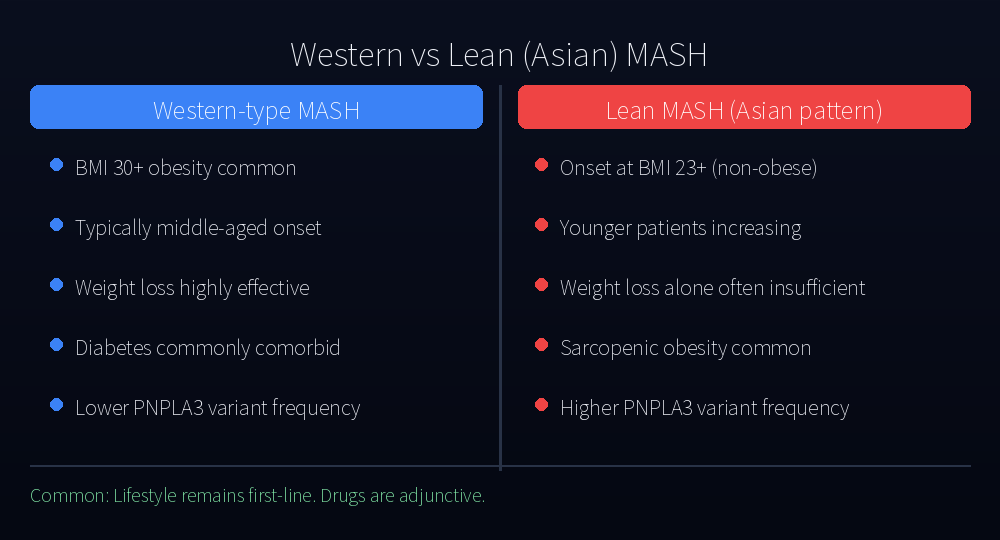
MASH is often imagined as a disease of obesity. In Western cohorts, that picture is broadly accurate. In East Asian populations, it is incomplete.
- Prevalence: A 2023 Lancet meta-analysis estimated global MASLD prevalence at roughly 30% of adults — and East Asia (Korea, Japan, China) is at the upper end of that range.
- Lean MASH: 15-20% of MASLD cases in Korean and Japanese cohorts occur in patients with BMI <25 (KASL 2024 guidance), versus 5-10% in U.S. cohorts. These patients often have visceral adiposity hidden by a normal BMI, plus sarcopenia.
- Genetic susceptibility: The PNPLA3 rs738409 variant (I148M) is strongly associated with MASLD. Its allele frequency in East Asians is approximately 0.45-0.50, roughly double the European frequency. This explains why some normal-weight Asian patients develop progressive disease without the typical metabolic syndrome features.
MAESTRO-NASH enrolled approximately 11% Asian patients — a meaningful but limited sample. Whether resmetirom’s effect size in lean MASH and PNPLA3-driven disease matches that in the broader cohort is an open question. Subgroup analyses and Asia-specific phase 4 studies are needed. The theoretical case is appealing: since resmetirom works independently of weight loss, it could serve patients for whom “lose 10% of body weight” is neither feasible nor sufficient.
What This Means For You
A few things are worth knowing before assuming this drug is for you or someone you know.
- Who qualifies: Resmetirom is approved for adults with biopsy-confirmed or non-invasively diagnosed MASH with F2-F3 fibrosis. Simple steatosis (F0-F1) without significant fibrosis does not qualify, and neither does compensated or decompensated cirrhosis (F4). For F0-F1, lifestyle change remains both the cheapest and most effective intervention.
- How to know your stage: Standard tools are liver biopsy (gold standard but invasive), transient elastography (FibroScan LSM), magnetic resonance elastography (MRE), and serologic scores like FIB-4 (calculated from age, AST, ALT, platelets). FIB-4 <1.3 makes advanced fibrosis very unlikely; FIB-4 >2.67 warrants specialist referral. Ask your physician for a FIB-4 calculation if you have known MASLD.
- Lifestyle is still first-line, with specifics: AASLD 2023 guidance recommends 7-10% body weight reduction (sufficient for histologic improvement in roughly 50-90% of patients depending on magnitude), a Mediterranean-style diet, ≥150 minutes/week of moderate aerobic activity, and resistance training twice weekly. The cardiometabolic risk factors (T2DM, hypertension, dyslipidemia) need active management — they accelerate progression independently of liver-targeted therapy.
- Side effects to know: In MAESTRO-NASH, diarrhea (~27% vs 16% placebo) and nausea (~22% vs 14% placebo) were the most common adverse events, usually mild and improving over time. A small number of patients had ALT elevations >5x upper limit of normal, so periodic liver enzyme monitoring is required.
- Cost and access: List price in the U.S. is approximately USD 47,000/year. Insurance coverage and outside-U.S. availability remain limited; in many countries including South Korea, regulatory approval was still in process as of mid-2026. Do not pursue unregulated overseas purchase without specialist supervision — both for liver safety monitoring and to avoid counterfeits.
The Bottom Line
The arrival of the first MASH-targeted therapy is a meaningful advance after a long drought. But three caveats sit alongside the optimism. First, roughly 70% of patients in the pivotal trial did not achieve the resolution endpoint — this is a step forward, not a cure. Second, long-term outcomes (cirrhosis prevention, liver-related mortality, all-cause mortality) require the ongoing MAESTRO-NASH-OUTCOMES study; histologic improvement at 52 weeks is a surrogate, not a hard outcome. Third, the drug does not displace the foundation of MASH care — weight management, metabolic risk control, and avoidance of hepatotoxins.
If you have been told you have fatty liver disease, the right next step is not waiting for a prescription. It is getting an accurate read on your fibrosis stage, and then making the lifestyle and metabolic changes most likely to keep you out of the F2-F3 zone in the first place.
This content is for informational purposes only and is not a substitute for professional medical advice, diagnosis, or treatment. Always seek the advice of your physician or other qualified health provider with any questions you may have regarding a medical condition.
Key references:
- Harrison SA, Bedossa P, Guy CD, et al. A Phase 3, Randomized, Controlled Trial of Resmetirom in NASH with Liver Fibrosis. N Engl J Med. 2024;390(6):497-509.
- Rinella ME, Neuschwander-Tetri BA, Siddiqui MS, et al. AASLD Practice Guidance on the Clinical Assessment and Management of NAFLD. Hepatology. 2023.
- Younossi ZM, et al. The global epidemiology of NAFLD and NASH. Lancet Gastroenterol Hepatol. 2023.
- Korean Association for the Study of the Liver (KASL). Clinical Practice Guidelines for Nonalcoholic Fatty Liver Disease 2024.