
TL;DR
- The Study: In SCORPIO-PEP (NEJM, May 2026), 2,387 household contacts of a COVID-19 patient took ensitrelvir within 72 hours of the index case’s first symptom. Symptomatic infection through day 10 fell from 9.0% on placebo to 2.9% — a 67% relative risk reduction.
- The Mechanism: Ensitrelvir is a 3CL protease (Mpro) inhibitor, like nirmatrelvir in Paxlovid — but without the ritonavir booster, the dysgeusia, and most of the drug-drug interactions.
- What Changes: This is the first oral antiviral with phase 3 evidence for post-exposure prophylaxis (PEP) in COVID-19. It moves antiviral use from “after diagnosis” to “after exposure” — a paradigm shift, with caveats.
A Drug You Take Because Your Spouse Got Sick
Every approved COVID-19 antiviral, until now, has been a treatment. Paxlovid, Lagevrio, remdesivir — all start after a positive test. If your spouse or child tested positive last weekend and you didn’t, your toolkit was masks, ventilation, and luck.
The SCORPIO-PEP trial, published in the New England Journal of Medicine in May 2026, fills that gap. It is the first phase 3 randomized study to show that an oral antiviral, started in a household contact before they test positive, can prevent symptomatic COVID-19. The drug is ensitrelvir (brand name Xocova, marketed in Japan and Singapore by Shionogi). The effect size — a 67% relative reduction in symptomatic infection — is large enough that the FDA accepted the new drug application for the PEP indication in September 2025, with a PDUFA action date of June 16, 2026.
The headline number is striking. The implications for how we think about household-level COVID-19 care are bigger.
Why Post-Exposure Prophylaxis Matters
Household transmission of SARS-CoV-2 is the dominant route of community spread, and it has stayed high through the Omicron era. A JAMA Network Open meta-analysis of 135 studies across 36 countries (n > 1.3 million) put the household secondary attack rate at 42.7% for Omicron — up from 36.4% for Alpha and 29.7% for Delta. Full vaccination reduces susceptibility to Omicron infection by only about 18%, which means a household exposure is, on the present evidence, roughly a coin flip.
Until SCORPIO-PEP, the only intervention available to that exposed family member was non-pharmaceutical: masking, ventilation, room separation. The treatment toolkit was structurally one step behind transmission — you had to become positive to access it.
The Trial: Design, Endpoints, Numbers
SCORPIO-PEP was a Shionogi-sponsored, double-blind, randomized, placebo-controlled phase 3 study conducted across the United States, Japan, several South American countries, parts of Africa, and Asia. The design choices matter:
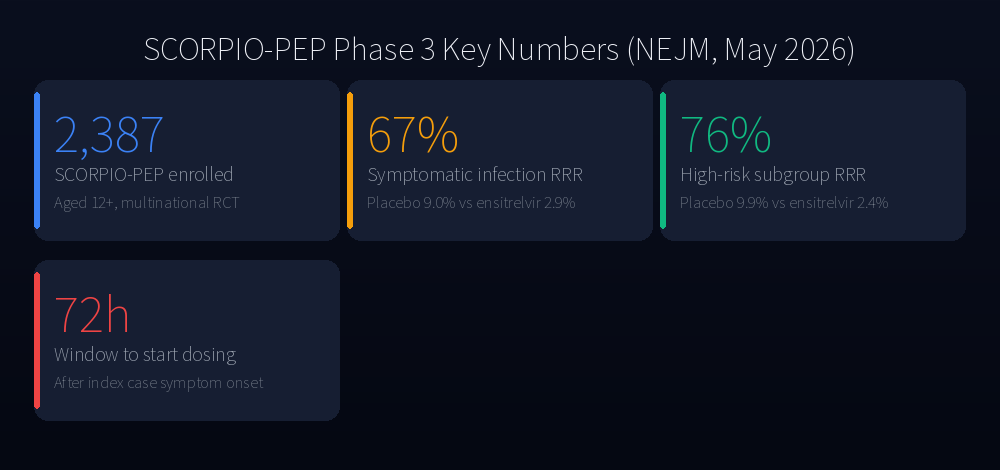
- Population (n = 2,387): Household contacts aged 12 or older of a person with symptomatic, laboratory-confirmed COVID-19. At enrollment, contacts had to test negative on a SARS-CoV-2 screening test and report no symptoms.
- Intervention: Ensitrelvir 375 mg on day 1 (loading dose), then 125 mg once daily on days 2–5, started within 72 hours of symptom onset in the index patient.
- Primary endpoint: Symptomatic SARS-CoV-2 infection (RT-PCR positive plus at least one COVID-19 symptom) through day 10.
- Period: Enrollment from June 2023 through September 2024, covering Omicron-era subvariants including the JN.1 and KP.2 lineages.
The primary endpoint result: 2.9% of contacts on ensitrelvir developed symptomatic COVID-19, versus 9.0% on placebo — a 67% relative risk reduction. A prespecified subgroup of contacts with at least one risk factor for severe disease (older age, BMI ≥ 30, chronic conditions) saw an even larger effect: 2.4% versus 9.9%, a 76% relative reduction.
Safety was unremarkable. Adverse events occurred in 15.1% of the ensitrelvir arm versus 15.5% on placebo. Headache and diarrhea led the list. Crucially, no cases of dysgeusia — the metallic taste so common with Paxlovid that it has a folk name (“Paxlovid mouth”) — were reported. The data were first presented as a late-breaker at CROI 2025 and have now passed full NEJM peer review.
Deep Dive: Why a 3CL Protease Inhibitor Works as PEP
Understanding the mechanism explains both the strength and the limits of the result.
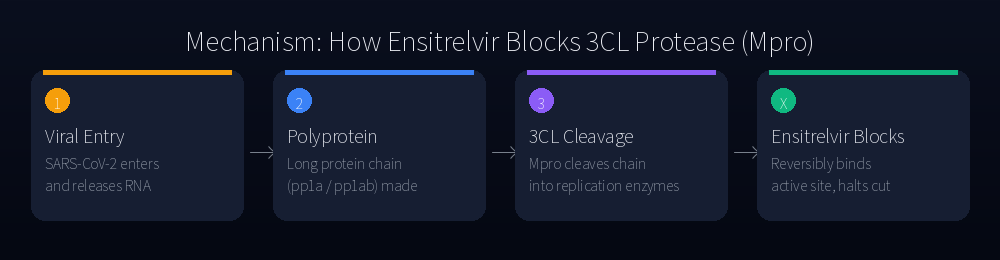
SARS-CoV-2, once it enters a cell, translates two very long protein chains — polyproteins pp1a and pp1ab — from its RNA genome. These chains are functionally inert as written. The virus must cleave them at precise positions to release 16 individual non-structural proteins, including the RNA-dependent RNA polymerase that copies the viral genome. The enzyme that performs almost all of those cuts is the 3CL protease, also called the main protease or Mpro.
Block 3CL, and the polyproteins stay un-cleaved. No active polymerase, no genome replication, no new virions. Because 3CL is essential, highly conserved across coronaviruses, and structurally distinct from any human protease, it is a near-ideal antiviral target.
Ensitrelvir is a non-covalent, reversible inhibitor that binds the 3CL active site. It was discovered through a structure-based screening collaboration between Hokkaido University and Shionogi. The non-covalent binding mode is part of what gives it a relatively long half-life and forgiving pharmacokinetics.
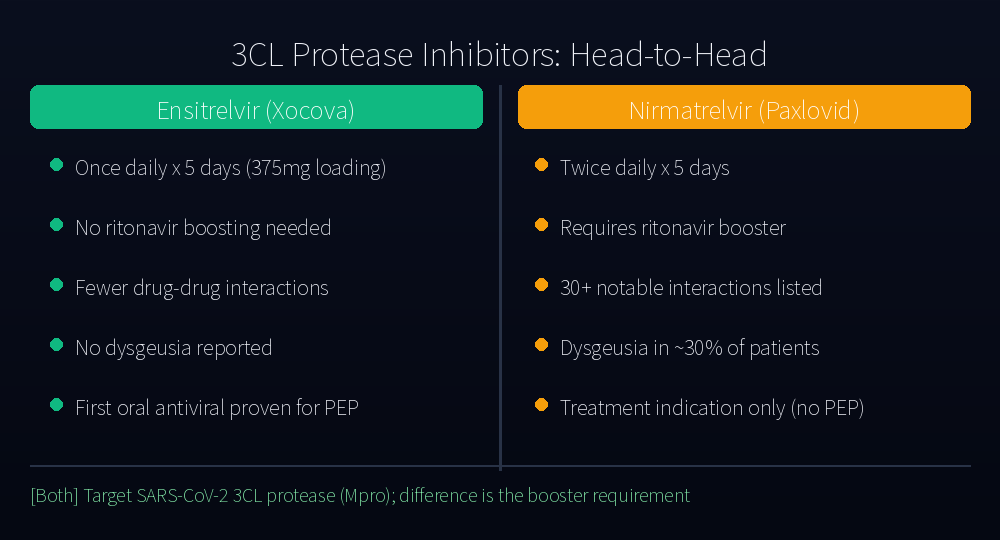
This is the same target class as nirmatrelvir, the active antiviral in Paxlovid. But the two molecules differ in ways that matter for prophylactic use, where you are dosing healthy people across a household — possibly several at once.
- No booster needed. Nirmatrelvir is cleared rapidly by CYP3A4, so Paxlovid combines it with ritonavir, a strong CYP3A4 inhibitor, to keep blood levels therapeutic. Ritonavir’s own CYP3A4 inhibition is what generates Paxlovid’s >30 clinically meaningful drug-drug interactions, including with several statins, anticoagulants, and antiarrhythmics. Ensitrelvir has a long enough native half-life to be dosed once daily without a booster.
- Once-daily dosing. Adherence in a prophylactic context — where the person feels well and may resent the regimen — degrades fast with twice-daily pills. SCORPIO-PEP’s 5-day, once-daily schedule (after a single loading dose) is operationally easier to deploy across an exposed household.
- No dysgeusia. Taste disturbance is one of the top reasons patients stop Paxlovid early. The placebo-comparable AE profile in SCORPIO-PEP suggests the population most likely to take a PEP regimen — generally healthier adults — will tolerate it.
Methodology Notes and What the Trial Did Not Settle
A few caveats deserve a clear-eyed reading.
- Variant horizon. Enrollment ran during JN.1/KP.2-dominant periods. The 3CL active site is conserved, but resistance-associated substitutions have been observed in vitro under nirmatrelvir pressure. Surveillance will need to monitor whether widespread PEP use selects for ensitrelvir resistance over time.
- Hard outcomes not powered. The primary endpoint was symptomatic infection, not hospitalization or death. The trial population was largely younger and healthier than the audience most likely to benefit clinically (older adults, immunocompromised), and severe outcomes were too rare to estimate a relative reduction precisely. The 76% effect in the high-risk subgroup is encouraging but should be read as hypothesis-generating, not definitive.
- Population narrow. Pregnant people and children under 12 were excluded. Both are precisely the populations where household exposure decisions get most fraught.
- Sponsor. Shionogi designed and funded the trial. The protocol, statistical analysis plan, and full data are available with the NEJM publication, and the result has passed external peer review — but independent replication remains valuable.
- Sustained protection unknown. The trial measured infection through day 10. Whether benefit persists beyond the 5-day course (i.e., what happens if a contact is re-exposed two weeks later in a slow-burning household outbreak) is unstudied.
What This Means For You
For most readers in the United States, ensitrelvir is not yet a prescription option. That changes on or after June 16, 2026 if the FDA approves the PEP indication. In Japan, Xocova was approved for treatment in 2024 and received a supplemental indication for post-exposure prophylaxis in March 2026, making Japan the first market with regulatory-approved oral antiviral PEP for COVID-19.
Until ensitrelvir is broadly available, the practical takeaways are these:
- Know your household’s risk profile. If you live with someone over 65, immunocompromised, or with a chronic condition that puts them at risk of severe COVID-19, the calculus for any PEP option (including future ensitrelvir access) will favor early action. A pre-arranged plan with the household’s primary care clinician matters more than the specific drug.
- The 72-hour window is the operational point. SCORPIO-PEP showed efficacy when dosing started within 72 hours of the index case’s first symptom. Whatever PEP becomes routinely available, it will likely share this fast-acting requirement. Keep rapid antigen tests at home, and treat the first symptomatic family member as a clinical event, not a wait-and-see.
- Physical mitigation still works. PEP is additive to, not a replacement for, ventilation, masking around the symptomatic person, and (where feasible) bedroom and bathroom separation. The household secondary attack rate during Omicron sits above 40% precisely because most homes cannot enforce true isolation.
- Do not stockpile or self-medicate. Ensitrelvir is not approved in most countries outside Japan and Singapore. Resistance management is one reason its use will be tightly controlled when it does launch.
The Bottom Line
The deepest result in SCORPIO-PEP is not the 67% number itself — encouraging as that is. It is the demonstration that an oral antiviral, given to healthy people after household exposure, can meaningfully suppress symptomatic infection from a respiratory virus. That is a template that may eventually apply to influenza and RSV, where PEP development has historically lagged behind treatment.
For now, the trial reframes a familiar scenario. The pill you take because someone else got sick is no longer a hypothetical. It is sitting in a regulatory file at the FDA, with an action date a few weeks from this article’s publication, and it has changed what the right answer to “what can I do?” might be.
This content is for informational purposes only and is not a substitute for professional medical advice, diagnosis, or treatment. Always seek the advice of your physician or other qualified health provider with any questions you may have regarding a medical condition or treatment. Ensitrelvir is not approved for post-exposure prophylaxis in the United States as of May 2026 and remains under FDA review.
References
- SCORPIO-PEP Trial. Ensitrelvir for Covid-19 Postexposure Prophylaxis in Household Contacts. New England Journal of Medicine. 2026;NEJMoa2509306.
- Madewell ZJ, Yang Y, Longini IM, et al. Household Secondary Attack Rates of SARS-CoV-2 by Variant and Vaccination Status: An Updated Systematic Review and Meta-analysis. JAMA Network Open. 2022;5(4):e229317.
- Shionogi & Co. Press Release. SCORPIO-PEP Phase 3 Trial Late-Breaker, CROI 2025. March 2025.
- Shionogi & Co. Press Release. Approval of XOCOVA® for Post-Exposure Prophylaxis of COVID-19 in Japan. March 2026.
- U.S. FDA. NDA Acceptance, Ensitrelvir for COVID-19 Postexposure Prophylaxis. PDUFA action date: June 16, 2026.