
TL;DR
- The Study: KEYNOTE-689 (NEJM, May 18, 2026) randomized 714 patients with resectable, locally advanced head and neck squamous cell carcinoma to standard care alone or to standard care plus 2 cycles of neoadjuvant pembrolizumab and 15 cycles of adjuvant pembrolizumab. Median event-free survival rose from 30.4 to 51.8 months (HR 0.73, P=0.0041).
- The Mechanism: Giving an anti–PD-1 antibody before the tumor is removed lets cytotoxic T cells “see” the full antigen repertoire and form memory — a paradigm tested first in melanoma and lung cancer, now confirmed in head and neck disease.
- The Caveat: 38% of patients in the pembrolizumab arm experienced a serious adverse reaction during the adjuvant phase (immunotherapy on top of radiation ± cisplatin). PD-L1 status matters: patients with CPS ≥ 10 saw EFS more than double, while the benefit is smaller in low-expressors.
A Long Plateau, Suddenly Broken
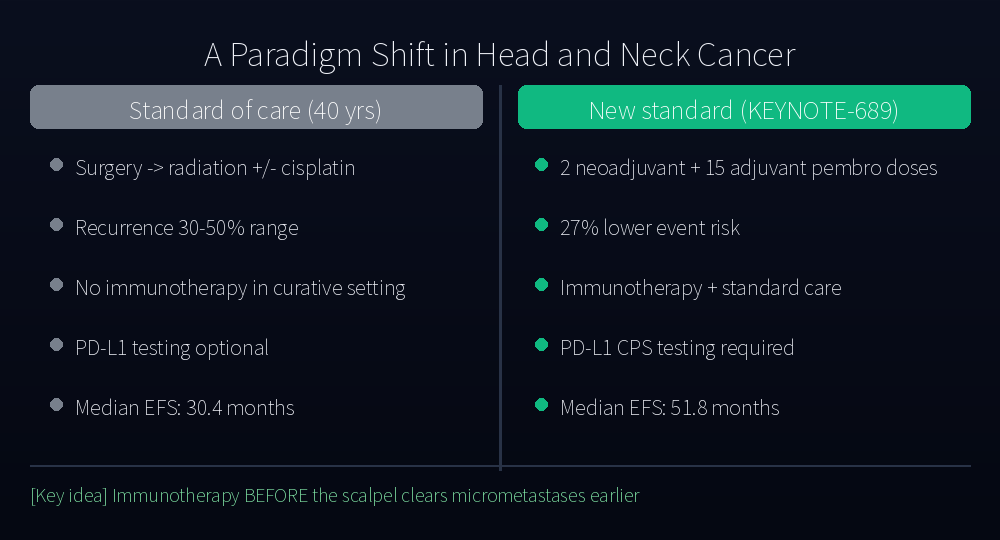
For roughly four decades, the standard of care for resectable, locally advanced head and neck squamous cell carcinoma (LA-HNSCC) has barely moved: surgery, then adjuvant radiation, with cisplatin chemoradiotherapy for high-risk pathology. The combination saves lives, but a 30–50% recurrence rate has been stubbornly persistent. Patients live with the dread of a follow-up scan more than they live with the cancer itself.
On May 18, 2026, the New England Journal of Medicine published the full results of KEYNOTE-689, the phase 3 trial that the FDA had already used to approve perioperative pembrolizumab in this setting in June 2025. The trial enrolled 714 adults with stage III or IVA resectable LA-HNSCC of the oropharynx, larynx, hypopharynx, or oral cavity, randomized 1:1 to standard of care alone or standard of care plus pembrolizumab — given as 2 cycles before surgery and 15 cycles afterward.
The primary endpoint, event-free survival (EFS), reached 51.8 months in the pembrolizumab arm versus 30.4 months with standard care alone — a hazard ratio of 0.73 (95% CI 0.58–0.92; P=0.0041). In the prespecified subgroup of patients with PD-L1 combined positive score (CPS) ≥10, EFS more than doubled, from 26.9 to 59.7 months (HR 0.66; 95% CI 0.49–0.88; P=0.0022).
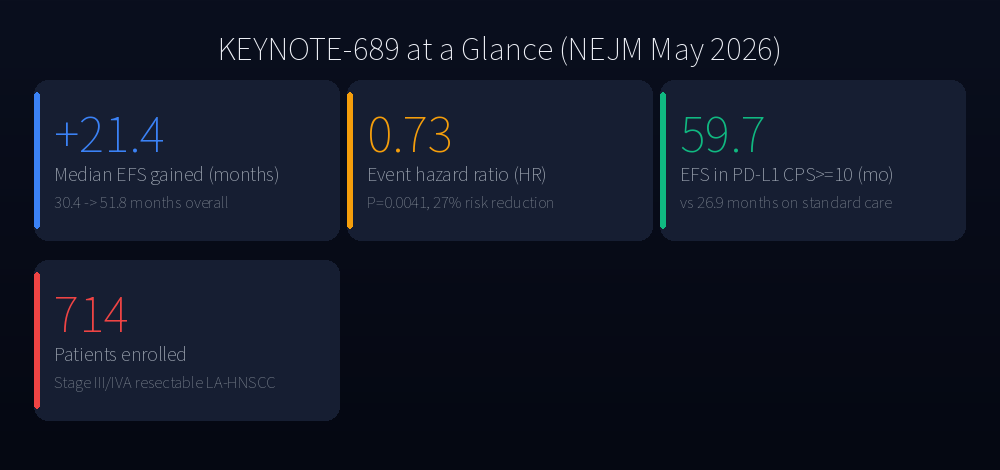
These are the kinds of numbers that move guidelines.
Deep Dive: Why “Before Surgery” Is Counterintuitive — and Why It Works
The intuitive treatment order is: cut the tumor out first, then bring in extra weapons to clean up. Neoadjuvant immunotherapy reverses that intuition. Three lines of evidence explain why the reversal works.
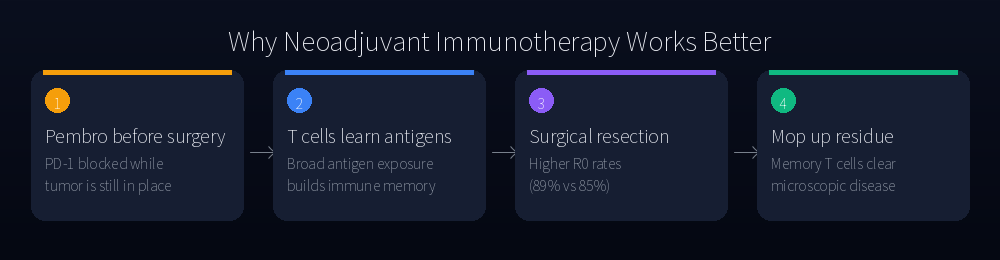
1. Antigen availability is the bottleneck. Immune checkpoint inhibitors release the brake on cytotoxic T cells — but only if those T cells have first encountered the relevant tumor antigens. While the tumor is still in place, dendritic cells in tumor-draining lymph nodes are continuously sampling and presenting the full neoantigen repertoire to naïve T cells. Once the tumor is excised, that antigen source is gone, and any priming of new T cell clones has to depend on residual microscopic disease — which by definition is hard to find. A 2018 Nature Medicine mouse study by Liu et al. showed that the same dose of anti–PD-1 produced substantially more tumor-specific T cell expansion when given before surgical resection than after.
2. Memory T cells are the long-term insurance policy. The neoadjuvant doses do not just shrink the primary tumor; they expand and diversify tumor-reactive CD8⁺ T cell clones, some of which become circulating memory cells. When the adjuvant phase begins, these clones are already in place to patrol for any cancer cells that escaped the scalpel.
3. Surgical outcomes get better, not worse. A reasonable worry about giving immunotherapy before an operation is that immune-mediated inflammation could complicate surgery. KEYNOTE-689 showed the opposite. The R0 (negative-margin) resection rate was 89.1% in the pembrolizumab arm versus 84.7% in the control arm, and the proportion of patients who required cisplatin in the adjuvant phase because of high-risk pathology dropped from 50.5% to 38.9%. Tumors that shrink under immunotherapy give the surgeon more room to work cleanly.
The competing hypothesis — that adjuvant-only immunotherapy would do just as well — has been tested across tumor types over the last five years and keeps coming up short. In resectable melanoma (KEYNOTE-716) and resectable non–small cell lung cancer (KEYNOTE-671), neoadjuvant + adjuvant strategies have outperformed adjuvant-only approaches. KEYNOTE-689 adds head and neck cancer to that list.
Deep Dive: Methodology, in Brief
KEYNOTE-689 was a global, open-label, multicenter phase 3 randomized trial. A few methodological points are worth flagging because they shape how you should read the result.
- Randomization and stratification. Patients were stratified by tumor site (oral cavity vs. other), PD-L1 CPS (≥1 vs. <1), and clinical stage (III vs. IVA). This matters because PD-L1 status was prespecified, not data-mined, so the CPS ≥10 subgroup result is more credible than a post-hoc finding.
- Primary endpoint. EFS — composed of disease progression precluding definitive surgery, local/regional/distant recurrence, second primary tumor, or death from any cause — is a more sensitive endpoint than overall survival but is also closer to what patients experience day to day. The trade-off: OS data will take longer to mature.
- Sample size and power. With 714 patients enrolled and an HR of 0.73 in the intent-to-treat population, the result is unambiguous statistically (P=0.0041) and the 95% CI excludes meaningful overlap with the null.
- Crossover and post-progression care. Patients on the control arm were not offered pembrolizumab as a primary endpoint event; that is consistent with the standard of care available at the time of the trial. As perioperative pembrolizumab becomes the new standard, future trials of competing strategies will need a different comparator.
- What’s not yet known. Quality-of-life data and long-term overall survival have not been reported in the May 2026 paper. The toxicity signal during the adjuvant phase — particularly when pembrolizumab is layered onto chemoradiotherapy — deserves longer follow-up.
The Cost of the 21 Months: Adverse Events
The trade-off is not invisible. In the neoadjuvant phase, 361 patients received at least one dose of pembrolizumab as a single agent before surgery. Of these, 11% experienced a serious adverse reaction. The most common were pneumonia (1.4%), tumor hemorrhage (0.8%), dysphagia (0.6%), immune-mediated hepatitis (0.6%), cellulitis (0.6%), and dyspnea (0.6%).
In the adjuvant phase, 255 patients received at least one pembrolizumab dose alongside radiation with or without cisplatin. Serious adverse reactions occurred in 38%. The top contributors were pneumonia (2.7%), pyrexia (2.4%), stomatitis (2.4%), acute kidney injury (2.0%), pneumonitis (1.6%), and COVID-19 (1.2%).
Two points are worth emphasizing. First, the 38% figure reflects the combination of immunotherapy + radiation + cisplatin, not pembrolizumab alone. Radiation-induced stomatitis and cisplatin-induced nephrotoxicity have always been part of the standard regimen; pembrolizumab adds an immune-related layer on top.
Second, immune-related adverse events (irAEs) showed the predictable pattern. Hypothyroidism occurred in 26% of patients, mostly manageable with daily levothyroxine. Less common but more dangerous were immune-mediated pneumonitis (1.6%) and hepatitis (0.6%) — events that require prompt recognition and high-dose steroids. NCCN and ASCO guidelines recommend pausing immunotherapy at the first sign of grade 2 toxicity and escalating to inpatient management for grade 3 or 4 events.
What This Means For You
If you or someone close to you has been diagnosed with locally advanced head and neck cancer, the practical implications are concrete. Discuss these with your multidisciplinary team — medical oncology, surgical oncology, and radiation oncology — rather than relying on this article.
- Ask for the PD-L1 CPS score. The biggest benefit shows up in PD-L1 CPS ≥10. If your tumor’s CPS is below 1, the marginal benefit of adding pembrolizumab is smaller and the toxicity calculus changes. The FDA label is for CPS ≥1 tumors; the CPS ≥10 subgroup is where the effect is most pronounced.
- Confirm fitness for perioperative immunotherapy. ECOG 0–1, no active autoimmune disease requiring systemic immunosuppression, no recent organ transplant, no active uncontrolled infection. Your oncology team will evaluate these criteria.
- Plan for irAE monitoring. Before each cycle, expect bloodwork for thyroid function, liver enzymes, kidney function, and complete blood count. Know the warning signs you should call about immediately: new shortness of breath (pneumonitis), severe diarrhea more than 4 stools/day above baseline (colitis), yellowing of eyes or skin (hepatitis), persistent fever above 38°C, and severe rash.
- Coordinate around HPV status if your tumor is in the oropharynx. HPV-positive oropharyngeal cancers behave differently from HPV-negative disease, and de-intensification strategies are an active area of research. The KEYNOTE-689 trial enrolled both HPV-positive and HPV-negative patients but did not restrict eligibility by HPV status.
- For prevention, the basics still hold. The HPV vaccine (Gardasil 9) protects against the HPV strains responsible for the majority of oropharyngeal cancers in countries where data are available. Tobacco cessation and alcohol moderation remain the most modifiable risk factors for HPV-negative head and neck cancer.
What Comes Next
The clinically relevant question is no longer whether to add perioperative pembrolizumab in this setting — that question has been answered. The next questions are who needs the full 17 cycles versus a shorter course, whether the cisplatin component can be safely de-intensified in pembrolizumab-treated patients with major pathological response, and whether overall survival data, when mature, will confirm the EFS benefit.
Globally, the implication is that PD-L1 testing must become routine at the time of head and neck cancer diagnosis — not optional, not an add-on. In countries where reimbursement decisions lag clinical evidence, the next two years will determine whether the 21-month gain is available to everyone who could benefit or only to those who can afford it.
For an individual patient, the 21 months is not a statistic. It is, roughly, two more birthdays.
This content is for informational purposes only and is not a substitute for professional medical advice, diagnosis, or treatment. Always seek the advice of your physician or other qualified health provider with any questions you may have regarding a medical condition.
Key references
- Uppaluri R, Haddad RI, et al. Neoadjuvant and Adjuvant Pembrolizumab in Locally Advanced Head and Neck Cancer. New England Journal of Medicine. May 18, 2026. DOI: 10.1056/NEJMoa2415434.
- U.S. Food and Drug Administration. FDA approves neoadjuvant and adjuvant pembrolizumab for resectable locally advanced head and neck squamous cell carcinoma. June 12, 2025.
- Liu J, Blake SJ, Yong MCR, et al. Improved efficacy of neoadjuvant compared to adjuvant immunotherapy to eradicate metastatic disease. Cancer Discovery / Nature Medicine, 2016–2018.
- KEYNOTE-716 (resectable melanoma) and KEYNOTE-671 (resectable NSCLC), supporting evidence for the neoadjuvant paradigm.