TL;DR
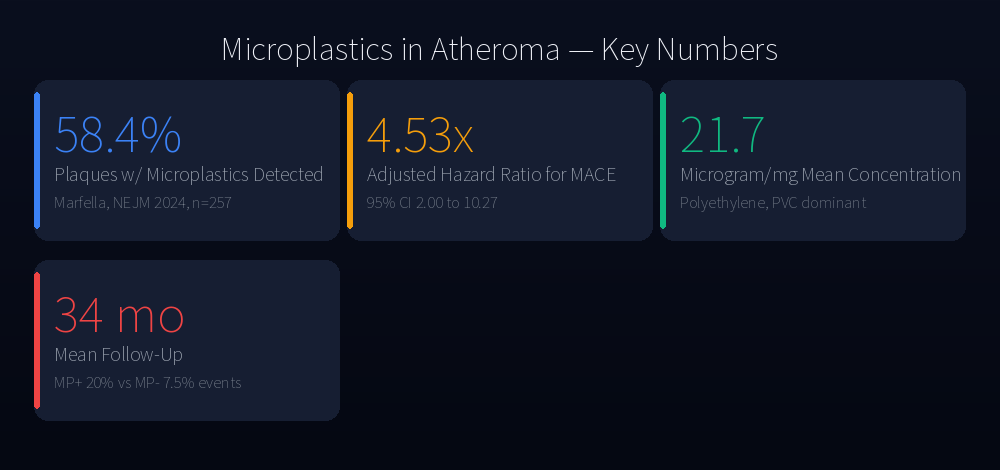
- The Study: In 257 patients undergoing carotid endarterectomy, 58.4% of plaques contained detectable microplastics — mostly polyethylene and PVC (Marfella et al., NEJM, 2024).
- The Risk: Over a 34-month follow-up, patients with microplastics in their plaque had 4.53x the adjusted risk of heart attack, stroke, or death.
- The Mechanism: 2025-2026 follow-up work points to NLRP3 inflammasome activation in arterial macrophages, destabilizing the plaque’s fibrous cap.
- The Action: Five evidence-backed steps to lower daily microplastic exposure — without panic.
Microplastics Are Now Showing Up Inside Human Arteries
For years, microplastics were framed mostly as an ocean problem or a lung-exposure issue. That framing changed in March 2024, when the New England Journal of Medicine published a study by Marfella and colleagues at the University of Campania.
The team analyzed plaque tissue from 257 patients undergoing carotid endarterectomy for symptomatic carotid artery disease. Using pyrolysis gas chromatography-mass spectrometry and stable isotope analysis, they searched for plastic polymers in atheroma samples. They found measurable microplastics in 58.4% of plaques — at a mean concentration of 21.7 micrograms per milligram of tissue. The dominant polymers were polyethylene (PE, used in bags and bottles) and polyvinyl chloride (PVC, used in pipes and packaging).
What turned this from a curiosity into a public health signal was the follow-up. Over an average of 34 months, the composite endpoint of nonfatal heart attack, nonfatal stroke, and all-cause death occurred in 20% of patients with microplastics in their plaque, compared with 7.5% of those without. After adjusting for age, sex, diabetes, hypertension, smoking, LDL cholesterol, and statin use, the hazard ratio was 4.53 (95% CI, 2.00 to 10.27).
That magnitude — comparable to or larger than traditional risk factors — is what has cardiologists paying attention.
How Did Plastic Get Into Your Coronary Arteries?
Microplastics are plastic fragments smaller than 5mm. Particles below 1 micrometer — nanoplastics — are the more interesting fraction biologically, because they are small enough to cross the gut epithelium and the alveolar barrier into the bloodstream.
Major documented exposure routes include:
- Drinking water: A 2024 Environmental Science & Technology study using a novel single-particle imaging method estimated that a one-liter bottle of bottled water contains, on average, about 240,000 nanoplastic particles — orders of magnitude more than older studies suggested.
- Seafood: Both wild-caught and farmed. Filter feeders such as oysters and mussels concentrate particles in their digestive tracts.
- Food containers: A 2023 Environmental Science & Technology paper showed that microwaving a single polypropylene container for three minutes can release up to 4.22 million microplastic particles and 2.11 billion nanoplastic particles.
- Indoor dust: Synthetic textiles, carpets, and furniture shed fibers continuously. Inhaled fibers can deposit in the deep lung.
- Paper cups and tea bags: Polyethylene-coated paper cups release roughly 25,000 microplastic particles per cup into 95°C water (Journal of Hazardous Materials, 2022).
Neither the World Health Organization nor the U.S. Environmental Protection Agency has set quantitative safety thresholds yet — the data are too young. But the trajectory of evidence points consistently in one direction.
What the Study Actually Did — And Where Its Limits Are
The Marfella paper is more rigorous than typical “microplastics in body X” reports, but it is not a randomized trial. Both strengths and limitations matter for interpretation.
Strengths
- Method specificity: Py-GC/MS plus stable isotope analysis was designed specifically to distinguish true polymer signatures from procedural contamination. The team also analyzed negative-control samples in parallel.
- Prospective design: Plaques were collected at a single time point, then patients were followed prospectively. The temporal ordering — “plastics first, events later” — is unambiguous.
- Multivariable adjustment: The hazard ratio held after adjusting for age, sex, smoking, diabetes, hypertension, LDL cholesterol, and statin use.
Limits
- Single center, single country: All patients were Italian and from one academic center. Generalization across diet, genetics, and exposure profiles requires replication.
- Observational, not causal: Association is not causation. It remains possible that more advanced or more inflamed plaques happen to trap more plastic — rather than plastic causing the inflammation that drives events. Mendelian randomization is not possible here.
- Detection threshold: Patients with very low but biologically active concentrations could have been misclassified as “MP-negative,” potentially biasing toward the null.
The Mechanism — NLRP3, IL-18, and Plaque Rupture
The 2024 findings triggered a wave of mechanistic work. By 2025-2026, papers in Circulation Research, Nature Cardiovascular Research, and European Heart Journal converged on a more specific picture than “plastic is inflammatory.”
The older intuition was vague: foreign particles in the artery wall provoke generic inflammation, which destabilizes plaque. The newer mechanistic chain is more specific:
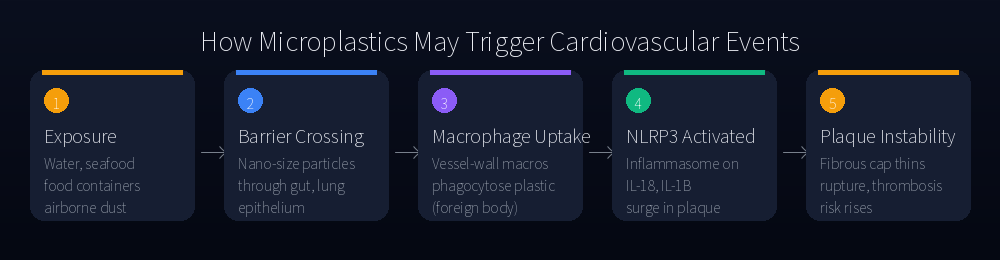
- Exposure and absorption. Nanoplastics ingested or inhaled cross the intestinal epithelium and alveolar membrane into systemic circulation. Smaller particles cross more readily.
- Vascular wall deposition. Circulating particles preferentially accumulate at sites of endothelial dysfunction — the same locations where atherosclerotic plaques are forming.
- Macrophage phagocytosis. Resident vascular macrophages (foam cells in plaques) recognize the particles as foreign and engulf them. But polyethylene and PVC cannot be enzymatically degraded.
- NLRP3 inflammasome activation. Indigestible particles rupture intracellular lysosomes, releasing cathepsin B and generating reactive oxygen species. Both are canonical triggers of the NLRP3 inflammasome — a multiprotein complex that activates caspase-1, which in turn cleaves pro-IL-1β and pro-IL-18 into their mature, secreted forms.
- Fibrous cap thinning. IL-18 in particular upregulates matrix metalloproteinases (MMPs) in vascular smooth muscle cells, accelerating breakdown of the collagen and elastin that hold the fibrous cap together. A thinner cap means a plaque more prone to rupture, which exposes thrombogenic core material to circulating blood — the proximate cause of most heart attacks and many strokes.
This pathway also explains a long-standing puzzle: why some patients suffer cardiovascular events despite well-controlled LDL cholesterol. NLRP3-targeting drugs (canakinumab, the IL-1β antibody) already demonstrated cardiovascular benefit in the CANTOS trial, lending biologic plausibility to this proposed pathway.
What This Means For You
A few principles before specifics. The exposure-risk dose-response curve is not yet defined, so “zero plastic” is neither realistic nor demonstrated to be necessary. The goal is sensible reduction in the highest-exposure routes, not anxiety.
1. Stop microwaving food in plastic containers. Use glass, ceramic, or stainless steel. The 2023 Environmental Science & Technology data showed that a single three-minute microwaving cycle in a polypropylene container released up to 4.22 million microplastic particles. This is plausibly the single highest-yield change a household can make. Mechanism: heat plus mechanical agitation accelerates particle release from polymer surfaces.
2. Filter your drinking water. A reverse-osmosis filter or a sub-0.5 micron activated-carbon filter removes more than 90% of microplastic particles per liter (Water Research, 2024). A 2024 paper in Environmental Science & Technology Letters also showed that simply boiling tap water for five minutes precipitates roughly 80% of polyethylene and polystyrene nanoplastics out of solution — a useful low-cost option. Dose: ~1.5-2 liters per day filtered or boiled.
3. Cut down on paper cups, tea bags, and disposable food packaging. Most paper cups are lined with polyethylene that sheds particles into hot liquids — about 25,000 per cup at 95°C. Many commercial tea bags are made from polypropylene mesh that releases billions of particles per brewing cycle. Loose-leaf tea with a stainless steel infuser is meaningfully cleaner. Timing: switching to a reusable cup at work is one of the higher-impact swaps for office workers.
4. Vacuum with a HEPA filter and ventilate regularly. Indoor air is a major exposure route via synthetic textiles. HEPA-filter vacuums reduce indoor microplastic concentrations by roughly 30% (Indoor Air, 2023). Ventilating at least twice daily for 15 minutes lowers cumulative airborne load. Mechanism: synthetic fibers shed continuously from carpets, furniture, and clothing dryers.
5. Choose smaller fish over predatory species — but do not stop eating fish. The cardiovascular benefits of omega-3-rich seafood are well established and likely outweigh microplastic concerns. However, top predators (tuna, swordfish, sharks) bioaccumulate more contaminants, including microplastics. Smaller pelagic fish such as anchovies, mackerel, and sardines are lower-burden alternatives that still provide EPA and DHA. Shellfish are eaten with the digestive tract and tend to have higher concentrations — consume in moderation.
What We Know — and What We Do Not
Established
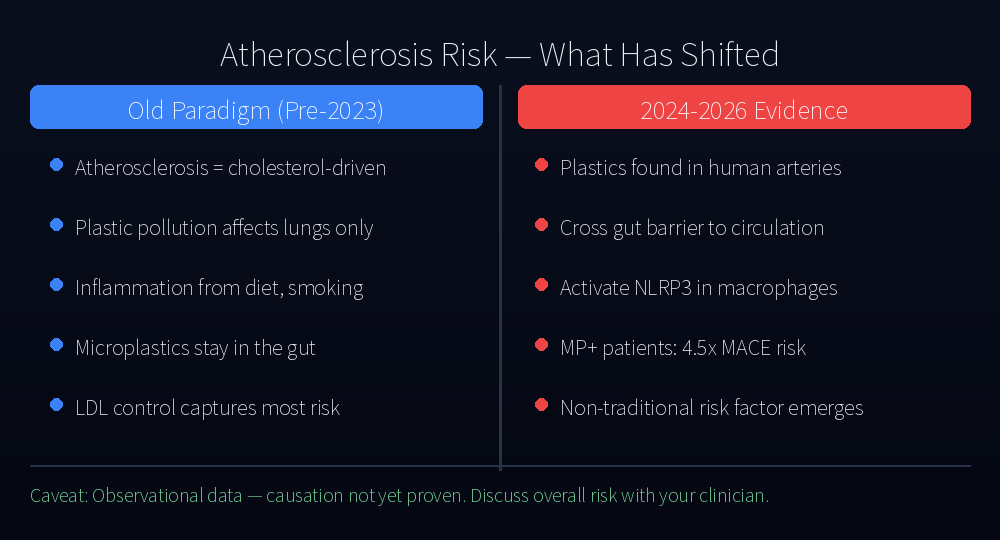
- Microplastics are present inside human atherosclerotic plaques.
- Their presence is associated with substantially higher cardiovascular event risk.
- A plausible molecular mechanism (NLRP3-driven inflammation, plaque destabilization) is emerging.
Not established
- A quantitative dose-response between exposure and risk.
- Whether reducing exposure clinically lowers event rates (no interventional trial yet).
- Whether existing microplastic burden in tissue is reversible.
- Race-, diet-, and genotype-specific differences in susceptibility.
For now, the practical takeaway is modest but real: alongside the standard cardiovascular checklist — LDL, blood pressure, glucose, weight, smoking — there is now a defensible reason to also reduce the highest-exposure plastic pathways. The most useful conversation to have is not with a headline. It is with your physician, who can help you weigh your individual cardiovascular risk and decide where to invest your attention.
This content is for informational purposes only and is not a substitute for professional medical advice, diagnosis, or treatment. Always seek the advice of your physician or other qualified health provider.
References
- Marfella R, et al. Microplastics and Nanoplastics in Atheromas and Cardiovascular Events. N Engl J Med. 2024;390:900-910.
- Qian N, et al. Rapid single-particle chemical imaging of nanoplastics by SRS microscopy. Proc Natl Acad Sci USA. 2024;121(3):e2300582121.
- Hussain KA, et al. Microplastics and Nanoplastics Released from Plastic Containers during Microwave Heating. Environ Sci Technol. 2023;57(26):9782-9792.
- Hernandez LM, et al. Plastic Teabags Release Billions of Microparticles into Tea. Environ Sci Technol. 2019;53(21):12300-12310.
- Yu Y, et al. Boiling Water Can Reduce Nanoplastic Exposure. Environ Sci Technol Lett. 2024.
- Ridker PM, et al. Antiinflammatory Therapy with Canakinumab for Atherosclerotic Disease (CANTOS). N Engl J Med. 2017;377:1119-1131.