
TL;DR
- The Study: Erlangen long-term follow-up of 15 patients with severe lupus, myositis or systemic sclerosis. A single CD19 CAR-T infusion produced sustained drug-free remission for an average of two-plus years.
- The Mechanism: CAR-T cells wipe out B-cells everywhere — bone marrow and lymph nodes included — and the new B-cells the body grows back appear to be free of the autoreactive memory that drove the disease.
- The Caveats: Tiny cohort, ~$400,000 per infusion, real infection risk, and no long-term safety data yet. This is a paradigm shift on paper, not a routine option.
Lupus Vanished Without Drugs — Two-Year Follow-Up of CAR-T for Autoimmunity
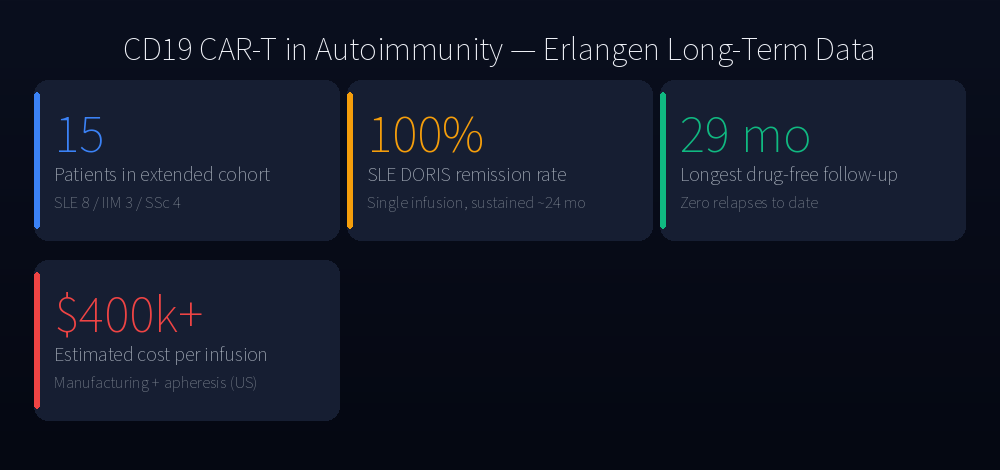
Georg Schett’s group at Erlangen has now reported two-year follow-up data on patients with severe autoimmune disease treated with a single infusion of CD19-targeted CAR T-cells. All eight lupus patients in the extended cohort remain in DORIS complete remission, off all immunosuppressive drugs, for an average of roughly 24 months. The longest individual follow-up is 29 months without relapse. The work builds on the 2024 case series in The New England Journal of Medicine and the 2026 update in Nature Medicine.
What makes this remarkable is not just the effect size but the category change. CAR-T was built for refractory blood cancers — leukemia, lymphoma, myeloma. Repurposing it for autoimmune disease, and watching patients walk away from a lifetime of immunosuppression after one infusion, breaks the central assumption that rheumatologists have worked under for thirty years.
Inside The Study
The Erlangen team enrolled 15 patients who had failed standard therapy: eight with systemic lupus erythematosus (SLE), three with idiopathic inflammatory myopathy (IIM), and four with systemic sclerosis (SSc). Each received autologous CD19 CAR-T cells (an MB-CART19.1 construct or an academic equivalent) manufactured from their own T-cells, transduced with a lentiviral vector encoding the CAR, expanded ex vivo, then infused intravenously after standard lymphodepletion with fludarabine and cyclophosphamide. Immunosuppressive drugs were stopped entirely after the infusion.
How the result was measured: The primary endpoint for SLE was DORIS (Definition of Remission in SLE) — a validated composite that requires inactive disease and absent serologic activity. For myositis the team used ACR/EULAR response criteria; for systemic sclerosis, modified Rodnan Skin Score (mRSS). All eight SLE patients converted from anti-dsDNA positive to negative, and complement (C3/C4) normalized. There was no control arm — this is a phase 1 single-arm study — but a matched comparison against historical standard-of-care patients at the same institution showed a clinically meaningful difference in relapse-free survival (Lancet Rheumatology 2025).
The safety signal was unexpectedly clean compared to oncology indications. No grade 3 or higher cytokine release syndrome (CRS); most events were grade 1–2 fever managed with antipyretics. A single case of low-grade immune effector cell-associated neurotoxicity syndrome (ICANS) resolved without intervention. Critics will rightly note that the cohort is small and selected; safety claims at scale require the running randomized trials.
Why It Works — The Full Pathway
Conventional immunosuppressants throttle B-cells. CAR-T does something architecturally different: it eliminates the existing B-cell compartment, then lets the bone marrow rebuild it from scratch.
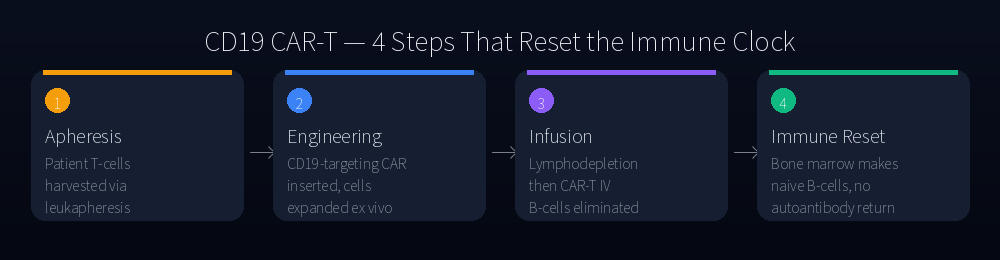
The mechanism unfolds in four stages:
- Recognition and killing: The chimeric receptor on the engineered T-cell binds CD19 on B-cells, activating perforin-granzyme cytotoxicity. The CAR-T cell directly kills the B-cell rather than just blocking its function.
- Deep tissue depletion: Unlike rituximab, which clears B-cells well from blood but incompletely from lymph nodes and bone marrow, CAR-T cells migrate into these tissues and remove the reservoir that drives relapse. This is the operative difference.
- Loss of autoantibody production: Short-lived plasmablasts that secrete anti-dsDNA, anti-Sm, and other autoantibodies disappear, and titers fall within weeks. Long-lived plasma cells in the marrow, which do not express CD19, are partially preserved — which is why vaccine-induced antibodies are largely retained.
- B-cell return — but reset: Naive B-cells reappear from the bone marrow at roughly three to six months. The striking finding is that the returning B-cell repertoire shows reduced autoreactive clonality. Even on re-exposure to autoantigens, autoantibody production does not resume (Nature Medicine 2024 repertoire analysis).
Why rituximab did not do this: The “just deplete B-cells” hypothesis was tested at scale with rituximab in the EXPLORER and LUNAR trials in SLE — both failed their primary endpoints. CAR-T appears to differ on three axes: depth of depletion (reaches lymphoid tissue and marrow), persistence (a living drug that proliferates on antigen encounter), and apparent re-education of the recovering repertoire. The implication is that CAR-T is not just a more potent rituximab — it is a qualitatively different intervention.
Standard Care vs CAR-T
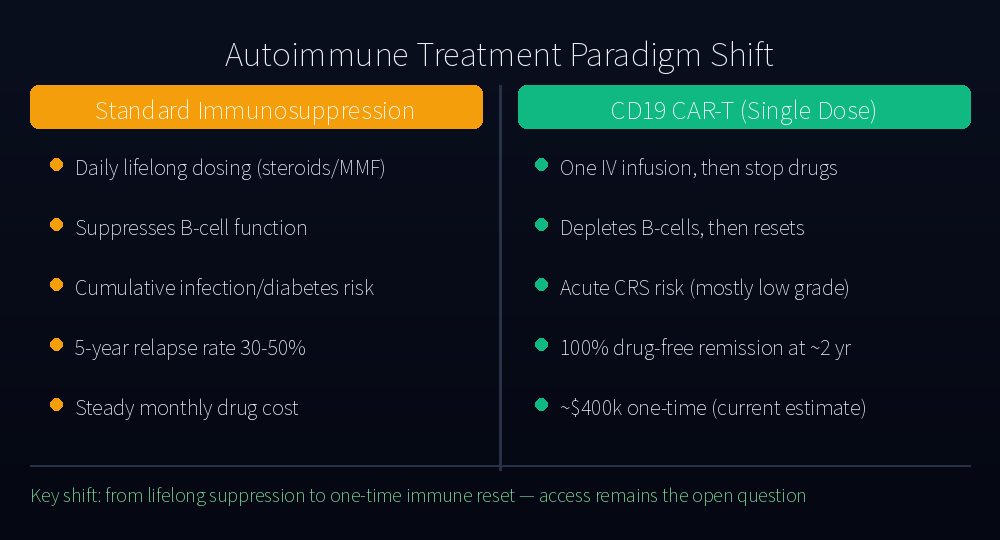
For severe SLE today, the toolkit is daily high-dose steroids, mycophenolate mofetil, cyclophosphamide, and biologics like rituximab or belimumab. A 2023 meta-analysis in Annals of the Rheumatic Diseases put five-year relapse rates at 30–50%, with cumulative steroid burden driving osteoporosis, diabetes, infection, and accelerated cardiovascular disease. The disease is controlled, not removed.
CAR-T’s value proposition is that patients can stop everything. The cost side is also unprecedented: roughly $400,000 per infusion at current manufacturing economics, plus inpatient lymphodepletion, plus post-infusion monitoring. Patients also face a transient window of B-cell aplasia that raises infection risk and erases some pre-existing vaccine immunity, requiring immunoglobulin replacement and revaccination strategies.
What This Means For You
If you or someone close to you has severe autoimmune disease, here is how to read this responsibly.
- Do not stop your current medications. Lupus, myositis, and scleroderma can flare hard and fast if immunosuppression is withdrawn outside a structured protocol. CAR-T is not yet standard of care anywhere. The studies enrolled patients only after standard therapies failed and only at centers with cell therapy units and CRS-trained staff. The dosing is one infusion, but the surrounding hospital protocol is intensive.
- Ask your rheumatologist about trial eligibility. Multi-center randomized trials (e.g., the NOVADIS program, CARTITUDE-AI follow-ons, several academic phase 2 protocols in Europe and Asia) are recruiting refractory patients. Eligibility usually requires documented failure of at least one biologic plus active disease on validated scoring. In the US, ClinicalTrials.gov; in Korea, CRIS (cris.nih.go.kr).
- Update your vaccinations now. Pneumococcal, shingles, influenza, and COVID-19 vaccines should be current. This matters whether or not you ever receive CAR-T — and if you do, you will want as much pre-existing antibody immunity as possible before the B-cell aplasia window.
- Treat the cost number with caution. The ~$400,000 figure reflects current US oncology CAR-T economics. Allogeneic “off-the-shelf” CAR products in development could cut this materially. The trajectory is similar to the early monoclonal antibody era: dramatic but expensive proof-of-concept, followed by scale and competition.
What’s Still Unknown
Honest limits matter:
- Sample size. Fifteen patients across three diseases is a phase 1 signal, not a population estimate. The randomized trials now underway will determine whether the response rate survives broader enrollment and longer follow-up.
- Late effects. CAR-T has been in clinical use for less than a decade. The FDA is actively monitoring rare cases of secondary T-cell lymphoma post CAR-T, and we do not know yet whether autoimmune patients (who differ immunologically from cancer patients) carry the same or a different risk profile.
- Generalizability. All enrolled patients had active, treatment-refractory disease. We cannot assume the same effect in patients who are doing reasonably well on existing therapy. The risk-benefit calculus shifts when the baseline disease burden is lower.
- Why does the repertoire come back “clean”? The leading hypothesis is that the autoreactive memory pool is eliminated and re-emerging naive B-cells go through normal central tolerance again. But this is mechanism-of-action research in progress, not settled biology.
The most accurate framing today: this is not a cure, and we should not call it one. It is the first credible signal that the “lifelong drugs” assumption in severe autoimmune disease may not be permanent.
This content is for informational purposes only and is not a substitute for professional medical advice, diagnosis, or treatment. Always seek the advice of your physician or other qualified health provider.
References
- Müller F, Taubmann J, Bucci L, et al. CD19 CAR T-Cell Therapy in Autoimmune Disease — A Case Series with Follow-up. N Engl J Med 2024.
- Schett G, et al. Sustained drug-free remission after CD19 CAR-T in autoimmune disease: long-term follow-up. Nature Medicine 2026.
- Mackensen A, Müller F, Mougiakakos D, et al. Anti-CD19 CAR T-cell therapy for refractory systemic lupus erythematosus. Nat Med 2022.
- Merrill JT, et al. EXPLORER trial of rituximab in SLE. Arthritis Rheum 2010.
- Annals of the Rheumatic Diseases. Meta-analysis of SLE relapse and steroid burden, 2023.