
TL;DR
- The Study: A 2026 Cochrane systematic review pooled 22 randomized trials and 1,995 adults with overweight or obesity to test whether intermittent fasting beats standard dieting.
- The Finding: It mostly does not. Fasting produced little to no extra weight loss compared with ordinary calorie restriction, and only a modest edge over no diet at all.
- The Nuance: Certainty of evidence is low to very low, and long-term data are thin. The practical lesson is about adherence, not a metabolic shortcut.
Intermittent Fasting Is No Better Than Calorie Counting, a Major Review Finds
For years, eating windows and fasting days have been sold as something more clever than simply eating less. The pitch was seductive: it is not just how much you eat, but when. On February 17, 2026, the Cochrane Database of Systematic Reviews (2026, Issue 2) pushed back on that story with one of the most rigorous syntheses to date.
Led by Garegnani and colleagues, the review combined 22 randomized controlled trials involving 1,995 adults with overweight or obesity. The headline result: intermittent fasting led to “little to no difference” in weight loss compared with regular dietary advice, and offered no clear advantage over no structured intervention either. As the lead author put it, intermittent fasting “just doesn’t seem to work” as a superior strategy for overweight or obese adults trying to lose weight, adding that current evidence does not justify the enthusiasm seen on social media.
To be clear, this is not “fasting fails.” People did lose weight while fasting. They simply did not lose more than people cutting calories the conventional way.
How the Fasting Switch Was Supposed to Work
The reason intermittent fasting felt special was a genuinely plausible biological chain. It is worth following it all the way to the end, because the last link is where the story breaks.
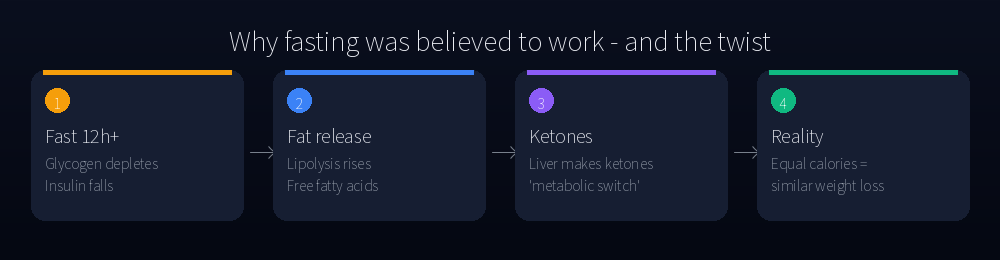
When a fast stretches past roughly 12 hours, liver glycogen runs low. Falling blood glucose pulls insulin down with it, and because insulin normally suppresses fat breakdown, lower insulin lets hormone-sensitive lipase go to work inside fat cells. Stored triglycerides are cleaved into free fatty acids, which travel to the liver and are converted into ketone bodies, chiefly beta-hydroxybutyrate. The body shifts its main fuel from glucose to ketones, the so-called metabolic switch. Layer on chrono-nutrition, the idea that eating during your active daytime hours aligns better with circadian insulin sensitivity, and you arrive at a tidy claim: the same calories should melt away faster if timed right.
The chain is real up to a point. The trouble is the final step. Even if the metabolic switch flips, most people quietly compensate, eating back the spared calories during their eating window. When total daily energy intake ends up similar, that elegant biochemistry does not translate into a different number on the scale. That gap between mechanism and outcome is exactly what the Cochrane team set out to measure.
What a Cochrane Review Actually Does
A Cochrane review earns its authority through method, not opinion. Instead of trusting any single trial, it gathers the randomized evidence on one question, formally rates each study’s risk of bias, pools the results, and grades how much confidence the body of evidence deserves.
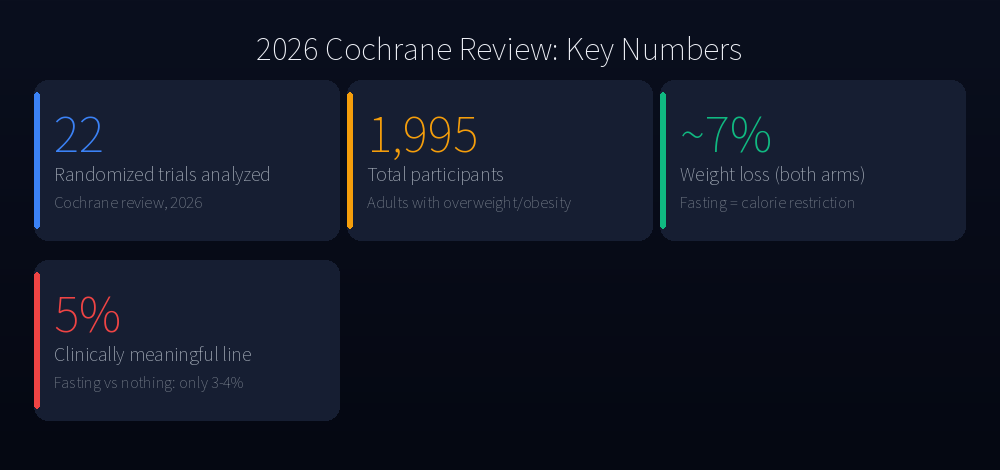
Here, “intermittent fasting” included time-restricted eating, alternate-day fasting, modified alternate-day fasting, and periodic 5:2-style fasting. The reviewers compared these approaches against (1) regular dietary advice and (2) no intervention or a waiting list. Against standard advice, fasting showed no clinically meaningful weight difference. Against doing nothing, the difference in percentage weight change was also negligible.
The numbers tell the same story. Both intermittent fasting and continuous calorie restriction produced roughly 7% body-weight loss at 6 to 12 months, statistically indistinguishable from one another. Compared with no intervention, fasting’s added effect landed around 3 to 4%, often short of the 5% threshold typically linked to meaningful health improvement.
The decisive caveat is certainty. Using the GRADE framework, the authors rated most key outcomes as low or very low certainty. Many included trials were small, carried risk of bias, and disagreed with one another, driving up inconsistency and imprecision. Crucially, few trials ran beyond 12 months, and adverse events were reported so unevenly that safety conclusions remain shaky. So the message is doubly humbling: there is no good evidence that fasting is superior, and the evidence we do have is not strong enough to settle the matter for good.
Belief vs Evidence
Set the familiar marketing beside the pooled data and the contrast is hard to miss.
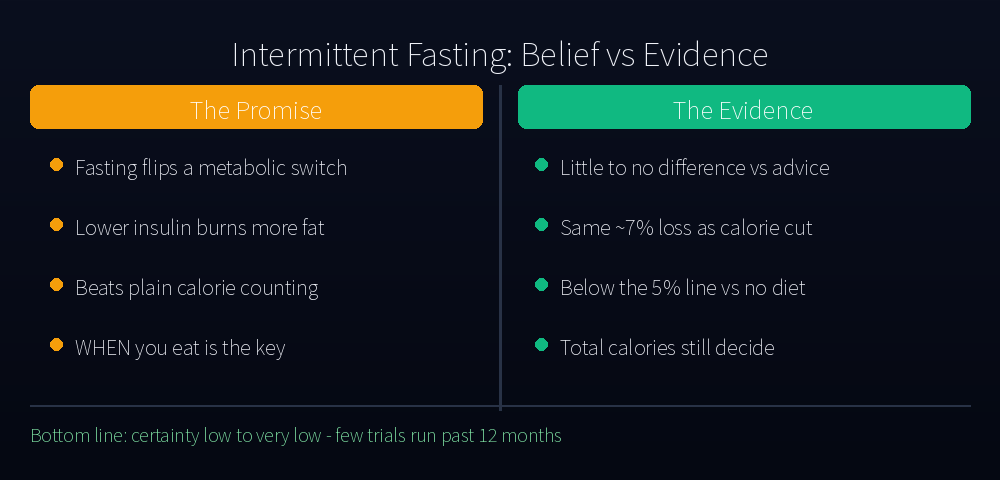
The belief was that fasting flips a metabolic switch, lowers insulin, and therefore beats plain calorie counting because timing is king. The trial evidence says the weight-loss effect of fasting is indistinguishable from ordinary calorie restriction. How much you eat still outranks when.
So why do so many people swear by it? The most credible explanation is adherence. A simple rule, such as “nothing after 8 p.m.” or “only lunch and dinner,” is easier for some people to follow than counting every calorie. The result is a smaller total intake, and the weight comes off, but the lever is the calorie deficit, not fasting magic. That reframes the real question. If two approaches work equally well, the one you can actually sustain wins.
What This Means For You
The practical takeaways are unglamorous, which is precisely why they are reliable.
-
Mind total calories first. Whether or not you fast, weight loss still comes down to energy in versus energy out. Logging your intake for even a few days reveals when you actually overeat. (Basis: Cochrane 2026, equal weight loss for fasting and calorie restriction at matched intake.)
-
If 16:8 suits you, keep it, but do not binge in your window. The benefit evaporates if you eat back the spared calories once the window opens. Keep portions normal rather than treating the eating window as a free pass.
-
Prioritize protein. Roughly 1.2 to 1.6 grams of protein per kilogram of body weight per day may help preserve muscle and curb hunger while dieting. With fewer meals, each meal’s protein density matters more.
-
Choose what you can sustain for a year. The shortage of data beyond 12 months means sustainability, not short-term speed, is the real battleground. The best plan is the one you find least painful to keep.
-
Talk to a clinician if you are higher risk. If you have diabetes and use glucose-lowering medication, are pregnant or breastfeeding, or have a history of disordered eating, prolonged fasting can carry real risks and should be discussed with a professional first.
Diet culture never runs out of new “hacks.” But the largest pool of evidence keeps pointing away from magic and toward something plainer: a modest, livable calorie deficit you can hold onto. That may be the most honest reassurance this research offers.
This content is for informational purposes only and is not a substitute for professional medical advice, diagnosis, or treatment. Always seek the advice of your physician or other qualified health provider.