TL;DR
- 📌 In a ~1.5-million-person Medicare study, adults who completed the two-dose recombinant shingles vaccine (Shingrix) had 33% lower risk of any dementia than the unvaccinated.
- 📌 A near-experimental study in Wales — where a single birthday cutoff decided eligibility — found roughly 20% lower dementia, pushing the evidence toward causation.
- 📌 This is not a “dementia vaccine.” Its proven job is preventing shingles; the dementia link is an associated benefit still being tested.
A Shingles Shot That Might Also Guard the Brain
Anyone who has had shingles remembers the pain. So it is striking that the shot people get to avoid that rash keeps turning up in a very different place: the data on brain aging.
The latest example was published in April 2026 in the journal Alzheimer’s & Dementia. A team led by Susan dos Reis at the University of Maryland School of Pharmacy analyzed the records of about 1.5 million Medicare beneficiaries aged 65 and older. They compared 502,845 people who completed the two-dose recombinant zoster vaccine (sold as Shingrix) with 1,005,690 who were unvaccinated.
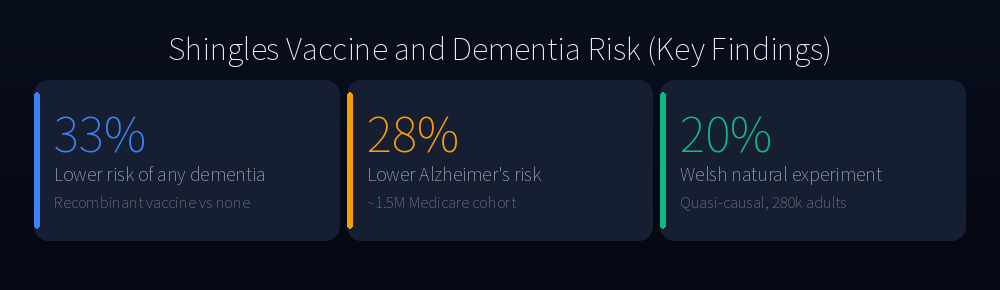
The gap was substantial. Compared with unvaccinated peers, the vaccinated group showed 33% lower risk of any dementia, 28% lower risk of Alzheimer’s disease, and 33% lower risk of vascular dementia. A shot meant to stop a skin rash appeared to move the needle on dementia statistics.
No single study settles this. What makes the finding hard to dismiss is that the same signal keeps appearing across studies built on completely different designs.
The Numbers: 33%, and Then 20%
The obvious objection comes first: maybe people who get vaccinated are simply healthier to begin with. It is a fair point. Health-conscious people tend to get vaccines, exercise, and show up for checkups. This is the “healthy vaccinee bias,” and observational studies that compare vaccinated to unvaccinated groups — like the Medicare analysis — cannot fully escape it. The authors adjusted for comorbidities and other factors, but they were clear about this limitation, along with a follow-up window of three years or less.
A study published in April 2025 in Nature (vol. 641, pp. 438–446) was designed to strip out that bias almost entirely. Markus Eyting and Pascal Geldsetzer of Stanford exploited an unusual rule in Wales as a natural experiment.
When Wales rolled out its shingles vaccination program, eligibility hinged on a single date: September 2, 1933. People born just before it were ineligible for life; people born on or after it could get the vaccine. In other words, a difference of one birthday decided who could be vaccinated. The two groups were nearly identical in age and lifestyle — only their eligibility differed. That is about as close to a randomized trial as you can get without running one, a method called regression discontinuity.
Among roughly 280,000 adults aged 71 to 88, those eligible for the vaccine were about 20% less likely to be diagnosed with dementia over the following seven years. The effect was stronger in women. This design moves the question past mere correlation and toward cause.
A 2024 Nature Medicine analysis from an Oxford team (more than 200,000 people) adds another piece. It found that people who received the recombinant vaccine (Shingrix) stayed dementia-free longer than those who got the older live vaccine — translating to about 164 additional diagnosis-free days among those who eventually developed dementia. The fact that the vaccine type changed the strength of the signal is the key clue for the mechanism debate below.
Deep Dive: Two Competing Explanations
How could a vaccine reach the brain at all? Two hypotheses are competing right now — and intriguingly, both have support.
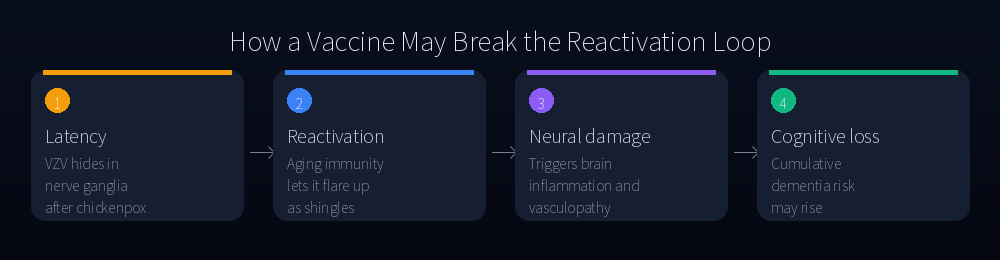
Hypothesis 1 — Blocking viral reactivation. The varicella-zoster virus (VZV) that causes shingles never leaves after childhood chickenpox. It hides, dormant, in nerve ganglia for decades. As the immune system weakens with age (immunosenescence), the virus can reawaken and cause shingles.
The problem is that reactivation may not stop at the skin. When VZV flares, it can inflame blood vessel walls, producing cerebral vasculopathy, and it can stoke chronic neuroinflammation. A separate 2025 Nature Medicine paper reported an association between VZV reactivation and higher dementia risk. The full chain reads: chickenpox → latent VZV → reactivation as immunity ages → vascular and neural inflammation → cumulative cognitive damage. If the vaccine prevents reactivation, it breaks a link in that chain. The fact that even the older live vaccine showed a dementia signal supports this view.
Hypothesis 2 — The AS01 adjuvant’s own effect. Here the story gets more interesting. Shingrix contains an immune-boosting ingredient called the AS01 adjuvant. An adjuvant amplifies the immune response to a vaccine. Some researchers argue that AS01 may protect the brain through “trained immunity” — broadly tuning the innate immune system — independent of whether it blocks the virus.
The strongest hint came from a 2025 study of about 437,000 people. The RSV (respiratory syncytial virus) vaccine, which uses the same AS01 adjuvant, was also linked to lower dementia risk — even though it contains no VZV at all. If a vaccine with no shingles virus still shows the effect, then “blocking the virus” cannot be the whole story.
So the most balanced reading today is “perhaps both.” The old assumption treated dementia as a largely unstoppable buildup of amyloid and tau. These studies suggest a new window — infection and immune modulation — through which dementia prevention might be approached. The live vaccine points to Hypothesis 1; the stronger signal from the adjuvanted recombinant vaccine hints at a contribution from Hypothesis 2.
What This Means For You
The evidence is genuinely interesting, but it is easy to over-read. Here is a grounded way to act on it.
- If you are 50 or older, talk to your clinician about the shingles vaccine — for shingles. The primary reason to vaccinate is preventing shingles and its complications, especially the lingering nerve pain (postherpetic neuralgia). Treat any dementia benefit as a bonus, not the goal. The right vaccine type depends on your immune status and chronic conditions, so this is a clinician’s call.
- Be skeptical of “vaccine that prevents dementia” claims. Every current finding is an association; causation is not established. Randomized trials now underway are needed before stronger statements are justified. Do not let marketing get ahead of the science.
- Do not rely on one shot — manage the bigger risk picture. The 2024 Lancet Commission on dementia reported that addressing modifiable risk factors — high blood pressure, hearing loss, smoking, physical inactivity, diabetes, and high LDL cholesterol, among others — could prevent or delay a meaningful share of dementia cases. A vaccine is one piece of a much larger puzzle.
- Finish the schedule. The recombinant vaccine requires a second dose 2 to 6 months after the first. A single dose leaves protection incomplete.
- Check cost and coverage first. Two doses are not cheap, and coverage varies widely by country and insurer. Confirm what your plan or local program covers before booking.
The Bottom Line
Large studies built on very different designs keep pointing the same way: the shingles vaccine is associated with lower dementia risk. The 33% from 1.5 million Medicare records, the 20% from the Welsh natural experiment, and two plausible biological mechanisms are too consistent to wave away as coincidence.
But “associated with” is not “causes.” For now, the smartest stance is to consider the vaccine for the clear, proven reason — preventing shingles — while treating the dementia angle as a promising possibility that ongoing trials will confirm or qualify. Whether to vaccinate, and which vaccine to choose, is a decision to make with a healthcare provider who knows your history.
This content is for informational purposes only and is not a substitute for professional medical advice, diagnosis, or treatment. Always seek the advice of your physician or other qualified health provider.